Friday, April 17, 2015

Boston Marathon bomber Dzhokhar Tsarnaev found guilty

Article originally published on Tuesday April 14 2015 in The California Tech

Boston Marathon bomber Dzhokhar Tsarnaev found guilty

Casey Handmer


On April 6, surviving Boston Marathon bomber Dzhokhar Tsarnaev was found guilty of all 30 counts, 17 of which may carry the death penalty. Nearly two years since the April 15, 2013, bombing and subsequent manhunt, which injured 280 and killed four, debate rages over motive, law enforcement procedure, intelligence failures and the prospect of state execution.


Dzhokhar Tsarnaev, and his elder brother Tamerlan Tsarnaev, both ethnically Chechen Muslims, autonomously built pressure cooker bombs and planned the attack using al-Qaeda in the Arabian Peninsula's online English language glossy magazine Inspire. The two bombs were detonated remotely near the marathon finish line 13 seconds apart. The brothers evaded capture until a shooting on April 18, 2013, followed by a final manhunt on April 19, 2013, four days after the bombing.


Dzhokhar Tsarnaev survived to be captured, and was immediately questioned for 16 hours. Subsequently read his Miranda rights, the admissibility of prior testimony is a matter of controversy. Despite a call for him to be tried as an enemy combatant, prominent legal scholars including Alan Dershowitz successfully argued that doing so would jeopardize the case against Dzhokhar Tsarnaev, as it has for many remaining Guantanamo Bay inmates, and the federal court system was judged sufficient to handle Dzhokhar's case.


Immediately following the bombing, questions about handling of intelligence were raised in the media. As in the cases of the underwear bomber (Umar Farouk Abdulmutallab), the shoe bomber (Richard Reid), the Times Square bomber (Faisal Shahzad), the 2009 Fort Hood shooter (Nidal Malik Hasan) and a few others, it seems hints arising from the Tsarnaev brothers' not exactly stealthy activities were either ignored or not connected. Indeed, it was revealed that Russian intelligence services had even warned the FBI about the Tsarnaev brothers. There is now an alarming disconnect between two types of home-grown terror attacks. In the first, a handful of disaffected American citizens have successfully advanced plots to execution, often harming or even killing American civilians. In the second, dozens of plots funded and instigated by paid FBI informants have successfully entrapped financially desperate and/or mentally ill men in hastily written anti-terrorism legislation. Naturally these "plots," which are actually exploiting society's weakest members for PR and pose no threat to security, have been disrupted "in the nick of time."


In the investigation after the Boston marathon bombings, the FBI shot and killed Ibragim Todashev, a friend of the Tsarnaev brothers, during an interrogation in Florida. It has been suggested that Ibragim confessed to, and implicated Tamerlan Tsarnaev in, a triple homicide that occurred in Waltham, Massachusetts, on Sept. 11, 2011. No further evidence has emerged, however.


The number of Americans killed and injured during terrorist attacks over the last 30 years pales in comparison to those killed in vehicle accidents, home shootings, police shootings, food poisonings, lightning strikes, livestock accidents, as soldiers fighting overseas, etc. The heightened violence and mayhem combined with our free and open press serve to greatly amplify the terror and horror, which is precisely why violent extremist attacks against civilians are so effective.


How our society responds to brazen but ultimately futile attacks such as these is largely an open question, as information technology continues to redefine our systems of communication and interaction. As Bruce Schneier is wont to say, engineering security is nontrivial. Two concrete examples surrounding the bombing illustrate this.


In the first, some members of the online community reddit tried to analyze social media to discover the identity of the bombers, possibly contributing to the suicide of an ultimately innocent suspect. The court of public opinion poses a real risk to the application of justice even as well-meaning participants try to leverage new technology.


In the second, parts of Boston were put under lockdown for almost the entirety of April 19, 2013. It's far from clear that such extreme action assisted the manhunt or helped to protect lives. Ron Paul claimed that it violated civil liberties and represented a worrying precedent. In any case, like breathless media coverage, such action only amplifies the effect of the attack and may encourage further violence.

How should a coordinated response between police and residents act to contain the violence and rebuild after? It's clear that fighting religious fundamentalism with violence has a particularly poor record of success. Other obvious options have been tried. Engineering a fault-tolerant and robust society compatible with an ever increasing degree of globalization and almost certain economic catastrophes is a challenge worthy of the best thinkers of our age.


Sentencing begins on April 21. Dzhokhar Tsarnaev's ultimate fate, execution or life in prison, rests on proving that Tamerlan Tsarnaev was the prime actor and Dzhokhar Tsarnaev a partially-willing follower, possibly brainwashed by his brother's influence. Recent years have seen a resurgent discussion of the merits of the death penalty. Nearly all other developed nations have long since consigned the extreme measure to history, if only out of a recognition of the imperfection of the legal process, not to mention forcing state complicity in a compromising act of ultimate violence. Even if Dzhokhar Tsarnaev had acted alone, would killing him undo his harm, bring back the dead and absolve his guilt? Perhaps Dzhokhar Tsarnaev, like other violent criminals, could use a life of confined reflection to understand his mistakes. Perhaps Dzhokhar Tsarnaev's example could one day be a bridge for other disaffected and confused youth to forsake political violence and rejoin the mainstream of society.

Wednesday, April 1, 2015

The California Tech: Caltech Space Challenge

Article originally published 31 March 2015 in The California Tech

Caltech Space Challenge

Casey Handmer


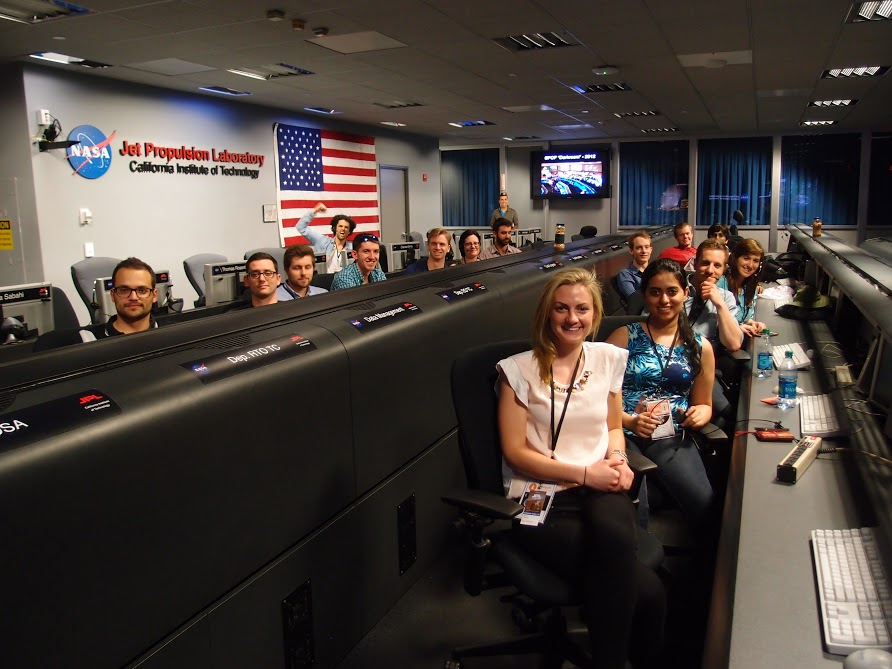
During spring break most Caltech students enjoyed a week of well earned rest and recuperation. Not so for the participants of the Caltech Space Challenge. Conceived in 2011, the Caltech Space Challenge brings together 32 of the brightest young minds in aerospace from universities around the world to tackle a speculative mission design problem. Split into two teams of 16, each worked independently in secret to bring their plans to fruition. The team in which I was a participant (Voyager) set to work on Sunday night in the palatial Keck Institute for Space Studies, a major sponsor of the entire event.


The problem: Design a mission from the ground up to send astronauts to a captured asteroid near the moon, extract resources, and have everyone survive. With fewer than 2000 person hours, that's exactly what we did. Voyager and Explorer broke into subteams of concerned with orbits, propulsion, science, risk management, vehicle design, environmental control and life support, human factors, radiation shielding, guidance, navigation and control, system, policy and outreach, structures and thermal, and a myriad other factors necessary to have a hope of meeting the competition requirements. Working in one room was a great way to dynamically reallocate human resources to solve problems as they emerged!


We didn't spend the entire time in the workshop. Program organizers scheduled a series of gripping lectures by the leading luminaries from JPL, Lockheed Martin, SpaceX, Planetary Resources, and several other key players in aerospace. After each lecture we grilled the presenters for information, trying to seem specific and knowledgeable without giving too much away to the other team.


On Wednesday everyone bused up to JPL for a workshop session with the A Team, a group of people whose job is literally dreaming up crazy mission ideas and speccing them out. I felt as though I was in the company of the gods, larger-than-life personages 12 feet tall capable of shooting laser bolts from their eyes. Our interactions couldn't have been more different. Profoundly humble and very enthusiastic, I found getting an "I don't know" to an answer empowering. When we worked out the details ourselves, we were now the world experts.


Thursday night bled into Friday morning as the final finishing touches were added to our report, fact sheet and slide presentation. With one hour to go the report integration reached fever pitch. Wholesale abandonment of version control and collaborative editing added drama and desperation! With seconds to spare the relevant pdfs were dumped onto a flash drive and whisked away to the judges and, intensely relieved, we stumbled away to lunch.


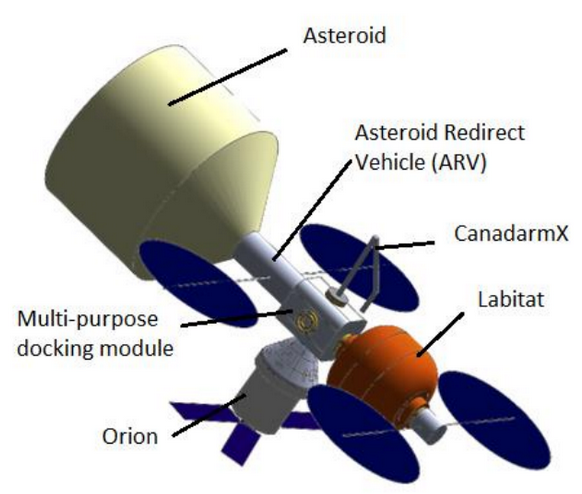
At 1pm we reassembled for the presentations. Team Explorer went first, the Voyagers and I sat in profound suspense waiting for the first slide to drop. For the next hour, Explorer explained to us and the judges the essence of their mission design. Surprisingly similar to our own, matching political, science, and crew support needs involved a Falcon Heavy-launched Habitat module and an SLS-launched Orion with three astronauts, a 25 day stay orbiting the moon, with 8 days at each end to get to and from. Both teams had to confront the reality that we collectively know nothing about what's inside asteroids. Devising methods to discover what we don't know is at the heart of science and, in a very Bayesian sense, is often driven by what we know how to discover.


Then it was our turn. Slides blurred before my sleep deprived eyes, I rose to moderate the Q&A section, and then we had to pack up, prepare for the evening reception and closing ceremony. A week of tremendous opportunity, collaboration, discussion, and creation. The Caltech Space Challenge was a dream come true.


Team Voyager in Mission Operations Control. Photo credit Randii Wessen.


Voyager Mission Concept


Friday, March 20, 2015

Great grandfather walkabout

I think it is time for some lighter fare! This is a blog analysing a letter written by my long-deceased great grandfather, Hector McKenzie. It was recently forwarded to me by my grandmother!

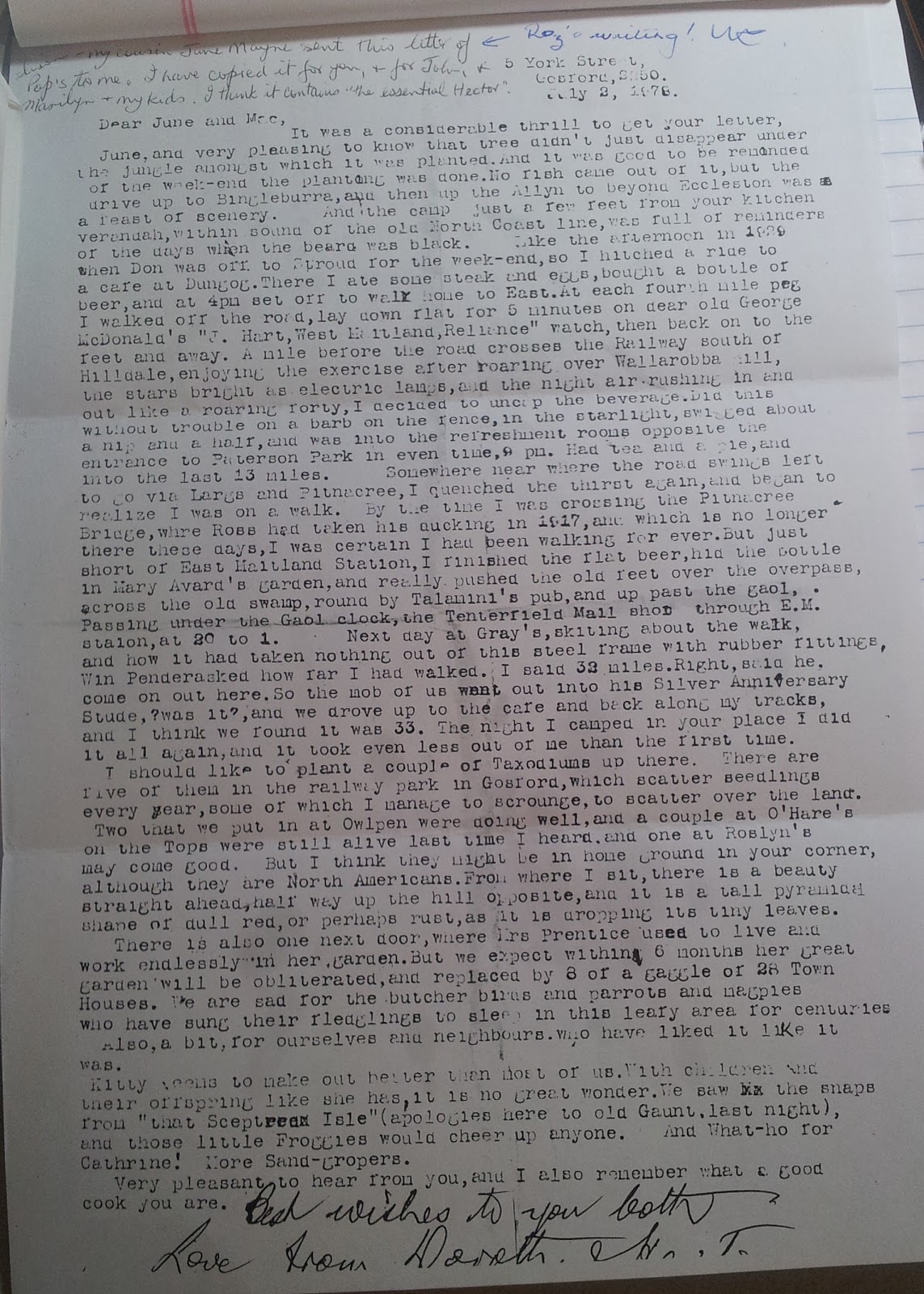
IMG_20150306_152919.jpg


Transcription

[handwriting]
Alison - my cousin June Mayne sent this letter of Pop’s to me. I have copied it for you, and for John, and Marilyn and my kids. I think it contains “the essential Hector”.
[handwriting, blue]
Roz’s writing! MC
[typewriter]
5 York Street, Gosford 2250. July 2, 1976.
Dear June and Mae,
It was a considerable thrill to get your letter, June, and very pleasing to know that tree didn’t just disappear under the jungle amongst which it was planted. And it was good to be reminded of the week-end the planting was done. No fish came out of it, but the drive up to Bingleburra, and then up the Allyn to beyond Eccleston was a feast of scenery. And the camp just a few feet from your kitchen verandah, within sound of the old North Coast line, was full of reminders of the days when the beard was black. Like the afternoon in 1929 when Don was off to Stroud for the week-end, so I hitched a ride to a cafe at Dungog. There I ate some steak and eggs, bought a bottle of beer, and at 4pm set off to walk home to East. At each fourth mile peg I walked off the road, lay down flat for 5 minutes on dear old George McDonald’s “J. Hart, West Maitland, Reliance” watch, then back on to the feet and away. A mile before the road crosses the Railway south of Hilldale, enjoying the exercise after roaring over Wallarobba hill, the stars bright as electric lamps, and the night air rushing in and out like a roaring forty, I decided to uncap the beverage. Did this without trouble on a barb on the fence, in the starlight, swigged about a nip and a half, and was into the refreshment rooms opposite the entrance to Paterson Park in even time, 9pm. Had tea and a pie, and into the last 13 miles. Somewhere near where the road swings left to go via Largs and Pitnacree, I quenched the thirst again, and began to realize I was on a walk. By the time I was crossing the Pitnacree Bridge, where Ross had taken his ducking in 1917, and which is no longer there these days, I was certain I had been walking for ever. But just short of East Maitland Station, I finished the flat beer, hid the bottle in Mary Avard’s garden, and really pushed the old feet over the overpass, across the old swamp, round by Talamini’s pub, and up past the gaol. Passing under the Gaol clock, the Tenterfield Mall shot through E.M. station, at 20 to 1. Next day at Gray’s skiting about the walk, and how it taken nothing out of this steel frame with rubber fittings, Win Pender asked how far I had walked. I said 32 miles. Right, said he, come out here. So the mob of us went out into his SIlver Anniversary Stude, ?was it?, and we drove up to the cafe and back along my tracks, and I think we found it was 33. The night I camped in your place I did it all again, and it took even less out of me than the first time.
I should like to plant a couple of Taxodiums up there. There are five of them in the railway park in Gosford, which scatter seedlings every year, some of which I manage to scrounge, to scatter over the land.
Two that we put in at Owlpen were doing well, and a couple at O’Hare’s on the Tops were still alive last time I heard, and one at Rosyln’s may come good. But I think they might be in home ground in your corner, although they are North Americans. From where I sit, there is a beauty straight ahead, half way up the hill opposite, and it is a tall pyramid shape of dull red, or perhaps rust, as it is dropping its tiny leaves.
There is also one next door, where Mrs Prentice used to live and work endlessly in her garden. But we expect within 6 months her great garden will be obliterated, and replaced by 8 or a gaggle or 28 Town Houses. We are sad for the butcher birds and parrots and magpies who have sung their fledglings to sleep in this leafy area for centuries.
Also, a bit, for ourselves and neighbours, who have liked it like it was.
Kitty seems to make out better than most of us. With children and their offspring like she has, it is no great wonder. We saw the snaps from “that Sceptred Isle” (apologies here to old Gaunt, last night), and those little Froggies would cheer up anyone. And What-ho for Cathrine! More Sand-gropers.
Very pleasant to hear from you, and I also remember what a good cook you are.
[Handwritten]
Best wishes to you both.
Love from Dorothy and Hector


Discussion
I found this letter extremely interesting. Although I have travelled to Stroud and Dungog a few times during my life, there was little context at a young age to anchor the landscape in both place and time. Fortunately the internet exists, so I decided to unpack some of the detail. According to Google, the walk was indeed 52.1 km, or 32.37 miles, which is longer than a marathon. Australian English often uses 's' in place of 'z', but I was interested that Hector used 'z' in 'realize', perhaps a hangover from his time spent practicing dentistry in Canada in the late 1930s.

Map of Hunter Valley location in Australia.
Inline image 1


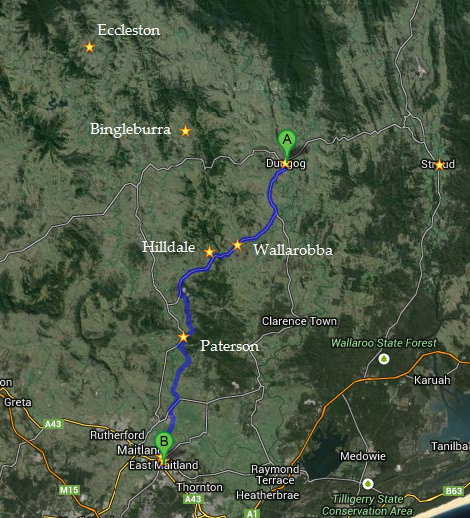
Map of the Hunter Valley, home of excellent Australian wine and some of the biggest open cut coal mines on Earth.

HectorMap2.png


Geological context. Eccleston is just south of Barrington Tops National Park, a heavily eroded volcanic remnant. The north-south lineations just north of Stroud are part of the New England fold belt, derived from the Hunter Bowen orogeny during the Permian and Triassic, 250-220 million years ago. 


Inline image 2

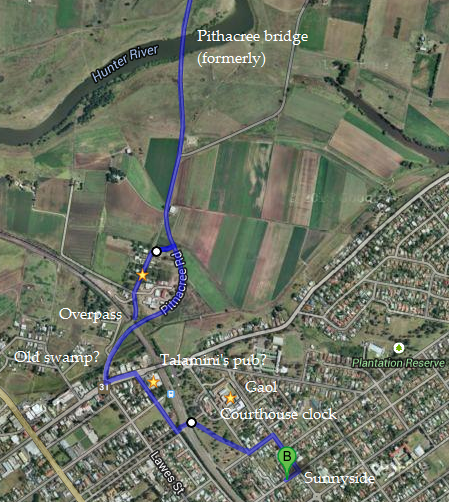
Pitnacree-Maitland route (google is slightly confused here - the actual route passes through Pitnacree and then up the road to the right)
HectorMap3.png


The 1929 silver anniversary "Stude" was probably 1929 silver anniversary Buick, pictured below!

140.jpg
The Reliance Watch was sold exclusively in Australia by J. Hart in West Maitland, according to a paragraph in “The Maitland Mercury” dated July 23, 1887.
Mentioned once more in the issue of June 9, 1889, in the context of mechanism improvements and maintenance.
J Hart and Co Jewelers were bought out in 1939.
Their building at 418 High St bears an inscription stating construction in 1855, or possibly 1885.
HectorMaitlandHartStreet.png

The watch looked probably very similar to this, a Reliance watch from the same era.

Taxodium is one of three species of swamp cypress native to the American south. Trees in the northern part of its range are deciduous. As far as I know, the one he planted in Mullum (Huonbrook, near Mullumbimby) is still going strong.

HectorTaxodium.png


Screen grabs along route from street view

Dungog main street
Inline image 3
After turnoff at Dungog road
Inline image 4
Looking down the Wallarobba hill
Inline image 5
Likely place of 'beverage uncapping' (looking north)
Inline image 2
Crossing south of Hilldale (don't turn off here!)
Inline image 7
Paterson Park with war memorial and station in the background.
Inline image 9
Where the road turns off to go via Largs and Pitnacree (to the left)
Inline image 10
Pitnacree bridge was demolished after the Hunter river changed course in 1951. http://www.patersonriver.com.au/places/pitnacreebridge.htm

Fomer site of Pitnacree bridge, from adjacent levee
Inline image 11
Pitnacree main street. I'm unsure which is Mary Avard's garden, but I think it might be the one behind the mower
Inline image 3
Courthouse clock
Inline image 13
Turning onto the home street, with only a few yards to go
Inline image 14
Time for a nap
Inline image 15

Hector "Darpop" McKenzie had a long and extremely interesting life. He left school at 16 to jackaroo during the first world war, went back to school and taught himself Latin in six months, entered dentistry school, practiced dentistry in Gosford (where I was born half a century later), beginning in the Great Depression. Although a lot of the houses of that era no longer survive, the small cottage in which he grew up (with 8 siblings!) in Maitland is still there. Well into old age he was an avid fisherman, motorcyclist, and bushwalker. My father relates an anecdote that during the building of the first family home when I was about -1, Hector (aged ~86) showed up having hiked a few miles from the nearest sealed road, bringing his racing axe and a few sandwiches to help clear the land. He is my mother's mother's father, and he died in 1989, shortly after my brother was born.

Tuesday, March 10, 2015

Grad school, exploitation, and gender: the discussion continues

Article first published in The California Tech on March 9, 2015


Grad school, exploitation, and gender: the discussion continues

Casey Handmer


After last week's article was published, more women came forward to relate their experiences. Like, Chloe, Cynthia-Rose, Lilly, and Patricia, Jessica* has experienced forms of sexism throughout her time in academia. Learning what is normal and what is acceptable doesn't happen overnight. Jessica relates, "At the first conference I ever went to, when I was a 21-year-old undergraduate, the head of the [experiment], who was engaged and had a newborn, was trying to buy me drinks all night and was saying inappropriate things, like 'Global warming is really the fault of women like you, because you're so hot men will fly anywhere to have sex with you.' It seems dumb now, but I was terrified. I thought it was my fault because I was wearing a dress and heels and as a [naive] undergrad, I didn't know what to do. One of the grad students saw what was going on and rescued me. He told the head of the collaboration, who pulled me aside to ask what had happened. He assured me, saying, 'This is not okay,' and the guy ended up being put into mandatory sexual harassment training. But at 21, I was completely mortified. I never told my [then] adviser because I thought if he knew, he'd think it was my fault and ban me from conferences."

In addition to contending with trouble at conferences and not trusting her adviser to back her up, Jessica's work environment was also compromised by a grad student who shared the same adviser and was peripherally related to her research. "[My soon-to-be-ex] boyfriend moved [permanently] to Massachusetts. Every single weekly pub trip after my ex had left, this grad student [in my lab] was coming onto me, and not gently: he was putting his hand on my leg. I brushed him off every week. [The morning after the yearly Christmas party, I received] an email from him. I must have told him to [go away in no uncertain terms], because it said 'You would be nowhere without me. Who do you think you are? You know nothing. You can't do research without other people.'" As though, even if that were true, Jessica would somehow owe them anything. Nevertheless, in the cold light of dawn, "I apologized, 'You know I'm sorry if I offended you in some way,' and he responded, 'I now have more respect for you.' I never told anyone about it, especially not our shared adviser, because I thought it would be my word against his. I was still super naive, and thought it was somehow my fault. Maybe I should have gone along with it? How messed up is it, that as a 21-year-old I'm debating sleeping with quasi-collaborators so they don't verbally harass me."


Jessica's experience with such blatantly coercive behavior has shaped the way she approached grad school where, like Cynthia-Rose, the sexism she experienced has predominantly taken the form of marginalization, mocking, and erasure. It is clear that experiences fall along a continuum from illegal to unethical to relatively banal, but all manifestations of gender discrimination cause harm and are indicative of serious structural issues in the workplace that negatively affect people of all genders.


It is important to note that these experiences are not universal, nor even particularly common, at Caltech. Two of the women with whom I spoke had never experienced sexism in the workplace and were highly complimentary of Caltech's relatively progressive culture. Beca, who left the Ph.D. program after two years, said, "Most of the issue for me personally was that academic research, especially in my field, wasn't a good fit for me from the beginning, and it took me a very long time to consciously realize it. My [technical] parents encouraged me to go into a technical field, and my mother in particular is extremely passionate about encouraging young women to go into math and physics [and] I think that's wonderful. At Caltech, my motivation just plummeted. I felt like I absolutely didn't belong there, and I started having severe anxiety just from being in classes. I felt like I was stuck in this competitive, workaholic environment. I wondered if it was related to the group I was in, so I changed groups. That didn't help. Long story short, I happily left grad school. I don't blame Caltech for my early departure at all. Academic research was not something I wanted to be doing, and I'm happy I realized that before spending more than two years there." Beca's disillusionment with academia was not related to a gendered experience, though imposter syndrome, a relentless anxiety derived from personal denial of admission legitimacy, generally seems to affect women more than men.


Stacie, who completed her studies and now has an excellent job in industry, said, "I had no problems with all the gender stuff at Caltech. I felt supported, non-discriminated, and honestly content about that stuff the whole time. [That said,] imposter syndrome is completely real. I think every single one of my friends at Caltech (minus a few) was seeing a psychologist while attending. I, too, felt like I constantly didn't belong and now I wonder if it is manifested into my current position in industry. [I'm] not quite sure if it will ever go away. I wouldn't have traded my experience at Caltech for the world. I truly enjoyed all the people, mentors, students, and professors who I interacted with. They are some of the kindest, most intelligent people I've ever met."


The majority of cases of adviser-student relationships hurting women come down to either sexist attitudes prevalent in older advisers, or well-intentioned people inadvertently pushing all the wrong buttons. For many advisers, their only model student-advisor relationships comes from their own, often highly dysfunctional, academic history. How can we clear the roadblocks to help advisers help their students? Chloe suggested, "It's hard [to adversarially confront professors] because they're indestructible. They cannot be threatened except with shame. I don't think it exists, but we could all benefit from lessons for faculty on management of groups and people. How [do you] make sure a working environment is a comfortable, happy and productive place? Advisers in academia get zero management training. Eventually, they learn, but being alone makes for plenty of mistakes [and] undue harm."


One final key roadblock that women face in STEM is perceptions regarding family, which becomes a bigger concern as students enter their late 20s. What surprised me during my conversations was not a recognition that family life and academia are broadly incompatible, but that that was just the way things were. The Nordic countries have highly progressive family-leave regulations, and have seen vastly improved gender equality in the workplace. Those laws are not present in California, and thus compliance at Caltech, even if it were a nice idea, is not required. I know of a case where a Caltech professor, expecting x units of labor per grad student stipend, stonewalled female students who had had children until they were forced to switch labs to make room for new, more productive students.


Beca, who left the Ph.D. program for non-family reasons, nonetheless recognized family as a major challenge to an academic career. "The experience of being in grad school and getting a peek into academia just reinforced my decision to leave. I originally thought I'd like to become a professor, and I realized over time how tough that path must be on relationships. You move every few years for postdocs and having to deal with a two-body problem sounded like a special kind of hell. Add to that the idea of trying to achieve enough to secure tenure when you're at the age where you might like to start a family. It's simply not the lifestyle I want. I highly prioritize work-life balance and relationships over career ambition, and I didn't see that as compatible with academia."


Lilly added, "Many marriages end at Caltech. I personally know two men whose wives left them. Families have been around for a while, but there's an official family policy now, as of 2012, in compliance with federal law on family leave."


In these instances, academia's male-centric, traditional inflexibility with regard to family life continues to harm people of all genders. As a small, well-funded and leading institution, Caltech has a golden opportunity to lead by example, to show how science should be done in the 21st century, without waiting for eventual but inevitable legal compulsion.


For the women I spoke with, academia seemed a fixed constant. You either adapt or you leave. Cynthia-Rose and Patricia agreed that women are socially conditioned to be polite and to not rock the boat. Cynthia-Rose said, "I knew I wasn't going to be a professor. I knew I didn't have the drive, didn't enjoy coming up with big scientific questions, figuring out ways to solve questions, writing grants. Sexism is extant in academia and it's not going away anytime soon. Grad students are seen as slave labor; they don't have a union. We'll be taken advantage of until there are no more grad students."


Patricia, whose office mate eventually became aware of these issues, said, "It's not my personality to be confrontational [but] people can tell I'm pissed off, even if I don't like talking about it. Since everyone's going to know, I need to say something. What people said or thought, or their intentions, doesn't matter; what matters is how I feel about it. Don't make it about them; it's about how it's experienced. Sexism is an experienced, felt thing [and] it's more constructive to talk about it. You can be careful about how you say it, but you're okay to feel that; no one can tell you that it's wrong or bad. If you feel bad, say something about it. It's part of participating in a shared workplace. You shouldn't have to grit your teeth and deal with it. Even if the gender ratio is 50-50, if women hate being there it doesn't solve the problem."


All my interlocutors were happy to recount their experiences, but most were more comfortable with blaming themselves than being assertive about blaming others, even when that blame was obviously warranted. Perhaps, given the lack of empowerment to do much about extrinsic gender-specific challenges, internalizing the struggle is a survival strategy. Chloe, who has flourished at Caltech in spite of enduring the most overt harassment of any of the women with whom I spoke, ended our conversation with "Maybe there's something wrong with me."


*All names have been changed.