Wednesday, October 17, 2018

Short story: Russian Salt and Snow

(This story was originally inspired by a sequence in the non-fiction adventure book "Five Months on a Leaky Boat" (https://www.amazon.com/Five-Months-Leaky-Boat-Kozel-ebook/dp/B005HSH6WA) where the adventurers visit a tiny Siberian town with a dark secret, on the Yenisey river. I refined the basic ideas toward a novel length work, drawing heavily on my own, somewhat less drastic, experiences in the wilder parts of North East Asia. In 2016, I redeveloped it in short story form, and have intermittently operated on various serious narrative issues ever since. I'm 90% happy with this, and 100% convinced I've given the fundamental idea a decent try and, more importantly, would rather spend time developing newer, more optimistic story concepts! This story is probably more appropriate for older readers, and I wouldn't describe it as warm and fuzzy. Enjoy! C.H.)


Russian Salt and Snow

Casey Handmer 2018


***


"Without salt, the radiation will build up in our glands," said Misha.


He rowed their dented metal boat between trunks of broken concrete looming out of the night. What might once have been a wharf now cradled a lazy eddy. Beyond, a gash in the river's bank.


"This is the only town we have seen yet that hasn't been bombed, if that cooking smoke we saw yesterday is any guide," Lana said.


A crescent moon cut briefly through the clouds, showing a drowned spit of sediment and a shallow bay. Misha pulled the oars through the silent black water.


"Can we trade for salt?" Chaika asked.


"Trade what?" Lana took a breath. "As Nikolai would have said, we will 'scavenge' it," She sat behind Misha on the middle seat, facing forwards. Chaika perched at the stern, mindlessly picking at a net holding their meagre supplies.


"This town used to be called Yakutsk. My grandfather's brother was sent here," Misha said.


The boat nosed gently for the inlet. Chaika pointed the snake-like head of their Geiger counter at the water and it clicked faintly. Her eyes reflected the golden glowing dial. Its needle flicked like her heartbeat.


"This creek is not too bad." Chaika's voice registered her surprise. "How big was Yakutsk?"


"At least a hundred thousand people." With a final push, Misha crunched the hull against the gravel. "It is hard to believe it was overlooked."


***


"Chaika, take cover."


They skidded down a short embankment and crouched low in a roadside ditch.


"Lana, what is it?"


Their feet disturbed puddles in the moonlight beneath racing clouds. Chaika brushed the earth from her hands and looked around. Nothing.


Lana stared into the distance, pointed at the supposed source of the noise which had so startled her. She whispered under her breath "We could be surrounded, how would we know?"


Chaika agreed. The darkness which had only minutes ago disguised their movement now oozed with shadows and paranoia. Lena began to shiver. It was early spring and the ground was still covered in patches of snow.


"Do you want to stay here all night?"


Chaika padded down the ditch. Lena followed, checking behind her every third step. Up ahead, a ruin emerged from the night. Cracked prefabricated concrete panels, mud, and a moon-shaded nook they melted into. Lana heard nothing besides the beating of her heart and the shearing of their tired clothes with each fraught breath. Gradually, they felt the night relax around them.


"This must have been some kind of checkpoint back before perestroika."


"Maybe there's something left. We could wait here until dawn."


"Let's clear it and move on. It's still too far to town and I don't want to have to hide all day feeding mosquitoes."


Lana struck a match, squinting into the sudden flare. Chaika looked around, then gasped in surprise.


"Lana, it is a ground squirrel, we're in his house."


Lana saw it peeking out from between broken slabs. The match licked her fingers and she dropped it, shadows flickering upwards then dropping into darkness.


"It would make a good snack, if we could catch it."


"Lana, no! It's too cute. Maybe it has babies?"


Lana chuckled slightly, then stifled a cough. The air seemed to move between them. She struck another match. A tiny girl of maybe twelve years stepped into the light. She smiled in a tentative way, seemed to start to say something. As one, they uttered.


"Who are you?"


The light flickered. The girl's eyes stared with animal intensity.


"Grib."


"Chaika."


"Lana. Grib? You just pop up in the night?"


"That's what they say. Please, I'm not dangerous."


The match went out. A voice in the dark.


"Where are you going?"


"I want to escape Yakutsk. It is cursed. But they say it is impossible to survive in the wild. But here you are. Why do you want to go there anyway?"


"Chaika and I have been travelling for many weeks and need to obtain salt," said Lana. She tapped the radiation dosimeter pen in her shirt pocket. "Or we will die like the others."


Grib replied. "That's right. My father says the salt has iodine that helps protect against the radiation."


"So there is salt in this town?" Chaika asked.


"Yakutsk is a city, the largest left on Earth, they say. And yes, salt by the ton, if you know where to look. But it is a dangerous place. Forsaken."


Lana reached for Chaika's arm.


"We have no choice. Maybe you can show us where to find the salt. Then, after, we take you with us?"


Grib's voice seemed to have come much closer.


"Deal."


Grib led them through the predawn darkness. Chaika crept over the landscape like a cat. How little they knew about this skinny girl with big eyes! Lana thought it best to delay telling her about their hideout. The earth exhaled moisture that clung to her eyebrows and temples. Her shoes trod the softly thawing ground and she thought of Misha, back at the camp, and his child growing within her.


***


It is always coldest just before the dawn. Misha carefully flexed his stiff legs and stood up. He wrapped the scratchy blanket around his shoulders and turned towards the lightening eastern sky. They had travelled down the Lena river, brown and swollen by snowmelt, in a small aluminium skiff. They moved under cover of darkness, pulling ashore at dawn, looting abandoned settlements for food and water, then moving on.


Today, they had camped a few miles downstream from Yakutsk, where dense city had begun to fade into the endless boreal forest. Misha wandered between crumbling prefabricated concrete buildings jutting up like ancient teeth. The pavement was littered with rubble, dirty snow, and riven with weeds and trees bursting through every crack. Their leaves glistened with moisture.


His greatest fear was to be hunted, caught, by some other roving band of survivors with empty minds, or worse, empty stomachs. Nikolai had shown him how to make snares for animals, and today he prepared a set of decoys to warn him if anyone was approaching. He staked out a perimeter with a strand of fishing line and identified a few potential hiding places.


Misha, their hideout secured, took their most precious possession from their boat. He wound the crank to charge the ancient batteries of the Soviet-era Geiger counter, strapped it to his back, and was lost in a world of clicks as particles from the earth, the sky, and fallout conspired to generate tiny lightning bolts inside its electrostatic Muller tube.


***


Grib led Lana and Chaika right into the heart of the town. If they had been surprised to see her, imagine her surprise to find them, wandering the wasteland and apparently healthy. Grib spoke, "You know you're not the first strangers who have shown up here?"


"Where do the others come from?" Chaika asked.


"Probably outlying settlements or mines. They all end up there." Grib shrugged towards a shadowy pit. Ruts from cart wheels led right up to the edge.


"So strangers aren't welcome here?" Lana asked.


Grib shrugged again.


There were few people moving around in the early morning light. As they approached the central neighbourhood they heard the familiar snapping clicks of a Geiger counter, amplified over a large area. Whatever it was tracking was extremely active: the clicks blurred together into a constant screech of white noise. Lana knew better than to ask.


"What's that noise?" Chaika asked.


"I'll show you, since we are already being sneaky." Grib said.


She led them into a building that faced onto the central square. It was similar in design to many other buildings they had seen. A thick, insulated door. A central stairwell, vandalized post boxes, convection heaters that had once run on central hot water, and crumbling concrete risers. They spiraled up to the top, clambered up a pitted frozen ladder into a crawl space, and moved between piles of old crates, their contents and owners long forgotten. At the edge, a narrow gap afforded a view of the square.


"That building on the far side was the opera house." Grib said. "Yakutsk was nuked, like every other city. But ours was a fizzer. It's still right there, in the foyer, underneath the hole it made as it fell. Its core is unstable but, as of yet, subcritical. In the early days, they monitored it with a geiger counter. Later, they connected it into the square's PA system so everyone could hear how angry it was at any time."


"Does anyone go in there now?" Lana asked.


"Yes. A kind of madness has descended over this town. We call the bomb 'Tsar', and the fear that Tsar could yet detonate has seeped into the bones of everyone who remains here. Tending to its moods has become the purview of the priesthood. Sometimes it seems to become especially angry..."


Chaika cut in. "Nikolai would know how to placate Tsar. Niko always knew."


"Who is Niko?" Asked Grib. Lana replied.


"We lost him."


***


Misha walked through this emptying world with his Geiger counter clicking merrily away. Every now and then a twisted lump of metal in the street would warn him away. Yakutsk was far enough from other cities that the fallout here was either chunks of shrapnel that flew in from space like a meteor, or else fine dust that blew on the wind and settled on everything, like snow.


At first it was just him and Niko. Later, while they were still camping beyond the ruins of Severobaikalsk amidst a dragon's hoard of tinned vegetables, Niko had an idea.


"Maybe we should look for other survivors."


"Why?"


"Maybe we can find them before they find us." He looked at their winter hoard of supplies.


"Maybe they have some alcohol."


"Just up the coast is the town of Nizhneangarsk. I am old, I will search around here. Why don't you hike up there, look for people, and come back after a few days."


Misha packed a bag and set off. He walked through the long autumnal night to stay warm, and following the railway line, and found the town around noon the next day. It was quiet. A couple of hungry looking dogs wandered aimlessly, but the mostly wooden buildings were either burned or empty. Below the railway station, he saw one of the few masonry structures, a single level building, gradually sinking into the swamp. It was also in ruins, but there was no reason for Misha to not be thorough. He wasn't planning on coming back.


The floor was tiled where it wasn't mud, the walls were thick concrete, and a few had graffiti from which he understood it to have been a hospital long ago. In the core of the building, around the boiler room, he smelled human.


"Anyone here?"


A noise, but no reply. Misha cautiously followed the sound. He wasn't keen on meeting a lost bear at this time of year. Skinny bears are hungry.


He found her, hiding behind a doorway. Her eyes were fearful but oddly familiar.


"It's okay, I'm looking for survivors. Are you okay?"


She nodded.


"Do you want to come with me?"


She took his hand and stood up. She was shorter than him, about the same age, still shaking with fear. She went with him, and they walked back to the camp that night.


Back at the camp, Niko wondered if she could talk.


"Do you have a name?"


She nodded. She ate and drank and, after a week, cautiously cleared her throat.


"My name is Chaika."


"Welcome back, Chaika," Niko said. "Misha, she sounds like you."


"Why is that?" Wondered Misha. Niko had been around these parts since the beginning.


"Misha, Chaika, look at each other. Clearly you are related. Cousins, hmmm?"


Misha and Chaika both went round-eyed with surprise. Misha knew better than to ask.


***


"Enough tourism. Let's find the salt and get moving," Lana said. "I'd be happy to hear all the stories tomorrow or next week."


They turned back from the window and retraced their steps through the cluttered maze.


As they approached the hatch way, they heard deep voices at the landing.


"... sighted an unknown woman walking from the north …"


Grib held a finger to her lips. Chaika shrank back into the gloom. Lana tried to breathe quietly.


A few moments later the voices stopped and footsteps clomped down the stairs. Lana counted to one hundred, then crept toward the hatchway and peered over the side. She didn't see a hulking form step out of the shadows below and, grasping her hair, yank her down through the opening.


Lana fell heavily on the floor, winded. A bushy beard swam through swirling stars. She kicked out, a yelp of pain, then crisp impact of heavy boot behind her ear.


Chaika saw the assailant heft her limp body over his shoulders and climb down the stairs.


***


Misha explored the broken buildings, looking for cool water and anything else that might be useful. One of them was just taller than the surrounding forest. Carefully, he climbed through its broken roof and lay there, soaking up the morning sun. From there he could see the smoke from cooking fires inside the city, rising gently through the still air high into the sky. Like the fires they also breathed air, consumed fuel, and would spread under the right conditions. Hope dies last.


They had found Lana last, or rather, she had found them. Niko, Chaika, and Misha were climbing the hills west of Baikal looking for springs with uncontaminated water, when Lana had stepped out from behind a tree and asked to help carry the heavy items they had been shuttling back and forth. Lana was in her mid thirties, tall, and thin like the rest of them. She had a sadness in her eyes, a sobriety of purpose.


They built a lean-to shelter in a protected glade, a pocket valley in the hills. They filled the gaps with brush and, as the days shortened, cut firewood with their hatchet on continual rotating shifts until they were certain they could heat and dry until spring.


Chaika gradually straightened from an hour of splitting timber and watched the sun sink below the horizon. The sky above and on either side was a bright orange triple column of sparkling ice crystals stretching towards the heavens.


Then, with an exhausted slowness giving way to second fury, the dying autumn released its bated breath and drove phalanx after rushing phalanx of marching clouds across the inland sea and crushed them with snow.


They huddled around the smoky fire. They passed around a luke warm can of beans impaled by a twisted spoon. They splashed their faces with Misha's demonic vodka and slept long hours huddled in their greasy everyday clothes.


When the storms passed, they dug themselves out and popped out into a winter wonderland. The snow and leafless frosty branches absorbed every sound. Niko suggested that it was now too cold to snow, and he was right. They ran low on food, and trapped mice living under the snow. Misha's vodka ran out. Then it got colder.


***


Lana felt the sun on her face, blinked twice, and was fully alert. The ground blurred past below her. Hanging upside down, she saw a small clutch of rag-wrapped city folk standing at a distance, pointing furtively.


"Where are you taking me?"


Lana knew it was pointless to struggle. She and Misha's child were in trouble.


"What's your name?"


"Don't speak."


The man carried her down an shadowed alley and through a small door in the base of the opera theatre, then dumped her on the crumbling floor.


"Speak, brother."


"Father, I found a stranger. This one seems unusually healthy."


"Excellent work, Brother Alexander." The Father emerged from the shadows. He was unusually well built, tall, and clothed in the traditional hat and robe, cinched with a length of rope.


"Come, girl, we have a special task for you. You are going to help us placate our Tsar for a while longer."


Lana felt her child kick inside her just once and then nothing.


***


The first day of spring, Misha felt the warm breath of life on his cheek. The snow melted to mud, flowers began to burst up through the ground. Birds were nipping the greening buds of trees.


"Lana, Misha, how about you reset your snares?" Niko suggested. "The ptarmigans will start lekking soon, and if we can gather enough food we can move camp as soon as next week."


They walked off into the forest, and within minutes were isolated from the world. Misha thought back to when nearly anyone on Earth was only a cellphone call away. Their route took them on a wide arc through several parallel valleys, each of which had a rapidly running icy stream at its foot. The first few snares came up empty, but not to worry. Things were just getting started.


At the first stream, a fallen log provided a bridge. Lana went first, holding out her hand to steady Misha, who was carrying a pack. Salmon leapt up the rapids beneath their feet. On the other side, she looked at him. She could tell he had once been a chubby young man. Now slender, stretched by the winter, his eyes retained a merry twinkle, a sense of mirth, that she delighted in. She didn't let go of his hand, and he didn't either.


At the head of the next valley, the forest broke into a south-facing meadow, with berry bushes just starting to flower. The smell was intoxicating. Lana and Misha walked arm in arm through the meadow's knee high grass, stems leaning beneath poised buds. Lana stopped and looked up at Misha.


"Do you think this broken world can still contain love?" She asked. Misha smiled, and lifting his hand, carefully brushed a stray hair from her face.


"I feel it, like it's resonating beneath the ground, just waiting to come out, with all the flowers."


She kissed him, tentatively at first. Misha wasn't sure what to do. They spread a blanket to hold back the ground's cold and, as though the rest of the world was disintegrating, held each other.


***


The Father led Lana up onto the stage, then down among the seats, through the exits, and into the grand foyer. Several extraordinary staircases cascaded one from the next to the front entrance facing the square. The room was lit through the broken ceiling, a ray of sunlight pierced the gloom and dazzled them. Three floors below, at the foot of the largest staircase, the Tsar lurked in the substantial hole it had made on impact. Above its buckled metal skin hung the Geiger counter, its wire fixed to the ceiling high above by rude nails through the decaying stucco. Nearby, some kind of wheeled work platform.


"What is this place?"


"Here the brothers take the sacrament and placate our deity."


Lana's stomach knotted with fear. Her feet descended the stairs as though possessed. At the top of the last staircase, before the Tsar, she could feel its radioactive anger fill the room. The Father motioned several hooded brothers to come forward. They picked her up and secured her by the wrists and ankles to the platform. The altar. The brothers quickly left.


The Father pulled on his own hood, and wheeled the Lana between Tsar and the geiger counter. The pitch of its screaming white noise changed immediately.


"The Tsar seems likes his offering today."


He took a dagger and sliced her palm, sprinkling the blood over the Tsar's mangled carapace.


"O Tsar, grant us leave to live on your poisoned Earth for one more day. We bring you this offering, that your hunger for the Total End of Man may be momentarily sated."


The Geiger counter's pitch seemed to vary,  the breathing of a savage beast resting momentarily between sprees of random orgiastic violence.


"The Tsar is exceptionally pleased. I wonder..."


"I am pregnant. Please let us go!"


"So much the better. The offerings will continue until the Tsar is finally at rest."


Lana could almost taste the radioactive particles her body was absorbing, a metallic texture in her throat.


"When did you become a Father anyway?"


"I was once a technician at a power plant. When our God became manifest, I was called to lead the brothers in a new form of worship."


The Father looked at her wounded hand.


"I cannot remain in the presence for long, but I will be back every six hours to repeat the offering."


Until? Until her blood no longer flowed. Lana's mind raced. This was where strangers met their end in Yakutsk.


***


Misha left his reverie on the roof. He checked his snares, refilled the water, patched his clothing, and prepared to wait until Chaika and Lana came back, hopefully laden with plenty of salt.


Misha thought of Nikolai. How could they have lost him? What would they do now?


Niko, Chaika, Lana, and Misha had stopped for the day in a tiny abandoned village. As usual, Niko had taken Misha and the geiger counter into the ruins to scavenge for provisions. Today, they needed water more than anything. Surface water was contaminated with fallout, and the river water was brown with mud that was too radioactive to filter.


"Let's check this building," Niko suggested.


"It looks like it could fall down at any moment," Misha said.


"The roofline is crooked, but if it survived the winter snow and the freeze-thaw, it will be okay for another season. Probably." Niko's gappy smile was crooked like the broken down building.


"Water may have gotten into the roof space and pooled there?"


"Exactly. Mind for broken glass. The nearest hospital was years ago."


Niko glanced at Misha's wound, which began to ache. He had injured himself the previous week in a derelict building. Lana held him down while Niko closed the gash with a pocket knife and baling twine. His forearm was gradually healing, the scar already twisting and curving like a meat hook.


Up in the roof space, they found several large puddles between the uneven precast concrete. Standing for weeks, the fallout had settled to the bottom and Niko showed them how to skim off the top layer, filling a dozen empty containers they had brought up. Misha double checked each container. The water seemed cool enough, at least compared to the background that gradually cooked them night and day.


Niko was nearly seventy, so Misha, at twenty six, was the pack animal. He began to ferry filled water containers back to the street. On his last trip, Niko scanned each landing for radiation, checking against the background to ensure they hadn't picked up radioactive dirt. On the ground floor, one broken down door seemed particularly hot.


"Misha, stay here. I'm old and my cells can barely keep me alive, let alone make a new cancer. I'm going to check this out."


Misha waited as Niko's footsteps faded. After a minute, he heard a bang and a muffled splash. Misha dashed in after him. The darkened apartment had been thoroughly ransacked, its wooden floor scorched and broken away in places. In the middle of the main room, a prone form in a dull blue glow. Misha approached, cranking his mechanical flashlight. Its dull, yellow beam cut through a swirl of dust and lit the splayed figure. A skeleton, wrapped in tattered clothing, its skull at rest upon the ground. Small, a child.


Her skeleton hands cradled a melted rock, a skyfallen blast fragment hot enough to stop her freezing for the day or so it would have taken to burn her nerves. The starshard rested half submerged in a pool of water that glowed from the radiation.


"Niko, where are you?"


Silence. Misha skirted the ghostly wraith and stepped into the kitchen nook. Freshly splintered wood creaked underfoot. The Muller tube, wedged between planks, held the Geiger counter on its cord, suspended over a dark hole. Misha secured the instrument, hauled it back to his level, where it continued its demented clicking. Misha shone his flashlight over the edge of the hole. The flooded basement reflected diminishing ripples twelve feet below.


"Nikolai!"


Silence.


The old man was gone.


***


Lana was alone. The geiger counter continued to screech. Her hand stung. Her child was still.


Lana lifted her head and looked around. Her restraints were frayed and rotting. She stretched her injured hand through the restraint and nursed her ancient pocket knife from her waistband. She grasped the blade between her fingers, eked it into position, and attempted to saw through the ropes. Her hand cramped and bled. She didn't dare utter a sound. The blade nicked her wrist as she painstakingly wore her way through the rope. The first strand parted and the rest unravelled.


She rolled over to cut at the opposite wrist. Her hand spasmed in sudden pain and the knife dropped away for an eternity before clattering to the floor. She heard footsteps and lay prone. In her peripheral vision, she could see hooded shapes walking the stepped galleries above her. How long until they went away?


She waited for a hundred halting breaths after the last step faded, reached over, and started pulling at the knot. Soon her right arm was loose enough to wriggle free. She took ten more metallic, radioactive breaths, then sat up and began to work the knots loose at her feet. She heard footsteps again. Brothers were running down the stairs towards her. In desperation, she wrenched her feet free, slid off the platform, and stumbled to the ground. Her legs wobbled desperately until the adrenaline caught up, and as the hooded brothers started down the last set of stairs she limped into an arched portal beneath.


In the darkness, Lana fled between the columns deep into the heart of the building. She grabbed a fistful of her jacket with her injured hand to try to staunch the bleeding long enough to break the trail of blood that betrayed her route of flight. Behind her, the Tsar screamed at a higher pitch than ever.


Lana ran around the next corner and into blind alley. A hooded figure lurked in the shadows. He stepped out, blocking her path, and quietly intoned.


"Take the third right, the second left, another left, down the passage. You will be looking for salt?"


"Yes."


"At the end of the passage, continue downhill until the tunnel narrows. The second chamber has salt, the rest are booby trapped. Then follow the light. Go!"


She ran. Behind her, she heard her savior shout: "The sacrifice was running towards the box seats."


Third right, second left, and she was cut off. A group of brothers stood near her exit. She crept into an alcove and listened to the hunt.


She heard her savior once more, a high pitched shout then silence. There was a great commotion, and the group by the final door moved back towards the Tsar. Lana took her chance and stepped into the tunnel. She took a final glance over her shoulder and saw a man, bleeding from the mouth, strapped to the gurney. The roaring crowd triumphantly fed the traitor to their common deity.


Then she was underground. A series of tunnels hewn from the permafrost. The air was well below freezing and her eyes stung in the cold. The tunnel continued indefinitely into the gloom. She slowed to a fast walk and tried to catch her breath. Her hands shook.


The tunnel narrowed. She stopped, deep beneath the Earth. She could hear only her ragged breaths and pounding heart. Once again, she felt animal eyes boring into her.


"Grib? How do you see so well in the dark?"


"Lana. Have you got the salt?"


"Not yet, second chamber?"


"Second chamber. Chaika is already there."


"Let's load up and move."


A few minutes later, Chaika, Grib, and Lana climbed narrow stairs to the light. Grib scouted and led them to a hiding place nearby.


Secure for now, Grib noticed Lana's wound. She held the injured hand in her own, turning it to reveal her own wound, healed in a ragged scar.


"I see you have also met the Father," Grib said.


"How did you escape?"


"He was my father before he was everyone's Father."


That evening, Grib, Lana, and Chaika stole out of the city, past the pit of strangers, and back to the empty road.


As they reached the camp, Grib triggered one of Misha's whistle traps. They didn't see Misha until they heard him. Recognizing them, he beckoned them in.


"Welcome back old friends and, I see, new. I had a quiet day. How about you?"


Lana stared down narrowing tunnels at Misha's boyish face. She felt their baby kick as she collapsed to the ground.


Friday, October 12, 2018

What are the major causes of rocket launch failures?

What are the major causes of rocket launch failures?
Casey Handmer
Originally answered on Quora, July 28 2014

Let's look at the launch failures since 2000. And there have been a few! (Let me know if I missed any...)

European
Two failures prior to 2000 of Ariane 5, one from guidance software, one from anomalous upper stage torque.
Ariane 5 flight 10: Partial failure due to upper stage anomalously low thrust.
Ariane 5 flight 14: Upper stage anomaly, self destruct.

Indian
GSLV has had five failures.
D1, F02 and F04 due to guidance issues.
D3 due to upper stage booster pump failure.
F06 due to loss of control of liquid boosters (guidance or control issue).

Japanese
H-IIA F6 due to stage separation failure.

Russian
Russia launches a LOT of rockets. Some of their rockets are the most reliable in the world. Still, they have had some failures.

Proton-M has had 10 failures. 
1 due to overfueling of the upper stage (human error) in 2010. 
In 2002, optional Blok-DM fourth stage shut down prematurely.
5 due to problems with optional Briz-M fourth stage. 
In 2006, Briz-M stage shut down prematurely due to oxygen supply line burning through during second firing.
In 2008, Briz-M stage shut down due to failure of gas duct between gas generator and turbine.
In 2011, Briz-M stage lost attitude control due to software error.
In 2012, Briz-M stage failed after 7 seconds.
In 2012, Briz-M stage failed 4 minutes early.
3 due to Proton-M lower stage. 
In 2007, a damaged cable prevented stage separation. 
In 2013, yaw sensors were installed incorrectly, resulting in failure shortly after liftoff. 
In 2014, third stage engine failure. 

Soyuz 2 rocket has had 2 failures.
In 2009, due to under performing third stage leaving payload in lower orbit.
In 2011, due to failure of combustion chamber wall in third stage RD-0124 engine.

Rokot (a converted ICBM) has had 2 failures.
In 2005, due to a software error.
In 2011, due to upper stage malfunction.

Volna (a converted SLBM) has had 3 failures.
In 2001, due to payload separation failure.
In 2002, due to a payload/launcher interface issue.
In 2005, due to the failure of the first stage turbopump.

Soyuz U has had 21 failures out of an incredible 745 launches.
In 2002, due to engine failure on one of the boosters.
In 2011, due to an upper stage problem.

Chinese
Not every Chinese launch failure is public knowledge. Two prominent fatal accidents of the Long March 3B in the mid 1990s were due to guidance problems shortly after launch.
Long March 2C (unknown)

Ukraine
Dnepr-1 (converted ICBM) in 2006, due to hydraulic failure on one of the first stage combustion chambers. 

Zenit-3SL (launched in the US by Sea Launch). Originally developed as a booster.
In 2000, due to a software error.
In 2004, due to a wiring fault in the upper stage.
In 2007, due to debris in the first stage turbopump.
In 2013, due to premature engine shutdown and guidance faults.

USA
Atlas V in 2007, due to a fuel leak from a faulty valve.

Delta III in 2000, due to a guidance issue. Two previous Delta III launches in the late 1990s failed due to a software issue and an upper stage issue respectively.

Delta IV in 2004, due to premature engine cutoff. 

Brazil
VLS-1 in 2003, due to exploding on the launch pad.

Israel
Shavit 1 in 2004, due to unknown reasons.

Iran
Safir 1 in 2008, due to unknown reasons.
Three further failures in 2012 and 2013, reasons unknown.

North Korea
Unha-2 in 2009, due to third stage malfunction.
Unha-3 in 2012 shortly after liftoff.

Private
Falcon 1 in 2006, due to first stage engine failure - control electronics burned.
In 2007, due to second stage oscillation (guidance and control issue).
In 2008, due to software error in staging.

Rockets are very powerful machines with lots of parts and very little margin for error. In fact, if you assume some tiny probability for any given part to fail, then look at the overall probability of success, it is 0. All rocket parts need to be tested. Today, with computers, we are able to analyse some parts of the problem (like guidance software) in the loop very thoroughly. The hardware is correspondingly admittance tested to ensure that it will work.

Nevertheless, the above list of launch failures has a few trends. Some common problems are:
  • Inexperienced designers and builders, be that on new rockets, new companies or, in the case of several Russian launch failures, a lack of expertise caused by retirement and death of elderly program engineers.
  • Third/upper/vacuum stage problems. The vacuum stage is difficult to test on Earth, often runs on cryogenic fuel, is the last thing to go wrong, and has to operate in a bizarre environment. Some organizations have jealously guarded expertise in this area, others obviously do not.
  • Old systems or old parts.
  • Software errors. The cheapest part to change is often changed wrongly, and has poorly understood failure modes.
  • Guidance and sensor problems. This may seem obvious, but rockets need dynamic control to work. The systems are complicated and poorly understood.
  • A culture that doesn't prioritize getting it right. This is not as obvious from the above list, but many failures, particularly in the Japanese and Indian space programs, have been attributed to bad error handling. Invariably, someone knew something was wrong, but was unable or unwilling to fix it. Sometimes this is due to the junior engineer fearing or respecting the senior engineer, sometimes it is due to organizational issues. Either way, it's a dumb reason to crash a rocket.
  • Probably sabotage has contributed to North Korea's and Iran's ongoing difficulties.
  • Prior to the Long March 3B crash in 1996, China's launch success rate was around 80%. After that crash, which compromised and destroyed a classified Boeing payload, Boeing helped institute changes in project management which has subsequently greatly increased their success rate to about 98%.

Monday, October 8, 2018

Searching for asteroids and other small dark solar system bodies with a network of ground-based stellar occultation cameras

Searching for asteroids and other small dark solar system bodies with a network of ground-based stellar occultation cameras
Casey Handmer October 2018

Apologia
This is a blog written for a general audience. To the readers who (unlike me) actually know what they're talking about with respect to asteroids and astronomy, my deepest apologies. I hope that this is at least amusing, and I would be thrilled to learn of my mistakes. I do not have time or expertise to fully cite every idea or concept, but I have attempted to use phrases that, if googled, would point the reader in the right direction. Onwards!

Summary
A network of hardware-agnostic all sky cameras positioned all over the world can achieve a dense covering of the entire sky, with respect to stellar occultations of near-visible stars down to magnitude 7, out to the orbit of Jupiter at 5.2 AU. Such a system, decentrally implemented and operated, could rapidly survey the entire population of inner solar system asteroids larger than tens of meters, in just a few years. Gathered data will also reveal information about asteroid size and shape, irrespective of the body's albedo. Extensions of the fundamental concept using hardware readily available in 2018 could track solar system bodies of similar size well out into the Kuiper Belt, albeit at substantially increased cost.

What do we want?
Asteroids, millions small rocky bodies that exist primarily between the orbits of Mars and Jupiter, are still relatively unexplored and undiscovered. Of the estimated two million or so larger than 1km, only about 100,000 are known, skewing strongly towards the larger and closer specimens. 

Why do we want it?
In addition to their intrinsic scientific value and interest, asteroids routinely impact the Earth, with consequences ranging from a bright fireball (particle size <1cm) to major damage to a city (<10m, such as Chelyabinsk in 2013) to total destruction (<100m, such as Tunguska in 1908) and even planetary scale extinction events (Dinosaurs!!!).

This diagram shows what fraction of near Earth asteroids are currently known. Each image represents 100 objects, and any of them would be a really really bad day if they hit Earth.

Why is it hard?
While 916 of an estimated 981 near-Earth asteroids larger than 1km are known, vast numbers of smaller asteroids remain undiscovered. Smaller asteroids are hard to discover with telescopes using light reflected from the sun, and not just because they're tiny. They're also often surfaced with material as dark as charcoal, making them extremely difficult to see with reflected light. 

How will we do it?
Stellar occultations have been used to study asteroids for more than 50 years. A stellar occultation occurs when an asteroid or planet passes between the observer and a distant star, momentarily blocking its light. Because asteroids are quite small relative to the Earth, a stellar occultation makes a "track" across the Earth's surface, such as the one shown below.


asteroidoccultation.com lists predicted occultations of known asteroids passing the Earth so that a network of astronomers can point their telescopes at the correct star and, these days, take a video of the star momentarily winking out. When all the videos are combined with their GPS locations and times, the exact shape of the shadow, and hence the asteroid, can be derived. 

With a powerful enough telescope, hundreds of thousands of stars are visible. The Earth itself is about 12000km wide, and subtends a virtual beam into space in the direction of every star. If a body passes through any of these beams, a sufficiently sensitive photometer will detect the changing brightness of the corresponding star. As the Earth moves through its orbit, this pompom of beams will scrape out a volume within the solar system. If there are enough beams, essentially the entire volume of the inner solar system will be covered in the course of one year.


This diagram shows the Earth's orbit projected on a sphere of radius 3AU. Each star traces out an ovoid, depending on its declination. Combining the ovoids of thousands of stars covers the entire sky with a forest of beams, through which the odds of an asteroid passing without being seen goes to zero. In this diagram, each line is much wider (by roughly 10 times) than the actual beam subtended by the Earth, and the colors are a happy accident. 

In order to estimate the density of coverage, I randomly generated points in the sky then measured how close they were to the nearest beam, for stars brighter than a certain level. If they passed within an Earth radius, then they would generate a stellar occultation. I considered that good enough for detection.

These histograms show the numbers of samples that approach an Earth beam. While the brightest stars do not effectively cover the night sky, my rudimentary calculations show that 82% of the entire sky is covered in one year by just the brightest 5000 stars out to a distance of 3AU, which is roughly the middle of the asteroid belt. Including magnitude 7, which are just dimmer than visible, most points would be detected multiple times per year. It is captivating to think that if humans were able to keep records and time extremely accurately, they could have used this method in ancient times with only their eyes!

This graph summarizes the above histogram, showing that tracking of 5000 stars (M6) is adequate to cover 82% of sky in a year, while tracking of 15000 stars (M7) covers 70% of the sky in only 13 weeks.

Why is this better than the previous approach?
The traditional survey method has significant advantages. A single telescope, operating in an automated fashion, can survey the entire (night) sky in a night or two. Comparing multiple subsequent days enables rapid discovery of moving objects, and completely automated pipelines such as NEO-WISE (https://neowise.ipac.caltech.edu/) have resulted in the discovery of many thousands of asteroids. 

In contrast, an automated stellar occultation asteroid discovery system requires a coordinated network of thousands or millions of all sky video cameras, sophisticated statistics and software, patience, and must contend with the existing, non-ideal distribution of stars.

Stellar occultation has one principle advantage. Because stars are so bright and so far away, they are effectively point sources. Asteroids much too small and dark to be seen using traditional telescopes can still block light from distant stars, enabling their detection. In this way, stellar occultation thumbs its nose at the inverse square law, though without violating any laws of physics. 

When I began thinking about this problem last week, it occurred to me that this was, in some sense, the astronomy analogue of the STED/STORM family of super-resolution microscopy techniques, in that it exploits the statistically regular point spread function of a point source. Super-resolution microscopes are also real headaches to implement, but worthwhile for particular use cases. In this case, because there are millions of undiscovered and otherwise undiscoverable asteroids, it might be worth the trouble to attempt detection using stellar occultation.

What are its limitations?
As previously hinted, like any other experiment there are numerous technical challenges to overcome. This is a non-exhaustive list!

- Diffraction. For sufficiently distant stars and small asteroids, the occultation produces a diffraction pattern on the surface of the Earth rather than a discrete, hard-edged shadow. Given better than binary photometry, occultation diffraction patterns can be measured using the proposed network. 

- Seeing/scintillation. The Earth's atmosphere tends to wobble and in doing so produces 'twinkle' that naturally varies the brightness and apparent location of stars in the sky. This introduces a noise source that drowns out the occultation signal from particularly small asteroids. Collocating sensors within 10m, necessary to detect asteroids of similar scale, would suffer correlated scintillation noise. Combining data from a more broadly separated set of sensors could still detect the smallest asteroids, provided there were enough of them.

- Light pollution/sky glow. In many parts of the world, light pollution affects the visibility of the dimmer stars, particularly over the timescales (milliseconds to seconds) necessary for stellar occultations. Additionally, the sky is too bright to see almost all stars during the day, so the network would only be useful for searches during the night. In practice, apparent magnitude 7 and brighter stars still densely cover a 3AU sphere even without a space-based detector system, which can point much closer to the sun.

- Other sky objects. Planes, birds, clouds, meteors, insects, and satellites can all occult stars or introduce noise. Fortunately, occulations occur on a planetary scale, so more local noise sources can be readily filtered out. Indeed, a widely distributed network of all sky cameras would also be useful for tracking meteors and discovering the remnants of long-period comets, which also pose an existential threat to humanity.

- Sensor density. The mean free path of any given occultation track between sensors on the Earth determines how effective the proposed network is at detecting every occultation, and particularly the occultations by small objects that have narrow tracks. My analysis assumes that millions of sensors based on mobile phone hardware are positioned over the entire dark-sky land area of the Earth. Note that the network would still have substantial scientific value at smaller scale, but comprehensive exploitation of the opportunity requires an extensive network on Earth.

- Stellar radius. All the stars in the sky that are visible to the naked eye are either very bright, very close, or both. For particularly wide stars in the night sky, a small, close asteroid won't completely eclipse it. Instead of going completely dark for a fraction of a second, the star will only dim slightly. Star catalogs include star angular diameter, so excluding problematic stars for smaller objects is trivial. 

- Statistical inference. The proposed network will require a multifaceted data pipeline to first discover and measure an occultation, reconstruct an occultation track, generate candidate object sizes and orbits, and then produce predictions of future occultations that can be used to refine orbits. Yes, a dense covering of the sky guarantees repeated occultation observations of every body over a period of years, allowing orbital elements to be calculated. Nonetheless, processing all the data efficiently is a worthy problem.

- Pixel edges. As an example of hardware specific issues that complicate mere photometry, an all sky camera will not track individual stars. This means that stars will move through the visual field, crossing pixel boundaries and, in some cases, even sharing pixels with other stars. The detector software will need to include a star tracker so it knows what it's looking at and doesn't confuse sensor noise and pixel boundaries with an actual occultation. Detector orientation is otherwise hard to measure.

- Hardware heterogeneity. As much as I would love to spend someone else's money on a million ARGUS-IS gigapixel cameras (https://en.wikipedia.org/wiki/ARGUS-IS) and slap on a 3m fish eye lens, the proposed system will have to contend with hardware heterogeneity. This means that none of the cameras will be perfect, they will all be different, and the software they run will have to have sophisticated hardware models to compensate for these differences. One compelling option is to use retired smart phones with fish eye lens attachments and solar panels for power, and send reduced data back to base with the cellular network. 

- Deep sky limitations. Finally, the inverse square law does come back to bite when considering outer solar system uses of such a network. Stellar occultations for Kuiper belt object discovery and atmosphere measurement is an area of active research (e.g. https://www.lpi.usra.edu/books/ssbn2008/7022.pdf), but even the system I'm envisioning wouldn't be capable of producing a *dense* dragnet of the sky that far from the sun. There are two main reasons for this. The first is that the projection of Earth's orbit (parallax) gets smaller and smaller, reducing the length of the locus by a factor 1/r. The second is that the projection of the Earth's disk also covers less of the sky, shrinking the area of coverage by 1/r^2. This still scales better than direct discovery, which scales as 1/r^4! But surveying the sky at 60AU would require 20^3 = 8000 times as many stars as at 3AU, necessitating using all the stars up to magnitude 16, which is comparable to the brightness of the nearer Kuiper belt objects themselves! All things being equal, an aperture 100 times greater would be required to gather photometric data of stars this faint, while the sheer number of objects would complicate automated tracking. Furthermore, stars at this magnitude are predominantly located in the galactic plane and are not comprehensively surveyed. I'm not saying it's impossible, but it's a different sort of problem.

A vision for practical implementation
As of today, my best vision for deploying this instrument is the development of an app that runs on smartphones. Each phone would use its camera, an aftermarket fixed focus fisheye lens, GPS, Bluetooth, and a cellular connection, and power source such as a solar panel or very long USB cable.

Each phone's software incorporates a star tracker that monitors the brightness of each star while it sits within a pixel, checking for a dimming that is statistically at variance from background sensor noise. 

A candidate detection is tagged with location and the specific star, then compared within a local decentralized cluster of 2-15 phones within a ~100m area. Given a concurrence, the event is uploaded using a cellular or satellite network in compact text form, containing the following information: GPS location, start and end time, degree of extinction, an event reference number, phone configuration, orientation, and ID numbers, (most likely) star, and event's declination and right ascension. Local weather data (e.g. percent of the sky visible) is also included. 

The cellular connection is also used to receive information about predicted tracks. If the event is thought to involve a diffraction pattern, ring system, or atmosphere, then more detailed photometric data can be taken and uploaded for analysis.

On a remote server, incoming events are binned by sky location. Any event that does not have corroborating occultations of the same star are thrown out. Multiple events are reconstructed into tracks, depending on where they were observed, and a further statistical test ensures that a majority of the local clusters along the track all detected the event. For diffraction patterns, all relevant data can be processed together to pull the signal from the noise.

With sensors capable of tracking magnitude 7 and brighter stars, essentially all of the estimated two million asteroids larger than 1km (and billions of smaller ones) will be detected every year. Earth over(under)takes the slower moving main belt asteroids frequently enough that nearly every asteroid will be detected multiple times over a few year period. The final task of the central server is to process occultation event detections to deconflict coincidences. That is, if two million asteroids are detected twice, there are four thousand billion possible double detections. The vast majority of these can be excluded on physical grounds, but of the remaining, say one billion candidate orbits, each will generate at least one predicted occultation per year. This may seem like a lot, but each camera is tracking about 7000 stars at once, for 31 million seconds a year - a total of 210 billion star-seconds! With a decent sized dataset, most of the remaining candidate orbits can be excluded and asteroids definitively discovered. Finally, combining information from multiple occultations, the asteroids' shapes can be deduced.

Final Thoughts
Earth has a surface area of 510.1 million km^2. As of 2018, the are of the single largest telescope is 84m^2. The total area of all the optical telescopes is less than 0.002km^2. The total area of all human pupils is about 0.7km^2. All the rest of the star light that falls on the Earth is wasted! While radio astronomers have long used telescopes across the world for very large baseline observation, the use of such a huge canvas for visible observation is limited by the severe physical difficulty of recording a visible light signal at about a million billion Hertz. With stellar occultation, this limitation can be removed. Using the entire Earth and millions of artificial eyes to stare at the night sky is the only practical way to discover and catalog every asteroid that orbits between Earth and Jupiter, including every main belt asteroid, down to a size of tens of meters. 

Sunday, October 7, 2018

How to rig an election, or yet another think piece on gerrymandering

How to rig an election, or yet another think piece on gerrymandering

Casey Handmer, 4 January 2018 (revised and published October 2018)


This technical note lays out a recipe for gerrymandering any given set of congressional districts.


Context:

https://www.wired.com/story/pennsylvania-partisan-gerrymandering-experts/


Why is gerrymandering bad?

Gerrymandering is bad for two related reasons:

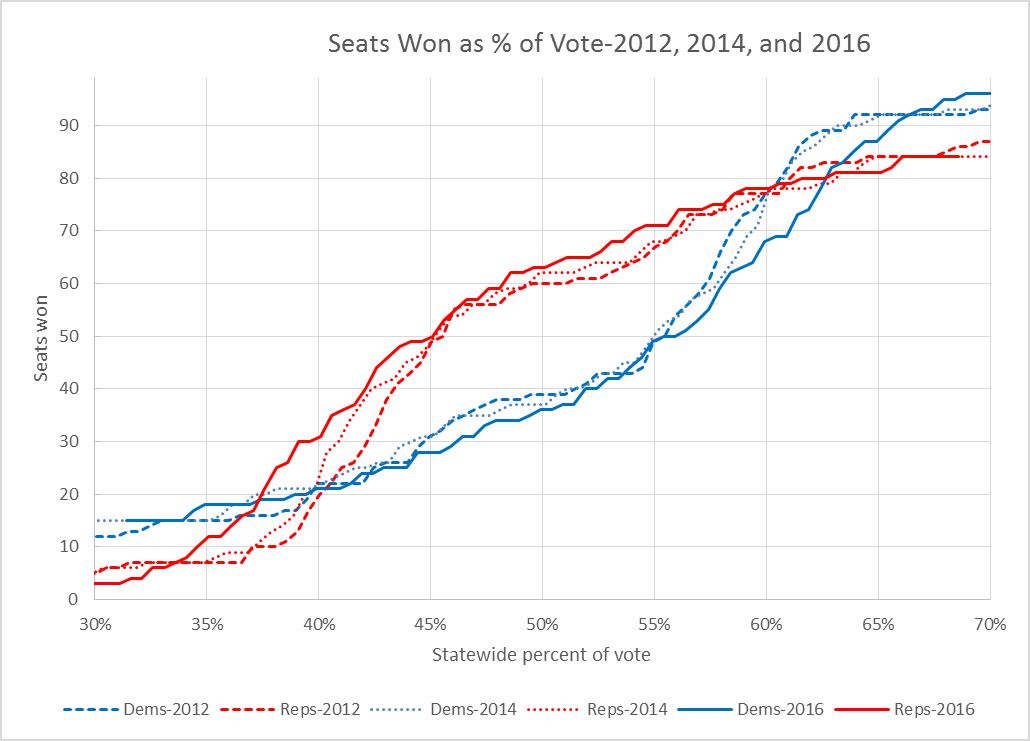
  • It subverts the will of the people, by skewing the x-intercept of the swing/representation graph, as shown below.

  • It radicalizes representatives, whose representation tends over time towards more homogeneous, less diverse congressional districts.

These two reasons drive partisan polarization for many, though not all, issues, and contribute to inefficiencies in the governing process.


There is a perception that a gerrymandered district is obvious, but a formal definition is surprisingly non obvious. Some ridiculous shape might help with the "know it when you see it" definition, but formally convex districts can also be gerrymandered. For the purposes of this discussion, I will consider a set of districts gerrymandered if their boundaries are statistically robustly shifting the x intercept of the swing/representation graph.


This graph shows a roughly even split of gerrymandering that ensures house safety even with a 5% swing. https://urbanmilwaukee.com/wp-content/uploads/2016/12/image00-3.png


There are many proposals for algorithms or mechanisms that can select less gerrymandered districts. My favorite proposal (today) is the "I cut, you choose" procedure, where each major party takes turns to draw one district of the appropriate size within the remaining area. This can tend to minimize the negative partisan effect of existing gerrymandering, but I will show that it doesn't actually solve the problem. It merely shifts it somewhere else.


Finally, there are a few other structural weaknesses of the US voting system, including the electoral college and non-preferential voting, but let's focus on one thing at once.


A note on divisive political issues

Elections in the US, where voting is non-compulsory, often swing on whether or not so-called "single issue voters" bother to show up. As a result, there is a disproportionate focus in partisan media and political commentary on a reasonably small set of these polarizing issues. Let's call them highly motivating divisive issues, or HMDIs.


There are many divisive issues out there, but only some are sufficiently motivating to be "big hills to die on." A good test case for whether an issue is an HMDI is whether it's the sort of thing that ruins Thanksgiving. It'll split a room and people just won't shut up about it, happily burning their family in the process.


The peculiar thing about HMDIs is that so many of them are fundamentally niche issues for the vast majority of US voters. I'm not saying they're not important or bellwether issues, but they just don't have a huge impact on the personal lives of most voters. For example:

  • Background checks for gun owners, almost all of whom would pass.

  • Abortion, despite the fact that most people will never have one.

  • Immigration, despite the fact that only a tiny number of people immigrate to the US.

  • Gay marriage, despite the fact that no-one's proposing to force anyone to marry a gay person.

  • Drug decriminalization, despite drug use being a personal choice.


My hypothesis is that the modern Democrat and Republican parties accidentally found themselves on either side of these issues which not only split the electorate roughly evenly, and along ideologically simple lines, but also conveyed a slight, unintentional x-intercept bias. Then the redistricting machine did its usual amplification procedure and here we are. In fact, we've even seen historical examples of both parties being on the other side of former HMDIs such as slavery, social security, or federalism.


Let's get technical

We know that our current congressional districts are drawn to classify voters with known preferences into different groups to "pack and crack," or try to dilute the influence of opponents while amplifying the influence of allies. Therefore, it's fair to say that the current US electoral district boundaries are, in some sense, a representation of the natural distribution of an inhomogeneous electorate and its preferences. Remember that humans self-sort and self-segregate in statistically significant ways, but that any given divisive issue doesn't predict another particularly well. I would estimate that the total space of >500 issues can be covered reasonably well by the first 15 principal components in terms of geographic voter allocation.


I hypothesize that, were another HMDI to become politically important in the next decade, and its preference prevalence to differ from the background of existing liberal/conservative splits, even a bit, that congressional districts would be redrawn to maintain their maximally gerrymandered state.


Therefore, it's fair to say that it's possible to construct a perturbative map from an existing electorate to a future one, where the set of voters and their most important issues changes, but there is a smoothly continuous variation of district boundaries that maintains a maximum of partisan advantage.


The big idea

This perturbative map rests on a hidden assumption that it's possible to analyse the stated and latent preferences of any demographic and to (re)draw a maximally gerrymandered district accordingly.


Given a weighted ranked set of HMDIs, then, it is possible to score any given (set of) potential congressional boundaries for partisan advantage, and select one accordingly. Given that it's difficult to be precise about which HMDIs matter and how much, this is not a particularly sound method for preventing gerrymandering, though it is a good (and proven) approach for maximizing gerrymandering.


The inverse map is more interesting. For any given set of congressional boundaries, the inverse map can generate a weighted ranked set of HMDIs. If, for example, congressional boundaries were redrawn at random after every election, political consultants would perform the inverse map to determine which issues were most likely to swing the election in any given district, then try to push a local agenda that raised the profile of these issues. It is important to note that while some of the issues are likely to be important to voters on both sides of the issue, other issues are likely to convey partisan advantage for only one party. For a historical precedent, see the staggering rise of anti-Muslim animus since 2001, becoming a supreme court issue (the Muslim ban) in only 15 years.


There is a further implication. Given a map gerrymandered to favor (say) Republicans, there will be a set of issues which divide that region to give, with the exact same boundaries, a gerrymandered advantage to Democrats. In reality, these issues are likely to be mostly relatively unimportant. But that doesn't mean it's not worth looking.


In other words, for any given map, electorate preoccupation with some issue will render partisan advantage. "This map is gerrymandered on abortion."


Conversely, for any given issue, there is a unique map which maximizes partisan advantage for this issue. "We gerrymandered this map on abortion."


Why is this interesting?

Do you find endless debates about abortion boring, but want to see some federal political attention given to, say, climate change, space exploration, or world peace?


Why is our political process obsessed with such insipid HMDIs? Who is driving this train?


I think it's fair to say that beyond a certain point, HMDIs function as memes that self-select given the existing set of congressional districting rules. This is a natural instability in the system and probably can't be avoided.


This is interesting because when maps are redrawn they can alter the relative importance of second-billing issues. We've already seen this - I don't think Newt Gingrich intended his strategy for political conservatism to see a resurgence of Nazism.


But a more involved quantitative understanding of this process, particularly if its precise workings can be concealed, leaves open the potential for major political meddling.


Let's redraw some districts around people who care about climate change and peaceful uses of rockets.


Monday, October 1, 2018

"The Program," or, a strategy for universal prosperity in the twenty first century

Energy! What is it, how do you get it? 
Energy has an esoteric physics definition, but for the purposes of this blog, energy is the ability to do useful work. Work energy per unit time is power, while force multiplied by distance is work.
Throughout human history, if a human wanted something done, they had to use muscle power. Muscles, powered by food grown using sunlight, water, and ambient carbon dioxide, was the limiting factor in the deployment of work for useful things. There were a handful of exceptions in the form of water or windmills, of course. 
That all changed in the 18th century when engineers in Britain devised the first practical steam engines. For the first time, mechanical power could be harnessed to operate pumps, mills, and vehicles, that wasn't derived from mammalian metabolism. 
This first industrial revolution was followed by the widespread development of factories and assembly lines in the 19th century. 
At around this time the gasoline internal combustion engine was developed, such that by the 1930s rubber wheels on bitumen were overtaking trains as a preferred land surface transportation mechanism.
The Second World War saw the rapid maturation of aviation and oil extraction technology, and from 1948 until 1973, world per capita energy consumption grew at 7% per year. Physicist Gerard O'Neill predicted that by the year 2000, humanity would need space solar power to continue its incredible growth. 
What does this story mean? Gasoline is a fuel, or a mechanism for the storage and convenient dispatch of mechanical energy. In this, it is hard to beat, as it is pourable, readily available, and incredibly energy dense. While highly flammable, it can be made safe to use. 
7% annual energy growth encapsulates billions of humans being lifted from the poverty of preindustrial subsistence agriculture. With gasoline powered machines, an individual human can be so much more productive, enabling great increases in quality of life. 
Of course, this trend has not continued to the present. Instead, we had a series of oil shocks and a plateauing of wealth in developed countries. Indeed, recent trends seem to point toward a zero-sum struggle for control of limited resources, rather than confidence in limitless growth, at least to the point of post-scarcity. Indeed, energy has only gotten more expensive. 
The figure below shows 5-year smoothed data for US per capita energy consumption and the price of crude oil. The period from 1939 until 1973 was marked by robust growth and steady, slightly declining oil prices. The period from 1973 until present has endured great uncertainty and change in the price of oil (up to 20% per year for several years!), and a commensurate loss of steady growth in the exploitation of energy. 

I believe that worldwide economic stagnation in the 1980s and 1990s was headed off only by the coincidental development of consumer-accessible computers.
Computers are a very unusual case, as they have gotten twice as good every 18 months for many decades, at least until recently. To provide an example of how unusual this is, the Curiosity Mars rover uses a particular kind of space-grade chip, which is necessarily of rather poor performance compared to the state of the art. The Mars Helicopter doesn't have enough power to run this chip, so the engineers had to select an option that was smaller and less power hungry. In any other field, this would imply even poorer performance, but because this is a computer, the smaller chip is 60 times as powerful, which is a great boon to the software developers! 
Moore's Law has tapered off in recent years due to fundamental physics, but I think that we're a long way from fully exploiting the potential of current computer hardware. 
While our civilisation has failed to obtain an infinite supply of ever cheaper energy, the growth of wildly cheap computing capacity has allowed us to subvert that constraint to some extent. Although computers don't perform mechanical work in any macro sense, their prodigious abilities with logic and calculation have extended the cognitive capacity of humanity in the same way that engines have extended our muscles. 
Of course, this has further exacerbated a chronic oversupply of human labor present since the end of WWII, since all human needs could now be met in developed countries with a ten hour work week. Today, we are seeing the computerized automation of middle management, such that employees of organizations like Uber are actually dispatched by an algorithm. And when one considers the affordability of real estate it's clear that in this period of macroscale industrial stagnation much value has been stealthily inflated away.
After this necessarily imprecise historical and economic review, it's time for me to pull out my crystal ball and talk about The Program.
I was discussing an application of cheap solar energy with my cousin J when my reference to The Program elicited a blank stare. This blog is my attempt to structure on paper my thoughts about energy policy over the next 30 years.
When we think of 2050, we think of supersonic passenger jets, flying cars, good food, free education, housing, healthcare, and other trappings of a wealthy, prosperous society. Yet even in 2018, nothing can happen without oil. Oil is a dirty, messy business that destroys the environment, corrupts governments, ruins our health, and poisons the atmosphere. But for all that, we can't live without it because, as explained earlier, it can give any human on Earth the superhero capacity to dispatch, as a rough average, 100 times more work than their muscles could achieve on their own. 
Given that oil is not only poisonous, it's also finite, a replacement will have to be found and deployed, and in our lifetime. 
While it's possible to chemically synthesize fuels at huge expense, I'm going to focus this blog on the technology that will prevail, namely electricity. 
Electricity and magnetism are magic. Like gasoline, electricity is a form of energy that can flow down conductive wires and, with motors, perform mechanical work. Its technological maturation has progressed alongside fuels and is so successful that everyone can get it from outlets in their walls.
Whereas a 19th century factory may have transmitted energy from a central steam engine using belts or shafts, these days nearly everything is run using electric motors. My robot vacuum has 12 motors in it! 
But while electricity has been the go to for appliances for decades, and not just because no-one wants to run a dishwasher with a motorcycle engine, gasoline has been the traditional energy source in mobile applications. 
This reminds me of the old joke about electric helicopters, which is that they needed a very long extension cord! In all seriousness, boats, cars, planes, and rockets needed fuels they could carry with them, so electricity was not an option. Recall why gasoline is such a compelling fuel! Cheap, pourable, energy dense, safe enough. 
When my father built the house in which I grew up in 1986, he used power tools powered by the mains, and drove a petrol powered car. When I attempt to construct things, I use battery powered tools and drive an electric, battery-powered car. No-one has a gas-powered mobile phone. World battery production is growing as batteries power ever-larger vehicles. The Tesla Gigafactory will reach 35GWh production later this year, two years ahead of schedule. There are serious proposals to build battery ships to transport electricity from solar farms in North Africa to Northern Europe!
In 1973, battery technology was not very advanced. In 2018, there are battery-powered planes that have crossed the English Channel. In short, the geological and geopolitical shortage of oil that halted the mechanical progress of humans is finally ready to be circumvented. 
Lithium batteries, like all products, require the mining of certain materials which have environmental effects. Needless to say, for equivalent work, lithium batteries are much less harmful than oil! They're also highly recyclable.
To get technical for a moment, the energy density of gasoline is about 46MJ/kg. The energy density of the best batteries is about 1MJ/kg, which improves by about 5% per year. The saving grace is that electric motors can be 95% efficient, while a car engine would be lucky to reach 15% efficiency, with the rest being wasted as heat. That means that on a per kg basis, batteries+motors are only 7 times less mass efficient than gasoline+engines. Further, electric motors have much higher power density, so can be lighter. Finally, vehicles such as cars spend most of their mass budget on things other than fuel and power train, so extra batteries can be added with only marginal increases in weight. This is notably not the case with long haul jets (50% fuel mass fraction) or rockets (95% fuel mass fraction) which both consume an inordinate amount of fuel.
To consider my personal carbon footprint, I use low wattage LED bulbs, but every time I fly to Australia my share of the plane's fuel is about 500kg, or 180 gallons. Each way. Driving a Hummer wouldn't make much difference!
A frequent though inaccurate criticism of electric cars is that the electricity they use, generated by coal, just moves the pollution elsewhere. This is imprecise, as electric cars are about 5 times as efficient at using energy due to regenerative braking and better motor efficiency, while electricity power plants are about twice as efficient as car engines, primarily because they operate at steady state and have better heat disposal mechanisms available.
Incidentally, while batteries are not yet good enough to operate long haul flights, there are now hundreds of companies developing short range electric commuter planes. Further, the power density and mechanical simplicity of electric motors allows for vertical take and landing, like a helicopter. Finally, I think that electric power has unique advantages which point the way to cost effective consumer supersonic flight, which is definitely part of my awesome vision for the future.
Nevertheless, The Program does not stop once it has succeeded in supplanting gasoline as the fuel of choice for all vehicles except orbital rockets. Indeed, as far as global warming goes, humanity could burn all the oil and all the gas and do relatively little harm compared to reserves of coal. Coal, a black, carbon rich fossil of trees, stores concentrated ancient sunlight and is extremely popular as a source of electricity.
While wind power has matured in recent years, the most applicable renewable natural resource is solar power. The sun is about 110 times wider than the Earth and will burn for another five billion years. During the day, every square meter of the Earth's surface receives about a kilowatt of power. It just rains down from space for free. It powers trees, so anywhere there's green, there's solar power.
But recall that preindustrial societies are solar powered! Horses and cows eat solar powered grass and humans eat wheat, corn, cows, and so on. No-one is deriving nutritional value from coal. How can solar power produce enough energy for our civilization?
The answer rests in efficiency. A modern commercial solar panel is about 20% efficient. Combined with a 80% efficient power transmission system, a 90% efficient battery charger and a 75% efficient cordless drill, about 10% of that kW of solar power, or 100W, makes it to the work piece.
Contrast this with agriculture, which also requires arable land, fertilizer, pesticide, and irrigation. Plants spend most of their energy transpiring water to keep cool in the sun, and are less than 0.1% efficient at converting solar energy into digestible starch. Cows or yeasts are about the same. Then the human metabolism is about 5% efficient at converting consumed energy to mechanical work.
So while a solar powered electric system is 10% efficient, an agricultural system is 0.000005% efficient. This is the main reason that farms are really big. To create value, they have to capture a lot of sunlight, which is rather dispersed. This is also the reason why biofuels can never scale to completely replace gasoline. Their end-to-end efficiency is thousands of times lower than solar and batteries, and there isn't enough arable land to produce enough ethanol. Not even close.
To dwell on power transmission for a moment, let's consider trees. Trees are self-powered, but they're not generally considered to be capable of locomotion. Animals that move need to eat a lot of plants to concentrate the stored solar energy. This is why very few animals bother with photosynthesis. Likewise, some electrical applications require so little energy that they can be powered directly by solar panels. But most human machines are too energy intensive to be powered in this way.
For instance, at highway speeds my car consumes about 15kW. If this were provided by a solar panel, in addition to being unable to drive at night, the car would need to be 50m long to fit in a standard lane. In the US this may be permitted on certain roads at certain times with escort vehicles; the SpaceX Falcon 9 rocket first stage is of a similar size.
Clearly, solar panels on houses or in dedicated farms are needed to concentrate the sun's power. A transmission grid continues to dispatch the supply to the end user.
How many solar panels are needed? Lots and lots! For a rough estimate, recall that solar is about 2000 times as efficient as non-meat food production, but that per capita energy consumption is only 1% food in industrial societies. Therefore, about 5% of the area devoted to agriculture is necessary to meet foreseeable electricity needs. About 11% of Earth's land surface is used for crops, so we're talking about 0.5%.
As an example, using only desert military bases in California and Nevada, which receive a lot of sun, would produce enough power to supply the entirety of North America. In practice, a mix of rooftop solar and utility farms in sunny areas is the most robust approach.
It's instructive to consider areal land uses for other forms of energy production. In Australia's picturesque Hunter Valley, there are several enormous open cut coal mines. I computed that a solar farm operating for 20 years will produce energy equivalent in value to a coal seam 3m thick. That is, even if the coal is at the surface, and it's not, if it's less than 3m thick it's better to use as a foundation for solar panels than to dig it up and burn it. Further, there aren't that many coal seams that thick anymore! A similar argument about nuclear power, given a 20km exclusion zone, shows that more energy rains down from the sky in that area than can be produced by fission.
Coal - leave it in the ground.
Like wind, solar is not a continually available resource. It varies daily and seasonally. For this reason, a smarter grid with responsive demand, intersticial storage, and a rational pricing strategy is a worthy goal. In practice, this means that in the future power will be very cheap at noon and during summer, so all sorts of new applications are possible. My favorite examples, though far from exhaustive, are aluminium production and mass desalination for agriculture, both of which require power below the price of 1c/kWh.
Indeed, in 2017 solar power supply bids reached 2.7c/kWh in Mexico, indicative of a long awaited reversal of the decades-long trend of gradually increasing energy costs. Extrapolating is risky business, but at present rates solar power will reduce in price by a factor of 10 every 17 years. Continuing that trend, in 2050 power will be cheap enough to artificially refill rivers parched by global warming with pumps and desalination, for example.
This trend need not stop in 2050. It is my belief that by the time I die, historians will see the period between 1973 and 2013 as an anomaly, a blip, a detour into computing on an otherwise unbroken industrial trend towards ever greater deployment of useful energy for peaceful humanitarian purposes.
What is The Program? The Program is a vision for the mass deployment of solar power, smart grid technology, grid storage, and electric vehicles. It is now economically viable to talk about public funding of generational infrastructure on the supply side, while a clear roadmap will drive private innovation in vehicle design. 

Sunday, September 16, 2018

Unpopular opinions in space

One of the fun things about speculative technology is encountering people with different views, and then trying to understand why and how, essentially, the same set of axioms leads to a different conclusion. In some ways, the community can be divided up into camps, representing the acolytes of various well-known thinkers in the area. As an example, concerning where humans should live in space, some people suggest the Moon, others Mars, others asteroids, Venus, or giant stations in deep space. For a second example, opinions differ about where the money may come from. I previously dealt with the funding question in another blog: http://caseyexaustralia.blogspot.com/2017/09/how-to-fund-space-settlement-where-does.html 

In this post, I'm going to air three unconventional if not unpopular opinions, then spend a few thousand words explaining my views on them. I will endeavor to use accessible math and be quite clear about which axioms can be altered. My intention is to continue the conversation and to have, in one place, a concise summary of a point of view which can be referred back to as necessary.

Rule 1: There is no problem in space that can't be most effectively solved by building a bigger rocket on Earth.

Rule 2: There is no commodity resource in space that could be sold profitably on Earth.

Rule 3: Self-replicating robots and matter compilers do not exist.

The implications of these rules are not as dire as they may seem. In particular, my recent book on Mars industrialization (https://www.amazon.com/How-Industrialize-Mars-Strategy-Self-Sufficiency-ebook/dp/B07GN3BJX3/) shares these axioms and retains an optimistic tone.

Why are these rules true? Read on!

Rule 1: There is no problem in space that can't be most effectively solved by building a bigger rocket on Earth.

In short, big rockets are expensive, but managing interfaces in a vacuum is much, much more expensive. Case in point: The ISS.

Unfortunately there are very few large rocket development programs to use as baselines, but there are a few. The Saturn V, which could launch 110T to LEO, cost about $1.2b to develop in 2016 dollars. The Soviet Energia was considerably cheaper. The SLS has already consumed tens of billions, but it is well understood in the industry that it is not exactly a lean program. SpaceX is developing the BFR using only internal funds, and will probably spend a similar amount to the Saturn V, though with a lower per-flight cost and much higher overall performance. 

In contrast, the ISS, which tested the idea of assembling a space station from modular parts launched using a partially-reusable shuttle, has cost $150b, and has taken the better part of 30 years to build, including on-Earth fabrication. And for that cost, a disproportionately high fraction of the overall station mass is consumed by the interfaces: heavy airlocks, narrow connecting passages, and architectural constraints. Further, the station will need to be retired in the next decade or so, as the "sausage link" interfaces are subject to bending fatigue that is gradually weakening them.

In a recent Quora question, I pointed out that a single expendable launch of the BFS would deliver much more volume to LEO than the entire space station (https://www.quora.com/How-many-BFR-launches-would-it-take-to-loft-the-entire-ISS-into-its-current-orbit/answer/Casey-Handmer). That is to say, a Skylab-style station based on BFR could be launched in one go, at a cost equivalent to the marginal cost of a single spaceship at retirement, which is close to nothing. 

Why is this true? The reason is that all large pressurized volumes require assembly from various sub-components. For Boeing jets, this is done in Renton, near Seattle. Even there, in a climate controlled factory, it is a serious headache. It requires a small army of engineers and technicians. But it is still cheaper to do it there, in the factory, than in flight or on the side of a small runway somewhere in the middle of Wyoming. 

In short, as much construction and integration as possible should occur on Earth, where labor costs are about a million times lower than in space. Payloads should be launched in the largest possible units, in plug-and-play configuration. And that is why, even though building an enormous rocket is extremely expensive, it is the cheapest way to do business in space.

Are there limits to this? Yes, of course. The largest rockets ever flown delivered about 100T to orbit. It is not clear to me that rockets could efficiently deliver more than about 1000T to orbit in a single shot, with chemical rockets. This is due to fundamental limitations on the strength of materials in pressurized combustion chambers, fuel and material density, and Earth's gravitational field. But 1000T to LEO is a very, very large chunk of stuff compared to the current model for doing business.

Note: While I personally think that there are all sorts of good reasons to pursue reusable rockets, and that larger rockets in the correct configuration are easier to make reusable due to improved margins, this rule doesn't imply that reusable rockets are necessary. In particular, the space station would have been much cheaper and faster to build if it were launched on a Shuttle-derived expendable heavy lift stack. 

Rule 2: There is no commodity resource in space that could be sold profitably on Earth.

One possible exception: The elixir of life, if it could only be obtained on the Moon. 

The usual examples range from water or Helium-3 mined on the Moon, to platinum-rich asteroids, to space-based solar power.

This rule comes down to a discussion of intrinsic value. Clearly, to be worthwhile, a space-based resource has to command an exceptionally high value-per-mass. There are a handful of commodities on Earth with values as high as $100,000/g, such as listed here: https://brightside.me/wonder-curiosities/the-16-most-expensive-materials-in-the-world-188955/ 

It is important to note that none of these are intrinsically valuable. The illegal drugs are expensive because there's a high cost to being caught making them. The diamonds are expensive because their market is manipulated. And rare metals are expensive because they're very hard to chemically extract from rocks, but also because they're basically never used in industry. That is to say, there is no demand for them. 

In particular, of all rare, valuable commodities there isn't a single one with a high level of baseline usage. This means that if the supply suddenly increased, because of an additional discovery, the price would collapse. Even if there was an asteroid of pure platinum orbiting the Moon, and there most certainly is not, increasing the global supply beyond baseline of about 40T/year would simply reduce the market price. 

As for water on the Moon, water isn't even intrinsically valuable or rare on Earth. In fact, as I showed in a previous blog (http://caseyexaustralia.blogspot.com/2017/04/does-lunar-resource-exploitation-make.html), it is probably cheaper to import water from Earth to the Moon than to extract it there. And even if it were cheaper to obtain water on the Moon, there is zero case to export water from the Moon to anywhere else. 

Finally, let's consider Helium-3. Helium-3 is a nice example, because it is relatively much more abundant on the Moon, and it is currently very expensive on Earth due to rarity. It is even used in some industrial and scientific processes as a refrigerant. But in order to make a business mining it on the Moon, adequate demand to both keep costs and revenues high must exist. For this, we are told, Helium-3 is a natural fuel for nuclear fusion. There may come a time when lunar Helium-3 fuels fusion-powered interstellar voyages, but I am unable to not put that in the science fiction bucket. 

So what would a space resource have to look like, quantitatively, to make a business selling it on Earth? My interest here is to be inclusive, so I will underestimate fixed costs as much as possible on the first pass. Let's say that although currently it costs about $3000/kg to launch something to LEO on a reusable F9 flight, SpaceX's BFR reduces that further to $100/kg. Let's suppose that further the cost of delivering cargo to the Moon using hardware based on the BFR is $1000/kg and the cost of returning cargo from the Moon $10,000/kg, which assumes at least local oxygen propellant production. By comparison, the cost of shipping a container half way around the world is about $0.10/kg. 

The question, then, is what commodity is relatively much more available on the Moon than the Earth to make up for the fact that shipping it is 100,000 times as expensive. I am not aware of any physical matter, short of the elixir of life, that would make this worthwhile. Yes, a tiny number of high net worth individuals may want to travel there for tourism, but that doesn't approach a billion dollar industry.

But what about space-based solar power, popularized by Gerard O'Neill in The High Frontier? While shipping matter to and from space is enormously expensive, it is much cheaper to beam microwaves as they have no intrinsic mass. 

Gerard O'Neill's book was written in the early 1970s, when it seemed as though the world was headed for a Malthusian crisis of population and energy consumption. This is not the case anymore. Indeed, the fundamental challenge with space solar power is that although the solar resource in space is about 3 times as good as the best places on Earth, the transmission losses from space are comparable in magnitude. Economically, it is much cheaper to deploy solar photovoltaic panels on Earth than in space, where at best the delivery costs are 1000 times higher, the maintenance costs a million times higher, and the environment much more difficult to deal with. 

As Elon Musk has concisely pointed out, the fundamental problem with space solar power is that it's obtaining a commodity, power, somewhere where it's expensive and selling it somewhere where it's cheap. This is not a good business. Indeed, it would make more sense to beam power from Earth to space stations, if they needed it. And, more generally, the same goes for supply chains for any other product.

That's not to say that microwaves have intrinsically low value. The trick is to use them for something other than carrying power, namely, information. And indeed, the majority of the space industry, and almost all of the non-military space industry, is dominated by microwave communications. The dispatching of information, through space, from specialized satellites made in factories on Earth. And SpaceX has a play in this market too, with their StarLink internet constellation. The right kinds of information, at the right place and time, are very valuable indeed.

Note: This rule doesn't necessarily apply to Earth-based manufacturing with a step performed in zero-G LEO. There are a number of companies pursuing niche products that exploit zero-G processes to make stuff, and at a potential level of revenue adequate to cover the cost of launch and recovery. These products however, do not necessarily lead to a generic space industrial capacity, or generalize in any particular way. There is no good reason, for instance, to extract material precursors from a passing asteroid instead of launching them from Earth.

Rule 3: Self-replicating robots and matter compilers do not exist.

In answer to the previous two rules, some proponents of space settlement argue that it's not necessary to launch giant payloads from Earth. All that needs to occur is the launch of a small, robotic egg to a convenient asteroid. Once there, it will process the raw materials to produce whatever it needs, build thrusters, antennas, copies of itself, habitats, food, televisions, whatever. This asteroid will then be a glorified robot and can be steered back to the Earth in preprocessed, highly valuable form to be used as a mine or space station or interstellar spaceship or whatever.

This idea sounds great, and variations of it have been kicking around since at least the time of the ancient Greeks. The fundamental problem is that such a compact universal factory, or egg, simply does not exist.

That's not to say it could not exist. Indeed, E. coli is a very capable self-replication machine, given the appropriate environment. However, no known life form prospers in vacuum, and that's not for a lack of searching on the part of astrobiologists. So any matter-compiling asteroid-munching probe would have be mechanical in nature, not biological. And there are no robotic self-replicating factories in existence, not even close. 

Indeed, the reason that there are so few countries capable of heavy industry, and all of them are very large, wealthy countries, is that industry is big. Why must industry be so big? The self-replicating machine that is modern industry requires about a million different kinds of specialists. Specialists train for years to be sufficiently efficient at their given tasks, without which the final product, such as an iPhone or fighter jet, may well take infinite time to complete.

There are numerous theoretical approaches to matter compilers, or rapid, atomic-level 3D printers, but I am not aware of any that pose a credible threat to the current industrial status quo. It would be cool, but as far as I'm concerned, we're more likely to have a vibrant lunar Helium-3 mining industry in 50 years than access to universal matter compilers. 

What does this mean? There is no way to do advanced industry in space without thousands to millions of humans. There are no miracle shortcuts. We just have to find a way to support thousands to millions of humans in space, probably on a planet with a diverse array of natural resources.