Monday, March 5, 2018

Footprints/Tryst/Pragyan speech transcript

In late February-early March, many Indian universities hold student-organized technical festivals, and in 2018 I was fortunate to be invited to speak at three of them: Footprints at MSU Baroda, Tryst at IIT Delhi, and Pragyan at NIT Trichy. The talks I gave had about 70% commonality and will eventually be uploaded to YouTube. Below, then, is a "final version" with a mix of local material.
(Don't speak too fast.)

Sound check! Could the people in the back row please wave?

Vadodara:
Gujarati - Kem cho
Marathi - Sub prabat
Hindi - Namaskaar

Delhi:
Hindi - Namaskaar
Urdu - Assalamu alaikum
Punjabi - Sat sri akaal

Tiruchirappalli:
Tamil - Vaṇakkam, eppidi irkreenga

G'day.

Good evening, ladies and gentlemen. I am humbled and privileged to be present among such brilliant people, and to be given the opportunity to share some thoughts. Today I am going to talk about my experiences developing technology including the Hyperloop and how that meshes with a yet grander scheme - the bold, experimental invention of an improved, more just world enabled by innovation.

If I have not yet had the pleasure of meeting you one on one, my name is Casey Handmer. Is anyone here on Quora? Excellent.

I was born and raised in Australia where, like you, I was attracted at an early age to the purity and truth of scientific exploration. I didn't really have access to scientific equipment or technical libraries until early adulthood, so I gravitated towards theoretical and mathematical studies. Later in life, I discovered many other mathematicians, like Ramanujan, who had taken a similar path, albeit much more brilliantly than I. Indeed, the experience of some intellectual isolation and technical frustration is known to have inspired the ancient greek mathematician Archimedes, responsible for very early treatments of calculus and also super weapons. Aren't we lucky to live in a place and time where it is possible to have colleagues! Isn't it great to enjoy the company of like-minded people?

I completed my undergraduate degree at the University of Sydney. Sydney is an incredible city on the edge of the world, and I've always felt fortunate to be able to call it home. But in 2010, it was necessary to find the toughest PhD I could, so I applied to numerous programs in the US. I was rejected from two thirds of them, including MIT and Stanford, but someone at Caltech admitted me and so, within a year of discovering that Caltech was even a place, I had moved there. Big Bang Theory wasn't a thing back then.

At Caltech, I switched fields again and performed research into gravitational waves as part of the broader LIGO effort that culminated in detection in 2015, the year I graduated, and a Nobel Prize last year. To be clear, my doctoral work had nothing to do with the detection or Nobel Prize. I did meet my wife at a party at Kip Thorne's house, though.

Actually, this seems like a good time to talk about gravitational waves, the subject of the most recent Nobel physics prize. As you know, our sun is a star like the hundred billion stars in our galaxy, which is one of the hundred million galaxies in the observable universe. Our sun burns hydrogen, which mostly formed during the big bang. When stars get old, they exhaust their fuel and puff up into red giants, which will one day consume the Earth. After that, the glowing white hot remnant becomes a white dwarf star. About a century ago the Indian mathematician and physicist Chandrasekhar computed that if a white dwarf weighed more than 1.44 times the mass of our sun, it would collapse to form a neutron star. Neutron stars are so dense that a single teaspoon would weigh as much as the hill upon which the Rockfort temple is built.

It turns out that if a neutron star weighs more than 1.8 or 1.9 times more than our sun, it too will collapse further into a black hole. Who here has seen Interstellar? The black hole in that was called Gargantua, and at one hundred million times the mass of the sun, it is similar in size to the black hole at the center of the Milky Way. We know of black holes that weigh almost a thousand times as much. But the LIGO detection was focused on black holes that weigh about as much as our sun. Imagine a pair of such black holes. Each has an event horizon a few kilometers across, about the size of this campus. Each is separated by a few tens of kilometers, about the distance from here to the airport. They orbit each other at nearly the speed of light, emitting energy and angular momentum in the form of gravitational waves, spiraling inwards. They orbit so fast, they complete hundreds or orbits a second, which means that gravitational waves, if transformed into sound waves, are in the human auditory range. They sound like this.

*Whoop*

And you might be surprised that at the end of that long process of inspiral and collision there is no final gigantic crash. In their final moment as separate black holes, each event horizon stretches out like two elephants high fiving with their trunks and then merge, all in about a thousandth of a second. That final gigantic crash occurs but the black hole event horizon grows and swallows almost all of it before it can escape. They swallow even their final scream.

The gravitational waves propagate outward through the universe at the speed of light forever, eventually passing through the Earth. When they do so, they stretch and squeeze the Earth by about the width of a hydrogen atom, which is significantly less that the deformation induced by stepping here to my left. But the LIGO detectors, one of which I think will soon be built in India, are able to filter out the noise and detect these incredible events. So, that's gravitational waves. I hope you were paying attention. There will be a short quiz next period.

I went to Caltech to learn about physics, as in the rules of the universe. What I was not expecting was to learn about physics, as in the way humans go about discovering, the rules of the universe. At 23 I was pretty sure that academia was a unique and privileged calling, and exempt from the mundane issues that plague any other attempt to get large numbers of people moving in the same direction! Well I have been wrong about many things, and I was wrong about that too! Management is non trivial and a skill that must be learned. The "academy" is not just a building that contains ideas. It also contains people.

By the time I finished the PhD, I had seen enough of the way that research works in the US to decide that I would rather spend my time contributing to the wellbeing of humanity in a more direct way. In 2013, Elon Musk and his team put together the "Hyperloop Alpha White Paper" technical document discussing his idea for a high speed surface transportation system that combines the speed of airlines and the convenience of cars, while outcompeting high speed rail.

As you know, the idea behind hyperloop is to adapt the concept of high speed maglevs and reduce air resistance by operating inside a vacuum tube. The advantage of the scheme is that the vehicle does not have to carry all its fuel, like a jet, it only has to carry the cargo, and can operate more efficiently on a given route.

I thought the document was pretty interesting, though even in 2013 I knew it was a long way from being technically complete. In particular, I was worried about how to route the tube over mountains. This geographic constraint was dramatically illustrated by the success of the Burma airlift, or "The Hump," over the Himalaya mountains in 1942. While obviously some parts of the world, like the Ganges plain, are relatively smooth, other parts, like the Tibetan plateau, are incredibly rough. How fast can vehicles travel while being close enough to the surface to avoid miraculous feats of civil engineering?

2013 was about the time that gradually made an important transition in academic life. If you haven't already encountered this, you will soon. Up until this point, my preoccupation had been with getting 100% on every exam, and thus demonstrating total mastery of the sum total of human knowledge in my discipline. But at some point, you reach the edge of the known and emerge into an area where there are no known solutions, and sometimes even the problems are very poorly defined. In such a case, 0% is the default grade, so if you spend a month or a year or 10 years on a problem and raise the state of knowledge to 1%, that is a huge improvement.

Likewise, I was tiring of the perception, probably developed while being raised in Australia, that technology and engineering is done by other people, and that if I wait long enough, cool stuff will eventually come to me. This is surprisingly common - how many otherwise competent and well-resourced people are waiting around for Elon Musk to take some time out of his busy schedule and solve their problem for them?

So I didn't need anyone's permission to run the calculations myself. Many cities are built near or between mountains, and my home town of Los Angeles is no exception. I wrote some basic code to try to optimize a route over the mountains. Today, four years later, I still use a descendent of that code to find terrain-optimal routes.

And, in the meantime, all kinds of adventures occurred! On the back of that analysis I was hired, initially as an intern, at Hyperloop One in September 2015. If you've followed the news, you know that we've had a lot of excitement since then. It's certainly helped me learn a lot more about how large scale organizations with a diverse range of personalities, experiences, and skills can still work together to accomplish a common goal. I suppose the act of government is preoccupied with similar concerns though on a yet much larger scale.

My primary responsibility at Hyperloop One was development of the devloop tech demonstrator levitation system. Most of the devloop systems were more conventional and had large teams of experts already hard at work. But we were trialing a few new kinds of levitation system and needed someone who could do the difficult quantitative analysis. And, by some crazy chance, I happened to walk through the door that very same day.

Step one was to get a handle on the underlying physics - electromagnetism, bulk currents, induction, and other stuff only just beyond a second year level. Step two, and for me the more unfamiliar step, was to interface with other teams, understand requirements, and get channels of communication up and running. This was followed by preliminary and more detailed design. After design, it was time to go back to analysis and thoroughly characterize theoretical performance. This is a good start, but since we couldn't test the levitation system before the first flight, we needed multiple lines of reasoning to prove it would work before we finally pushed the big shiny red button.

So I started again from scratch, this time using finite element analysis methods. On the first try, the simulation disagreed with the analytic result by more than a factor of two. This would be great in astronomy, but not great for a flight system. We had about six weeks to sort it out, so over the next six weeks, we identified about half a dozen errors, mostly sneaky ones hiding in the simulation system, and harmonized the results. Then we moved on to new projects while the downstream processes of fabrication and assembly turned our dreams to reality.

Within a year of starting out, the finished vehicle was sitting in the loading dock, its assembly getting one last quality check, before putting it on a truck and moving it to the test site in the desert about four hours drive away. The test technicians loaded it into the tube and, like everyone else on the team, I held my breath and hoped that, if something horrible went wrong, it would at least be someone else's part. But it worked. The test pod flew down the test track, and over the coming weeks, the team pushed the speed up to 107m/s, which is about 380km/h. This is the fastest hyperloop demo yet performed. We could have gone much faster, but we were running out of track!

Despite some setbacks, a few misunderstandings, and the constant stream of pessimism in the press, our team had taken a vision from imagination into the real world, and in only a couple of years. It is easier to criticise than to compliment. It is easier to destroy than build. So, it is always a struggle to innovate, to fail, and to try again, and again, and again, and eventually either succeed or die of old age. But it is worth it.

***

Enough about me. This is my first visit to your city, and I already can't wait to come back. I'm always happy to visit India, I'm not sure why. People told me the traffic would be bad, but honestly it's more scary in Los Angeles.

(MSU Baroda)

I arrived in Vadodara the day before yesterday and the student organizers have just been terrific. I used to participate in student organizations but I've never seen anything like this! At the inauguration yesterday it was great to hear about the beginnings of the Footprints festival, now in its 18th year and going strong. Footprints are such a powerful metaphor for deliberate progress.

And Laxmi's Vilas Palace! To be honest, I had no idea what to expect here in Vadodara, but isn't it amazing to have such heritage and world-famous architecture in your backyard? I walked there.

There is one other thing I saw that I would like to comment on. Yesterday I visited the Mechanical Engineering department. Who here is studying MechE? When noone was looking I peeked into the Heat Engines Laboratory because I saw the aeroplane engine and I like planes. And then, tucked against the wall, I saw the machine shop tools, lathes, mills, saws, and so on. They were remarkable for me in two ways - and I've seen a lot of workshops. They are the oldest looking tools I've ever seen. Older than stuff I've seen in a museum! But, more importantly, they are the best-cared for looking tools I've ever seen. As you know, a half hour of carelessness on any tool can destroy it, and I think it's a great testament to the respect I've seen here for technology that these tools have trained maybe five generations of expert machinists and engineers, and could easily train another five. Sorry, I'm getting a bit emotional here. Technology is the gift we produce for the future, and love for technology is, along with aerodynamics, the thing that keeps planes in the air, factories working, and the rest of us clothed and fed.

(IIT Delhi)

I arrived in Delhi late last night and stayed here on campus. Isn't it a beautiful place you have here to work. I walked through the gardens in the east part of the campus and encountered *herds* of peacocks who were friends with the local cats. I didn't even know peacocks could fly.

Walking through IIT Delhi, it seems clear to me that this is a very prestigious, very well resourced, very honorable, and very rigorous school. We are lucky to be the beneficiaries of such heritage, it will help us and our careers for the rest of our lives. I like to think about ways that I can take my good luck and pay it forward, to help to enrich this generous and powerful tradition.

(NIT Trichy)

I arrived in Trichy the day before yesterday and I've had a great time exploring this ancient city. At MSU Baroda, they assigned one student to accompany me and help out, at IIT Delhi they left me to my own devices, but here it seems all the organizing students take it in turns to hang out with us guest lecturers, presumably so you still get a chance to enjoy this great festival!

I have many Indian friends in the states, and when I mentioned I was going to Trichy, they said that it was famous for its temples. Well I had no idea what to expect, and then you took me to see Sri Rangam and Thanjavur. I have to admit they both kind of blew my mind. What I really liked was the juxtaposition of the eternal and the ephemeral. I walked through a gallery of ancient granite pillars, essentially unchanged since its building more than a thousand years ago. And then a cute toddler stared at me and offered me a bite of their snack - a singular moment, swamped immediately by the ongoing hustle and bustle.

I've enjoyed the sunny weather, which reminds me of home in California, and the cooling breezes, which we could do with more of! And finally, I got a chance to walk around the campus yesterday evening before the inauguration and check out all the new buildings and my favorite, the robot development lab. I've never seen so many robots being built so close to each other, it was practically a robot nursery!

***

Who remembers the launch of the SpaceX Falcon Heavy rocket two weeks ago? How good was that? StarMan is going to Mars! Let's talk about space for a bit, then move onto technology more generally. If you were at the inauguration last night, I have to warn you that Dr BN Suresh (former director of ISRO launch site) stole all my best lines, but I'll do what I can.

71 countries have space programs. Only six of them have the ability to build, launch, and operate robotic satellites and deep space probes. Those countries are China, Europe, which isn't even a country, Japan, Russia, USA, and of course India. Australia has more kangaroos than any other country, but we do not have a space program. Arguably, North Korea has better space technology than Australia. I may live long enough to see Australia get a space program, but I would have to be very lucky indeed to see one anywhere near as good at India's!

I think it's a big deal that India has such an excellent space program. In 2014 I had the pleasure of meeting Dr Koppollil Radhakrishnan when he visited Caltech, during his tenure as the director of ISRO, the Indian space agency. He was as aware as we all are that of the six countries that do space robots, India is arguably the poorest. From time to time, we hear criticism of space exploration on the grounds that it's expensive and there is no shortage of worthy uses for money here on Earth. Dr Radhakrishnan explained that India's space program is largely focused on Earth observation, and that the unique insights produced by the "eyes in the sky" help India predict, understand, and cope with natural disasters, unpredictable harvests and, more pressingly, climate change. In other words, the question is not "How can India afford space?" The question is "How can India not afford space?" How can we all not afford space?

To this I want to add that the expense of a space program is small compared to other government programs of similar technical complexity, which are usually oriented toward secret weapons development. Furthermore, money spent on space technology isn't just put in a gigantic pile and burned - it employs us. Ten or hundreds of thousands of highly trained technical experts whose knowledge and abilities build wealth - the fundamental mechanism for alleviating poverty through technology.

With that out of the way, let's talk about why the Falcon Heavy launch, and space more generally, is so exciting. ISRO has a deep space robot, the Mars Orbiter Mission, or Mangalyaan, which I just discovered is on the new 2000 rupee note. India is the fourth nation to send a probe to Mars. It is also the first to succeed on the first try! This is a big deal. Mars' hobby is eating robots for breakfast.

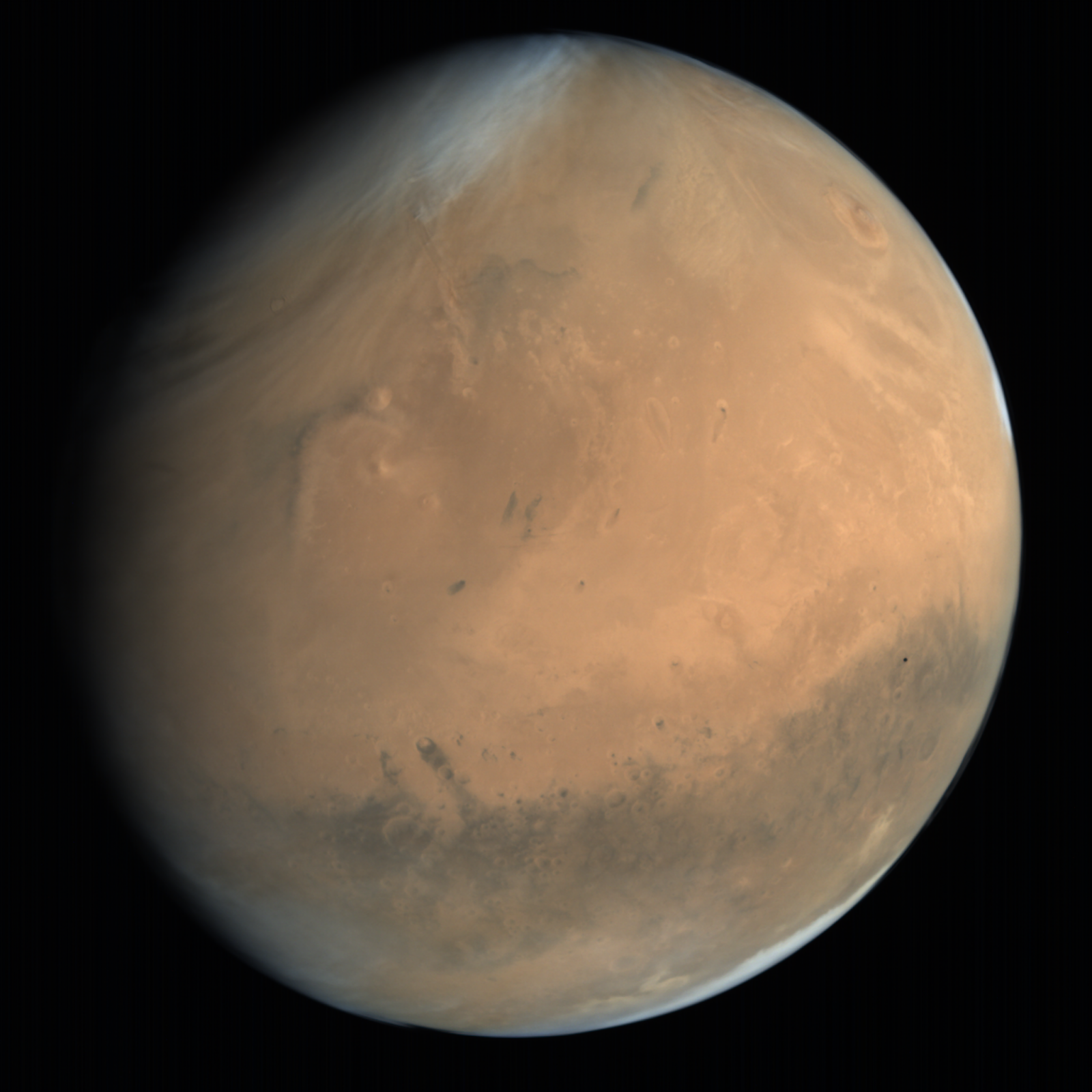
While rather tiny compared to NASA's rovers, I think Mangalyaan is also very cute! Yes, robots can be cute. In fact, my favourite photo of Mars was taken by the Mars Orbiter Mission last year. It shows the planet about ¾ full, with clouds, ice, dust storms, mountains, craters, and canyons all visible. This volcano, Elysium Mons, is so tiny noone ever talks about it. It's twice as tall as Everest. This is Olympus Mons, which is three times as tall as Everest, and about as wide as India. This is Gale Crater, where NASA's latest rover lives. Even better, there is a tiny black speck to one side - the silhouette of a moon in front of this world!

(Credit: ISRO)

Today, there are 7.6 billion humans on Earth, of which 1.3 billion are in India, almost a whole world in itself! Perhaps 100 billion humans have ever existed. Let me be perfectly clear, there is no physical way that any but the tiniest fraction of today's 7.6 billion will ever fly to space. To this day, 315 rocket launches have flown humans to space. In total, 536 people have been launched into space, some of them up to eight times, which seems excessive. And only twelve of those have walked on another world, the moon. Of those twelve, only five are still alive - it happened a long time ago.

Even if all of our dreams, and all of Elon Musk's dreams come true, maybe one in ten thousand humans will ever go to Mars. Maybe only one in a million. Correspondingly, most of our concern and technological effort must address the reality that humans must keep Earth habitable. But while billions will remain, perhaps some will go to build another city, another branch of humanity on other worlds. Making life multiplanetary is a worthy challenge and, along with preventing our own extinction, probably the most important evolutionary milestone since oxygen breathing life first evolved. I see no reason why India could not contribute its proven expertise and spirit to this enterprise!

***

I want to tell one more story about the very real dangers of apparently politically neutral technology. This story is a bit of a downer, but I chose it because it has an important point. Many technical people like to think of themselves as politically neutral, or apolitical. Afterall, a plane or a valve or a computer program is an idea that exists independent of ideology, except perhaps the basic philosophy of empiricism. In particular, no-one could describe a tool like a power drill as having a political party affiliation! How preposterous. Yet this attitude is not accidental. It is very unusual to find an academic mentor in the sciences who is even prepared to admit that they have political views, let alone specify what they might be. Why? I can understand why public servants employed by taxpayer money would be careful to avoid accusations of partisanship. Political policy does materially affect the wellbeing of our fellow humans, so there is something here that's worth thinking about.

In about 2010, the Defense Advanced Research Projects Agency, or DARPA, started up a program known as Nexus 7. DARPA, founded in 1958, is a secretive US agency whose mission is, to paraphrase, "no surprises." That is, anticipate and develop secret technology so that, in the event of a future world war, the US could not be blindsided by a secret weapon. Many of DARPA's inventions have subsequently made it into public view, including the internet, street view, graphical operating systems, GPS, voice recognition, holographic displays, TOR, and stealth technology. To be clear, I only know about this project through reading newspaper articles!

At this time DARPA, under the leadership of Regina Dugan, was aggressively pursuing academic partnerships to modernize its outlook in machine learning, and wanted to find ways to help fight and ultimately end the war in Afghanistan. Some of my colleagues at Caltech, motivated by pacifism, signed up to go to Afghanistan and help develop these projects. One of them was intended to try to understand the flows of money. In particular, variations in prices of food seemed to predict local unrest. If you can predict unrest, you can prevent it, and that begins the process of trying to break the cycle of violence that has persisted in some of these places for generations.

Further, perhaps half a dozen bomb makers producing roadside IEDs were obviously being paid somehow. But cash transactions are hard to track in a cash-based economy with electronic espionage. In essence, there are a huge number of unknowns and a few constraints. Traditionally, solving this linear algebra problem would use least-squares, since in engineering this helps to minimize the energy. But in this particular problem, applying least squares doesn't work because it would assign small payments by nearly every citizen to nearly every other citizen - something that doesn't occur in reality.

The insight was the development of compressed, or sparse, sensing, now used for all kinds of things, including image enhancement in every phone camera. Most people never interact financially with most other people. Take the same data and close it with the L1 norm rather than the L2 norm, and a remarkably accurate picture of the missing information emerged. This project was deemed successful, the people I knew rotated off the project and resumed their PhD work in the US.

Ultimately unrelated extrinsic factors led to the loss of Jalalabad and an escalation of violence, despite best efforts to solve it. Sometimes despite perfect moves you still lose the game.

Fast forward a few years. Although my former colleagues have long left, the projects continued to be developed, and related algorithms were applied to mobile network data. Again, most people only routinely call or text a handful of other people, so analysing the network topology can help determine the identity of the users of various mobile phones, even if their names weren't known or confirmed through more traditional James Bond-style spying. For reasons I don't know, this method, which worked quite well for financial data, was pitched as being a terrorist-finding tool with mobile data, despite a lack, to put it mildly, of peer review. The US forces proceeded to drone a bunch of phones, and the people standing near them, in Pakistan and Afghanistan that had "terrorist patterns of use." This is the sad part. It turns out that there are other user profiles who also have sporadic bursts of activity calling dozens of people: Wedding planners.

This story isn't intended to discourage technical innovation, because there's always a chance that something you touch will end up being used to hurt someone, and most people won't get any sort of say in how their widget is deployed after they deliver it. It's merely to illustrate that even the lowest ranked engineer does get a say in the future they are building, as they build it.

***

For the last part of this talk, I would like to zoom out and take a broader view of technical efforts in general. When we look at the gradual, incremental achievements of the past, the fruitless careers, the backwards steps in progress, it is easy to become discouraged. How can I be sure that what I'm devoting time and effort to will have any lasting effect? Well, the short answer is that on a long enough time scale, everything averages out to zero, even for Elon Musk or Steve Jobs. This can seem a bit depressing.

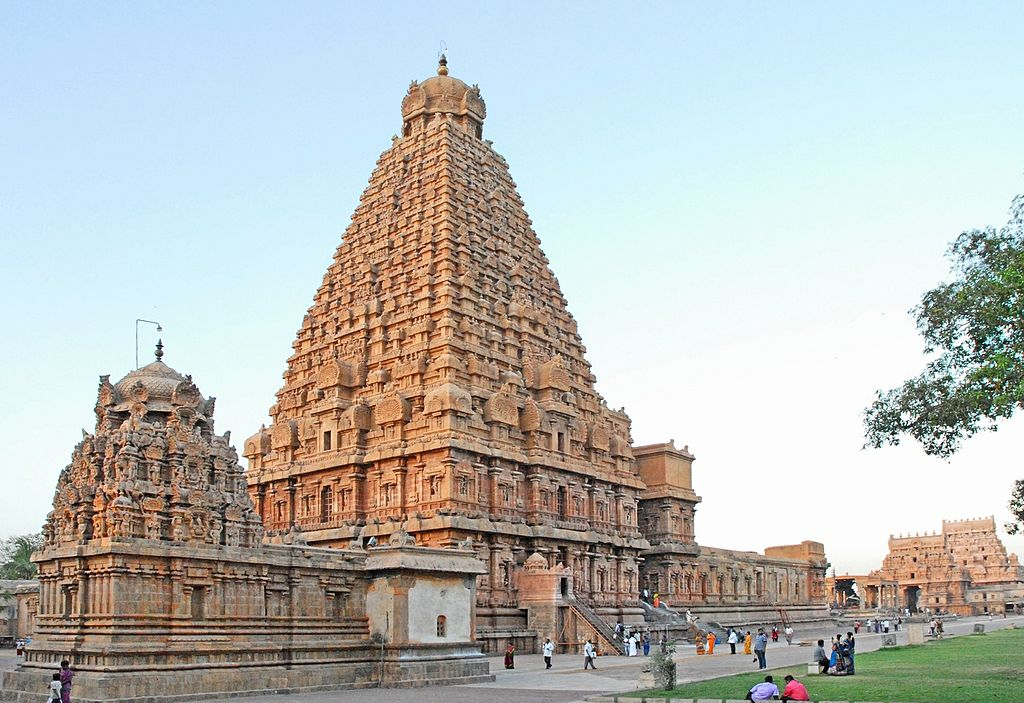
(Credit: Wikipedia)

But I had a thought yesterday, when I visited the Thanjavur temple. Consider the gopuram, that 80 tonne monolith at the top of the tall tower, and our confusion and uncertainty about how the builders put it there, a thousand years ago. There will, inevitably, come a time when our knowledge, identities, and methods are just as mysterious to people then as the builders of Thanjavur are to us today. But consider the present day. If the builders of Thanjavur could build all that in only seven years, what can we, with our internet, mechanization, computers, and science build in seven years?

Further, as far as we know, humans are the only entities in the universe capable of self contemplation and progress through technology. And we are fortunate to live in an era where we are already beneficiaries of so much painstaking progress. We can live long, peaceful lives relatively free of deprivation and pain. What I am trying to say is that there is an art, a performance art, to practicing science and living a technically contributive life. This is optimism in practice. A belief that our children will inherit a better world, and a belief that it's worthwhile to expend our blood, sweat, and tears to ensure that we leave this world better than we found it.

So why be technical at all? Why not let other people invent cool stuff? I will tell you a secret. Technically literate people have a special advantage. Through the practice of technology, we actually have a magical power, the ability to imagine a better future, and then to bring the rest of humanity forward with us. In fact, you can think of technical ability as a special kind of democratic power, a power that naturally comes with a level of responsibility. In addition to the vote you cast every few years for your own government, every code commit, every drawing release, is another vote for a particular type of future.

In the US, and Australia, and maybe in India, there is an unaccountable and irrational nostalgia for a simpler time back in the distant, and imaginary, past. Back when things were supposedly simpler and life was slower and we all lived healthy agrarian or even hunter-gatherer lives. Well if you've ever had a toothache you know just how shallow this romantic fantasy is.

In 2018, the human species faces all kinds of truly daunting challenges. These include, but are not limited to, resource depletion, climate change, poverty and greed, food security, internet security, energy security. Regressing to an agrarian way of life is not an option. Mass starvation is not an option. Zombie fantasies are not an option. Mass death is not an option.

The only way forward is up, meaning emancipation through technology. We need every brain  working on these problems. Not just US brains, or Australian brains, or Indian brains. Not only white brains, male brains, christian brains, or rich brains. And not just physicist or software brains. We need them all. I challenge each and every one of you to think about how much more we can all do. What we can do to promote the diversity we desperately need to transcend the human challenges of the 21st century. There is no one way to be a scientist, engineer, or technician. In particular, please don't try to duplicate my poor example and numerous career mistakes! There are an infinite number of paths to technical enlightenment.

***

Finally, what can we look forward to in 2050, now only 32 years away? Here are some things I would personally like to see. This is in some sense a fantasy, but it's not forbidden by the laws of physics. I feel they are very achievable.

  • Zero humans living in poverty. A sufficiency and dignity for all.
  • And yet, all humans treading lightly on this one Earth we share.
  • Ecologically conservative and restorative industry.
  • Renewable, clean energy and recycled resources.
  • Zero humans dying in war.
  • Zero humans suffering oppression or injustice.
  • Security, safety, and freedom on the internet.
  • Access to affordable, efficient mass transportation. Shoutout to hyperloop!
  • Humans living and working in space, on the moon, and on Mars.
  • Things we haven't even dared to dream of yet.

It's not enough to wish for these things. As technical people, it is our responsibility to build this future. We can, and we must, do everything we can to see these better futures brought about. I look forward to seeing you there!

***

Alright, let's move to some questions. I want to get through as many as possible, so please keep them short.

I am sorry if we didn't get to your question. Ask me on Quora or Twitter? Thank you!


Wednesday, February 21, 2018

Science fiction short story - That Final Moment

I wrote this in 2016 and finally decided to publish it on this blog. It was my first written foray into the mechanics of deep space industrialization.


THAT FINAL MOMENT
by Casey Handmer

"I am Sita." She could write a monologue of thoughts, organized by each activity at the moment of ideation. Identity and thresholds seemed to go together. She ran the flow check necessary to use the Mars surface airlock safely. Open valves to dump lock atmosphere into the air processor. Close valves. Check pressure on both gauges. Check the spacesuit was, in fact, not pajamas. Well sealed. Comms, temperatures, smell, pressure holding. Ears didn't pop--always a good sign.

She reached for the external door locking wheel and put her weight behind the mechanism. It ran smoothly enough. With practiced motion the door unlocked, opened inwards. A tiny puff of dust, cut by slanting rays of faded sun. She stepped through the narrow portal, like a submarine bulkhead door. Like a birth canal, no wider than it had to be, at least for people. Their machines birthed through a different door.

Vivid memories of her former life on submarines surfaced and just as suddenly faded into the depths. Between this outpost and those underwater islands of humanity, there was something fundamentally insular about society. Sita was here, now. She stretched towards the open sky for now there was no roof over her head. A few light steps over the trampled ground and, with intake of breath, a staring at, an acknowledgment of the horizon. If a problem is spherical, it is hard to see all of it at once.

Sita's problem was Mars. The outpost behind her looked no more worn than it actually was. Sita had accepted the mission with eagerness. Go to Mars, live there until something breaks beyond repair, then bail out. If you could. Sita had not flown with the exploration missions. She had waited on Earth and then flown with the outpost. She herself had explained it many times. "How do you solve the problem of machines eventually breaking more frequently than they can be fixed?" On Earth, all machines would eventually be retired, but on Mars, the very air was produced by a machine.

Therefore, an outpost on a dusty plain where humans lived indefinitely, with resupplies of parts and sometimes crew, every other year. Sita and a few others lived in this experiment. Or the experiment lived in them, since the blood and toil that kept the concern operational was the sheer dexterity of human ingenuity, their own capacity for biological regeneration, far better than any machine, and occasionally a liberal dose of the will to not-die-that-day.

And, she mused, a gigantic nuclear reactor. Every machine, every light, every pump, every vehicle, every robot--they all needed power, and their nuclear reactors provided it. She could see a heat shimmer beyond a nearby hill where they operated and quietly irradiated the surrounding area. Heaven help them if it ever broke down!

She scuffed the ground. How many years ago had they trenched the ground here, laid the power cables deep enough that frost creep and spring blow and wheels couldn't damage them? That tractor had been trouble from the start. Like every other machine, they could and did completely disassemble it with basic tools they had in their inflatable workshop. But, like nearly everything else they had back then, it had broken too frequently to be worth repairing.

Sita had dragged it out to the boneyard of orphaned machinery, a place of sculptures, metaphorical monuments to industrial ambition and too much clever complexity. There, with dozens of other unloved machines left by parents too busy to keep them alive, they waited only for oblivion. Which was worse? Gradually harvested for scrap, whittled away to nothing, and yet pieces living on as parts of other, more valued equipment? Or forever neglected, until sun and sand and aeons abraded the paint, wore away the shell, the chassis, and scattered every molecule in a wide, flat, glittery sand dune that ever so gradually slunk downwind from the outpost in shame?

Of course, Sita reflected, being recycled in some sense only delayed the inevitable for obsolete machinery. And indeed, explorers had passed, their bodies unretrieved, sometimes. Caught out at night, perhaps, and frozen to death. Or fallen and breached their suit. Or broken bones. Or poisoned by bad air. Or burned. So many abrupt paths to the end.

Sita had found one once. Kind eyes in his frozen, perfectly preserved face stared up through his wind abraded helmet, right into the void. Right into Sita's own black eyes. His peaceful expression reflected none of the ambition that must have driven him to Mars, to die out here alone. Her suit's profile, a hemispherical head with burning flashlight eyes, reflected in the glass of the deceased. The yet living and the dead superimposed in imago, like one hand covering the other. They placed him in the burial ground, opposite the boneyard and obscured beneath the crumbled surface.

Sita never found the other bodies. In her mind, they gradually transmuted from cogito ergo sum insularity to landscape. Wouldn't they all eventually find themselves blasted to smithereens by the passage of time, condemned to wander the northern latitudes by seasonal winds? Perhaps, given the risk of explosive decompression, that was why thoughts of identity and more importantly its willful continuation pervaded during airlock operation.

Sita's mind and eyes wandered the landscape as she stared into the horizon. Their outpost was spread out over a large area, a perfect island of solitude within a world that was, for now at least, empty. Positioned in a broad valley between distant ranges, their faded peaks in the distance. A tiny speck, a blemish, precarious in a nonsense landscape that told a garbled saga of dust and ice and wind and countless ancient impacts.

Her booted heel scratched at the ground as she turned to take in the view. She felt the sun's weak warmth through her pressurized carapace, her inner reptile took a second breath. In the distance, beyond the greenhouse, beyond the burial ground, she spied their return vehicle. The rocket sat there, inert, waiting to take them back to Earth. It had waited a decade. Four times, Earth had swung across the sky, daring them to cease their foolishness and fly home. Four times, they had duly performed the procedures to wake the sleeping behemoth and prepare it, just in case. Four times, Earth had passed out of range, its pale blue dot fading amongst the rest of the stars, and their loyal rocket had been put back to sleep. Sita wondered if the rocket could tell that Earth was no longer really home. That morning, something had changed. Everything had changed.

Sita felt she could have been happier. Against the odds, that same morning her mission had been deemed successful, by the squints up on the big world. Her team had proven the design methodology that could keep them alive indefinitely. Now, humans could come. Humans would come. First by the dozens, then the hundreds, then the thousands. An unstoppable rain of humanity from the sky. And her maintenance protocols would keep them alive, most of them, while they built their mines and refineries and foundries and factories and farms and cities, until humans could live on Mars without continuous resupply voyages from Earth.

Industrial autarky. Involuntary industrial autarky, necessitated by the hundred million miles of space between the nearest money and her. At least until someone made a warp drive or something. Then people would come by the million. Sita felt numb at the prospect. For a decade, just her and a handful of others under the Martian sky. Long rover traverses, endless testing, breaking, and repairing. Blue dawns to red days to blue dusks to black nights. Nothing but a planet and a mind, her mind, in it. Building Field Camp 18 in the next valley, confirming the aquifer. Building out a farm, growing food. A lifetime of learning and building and fixing and learning all over again.

They had one hundred days left. A message from the pale blue dot, confirming launch after thundering launch sending cargo and passengers to Mars. One hundred more days of relative solitude, before the new Martian hordes landed at the field camp aquifer, unfurled a gigantic tent over the barren plain and made the frozen desert bloom. There would be so many new faces. What does a face even look like? From the outside?

Sita didn't have to wait around to find out. There were still tasks to complete, systems to check, failures to diagnose, procedures to document. And Sita still had one hundred days of solitude to tread the rocks beneath her feet. Some were dark, scattered, their faces faceted and scored by wind. Some were rounded, perhaps some ancient alluvial disaggregate. And beneath them all, more rocks. Rocks on rocks, all the way down, enough rocks to hold a person to the planet's surface with a gentle, forgiving force. Sita could jump right over a rover in the three-eighths gravity. Not such a good idea, she thought as she eyed the dozens of patches holding her pressure suit together. It would be thought exceptionally bad form to leave the ranks of the living just before things got really interesting.

Sita stared beyond the return vehicle, right out along the almost featureless plain until the horizon's pastel browns and reds smeared ground right into sky. The horizon on this tiny world was never that far away. She could walk over it before lunch, find the outpost completely out of view. She could even make it back without running out of air, probably. Her helmet's glass fogged slightly with each breath. It was never warm outside. She checked her gas and power levels, then sat down on what had once been a voice command mainframe interface, its little silicon brain zapped by a cosmic ray. It had been a slow death, rambling ceaselessly in idiomatic Esperanto while Sita attempted repair before it, too, succumbed. Now it was a bench outside the airlock.

Sita leaned back and looked up towards the zenith, where the sky is always white. Why does the universe contain introspection? Why so little? Why at all? Her eyes looked through a few inches of air, a millimeter of polycarbonate visor, the pitifully thin Martian atmosphere, and then infinite space, where the very first photons were stretched beyond the limits of human eyes. If you look far enough in any direction the view is deepest red.

Metal robot oblivion dust is probably more glittery than the scoured remains of dead Martian explorers. Sita wondered how glittery she'd end up. If she lived long enough for the new city to get its biosphere up and running she'd request they recycle her remains. Nitrogenase and tyrosine are hard enough to come by without dumping them onto the frozen, ultraviolet blasted surface. But how was being eaten by worms any different from her recycling parts of broken machines? Were not humans machines themselves? Thinking, feeling, self-repairing and optionally self-replicating machines, but machines nonetheless?

Sita could cut off her oxygen supply with trivial ease. She could purge her suit's fuel right into the dirt. There would always be new ways to die a pointless death on Mars. But nothing could stop the new ships bringing new people to their new world. Sita's mission had shown that humans could live on more than one planet. Her identity was now part of the tapestry of human destiny. Something to mull over.

Sita stared at the sky and remembered the site as it was before they had built the outpost. She liked its design, a central hab connected to a variety of satellite structures by cylindrical tunnels. Against the odds, a tiny patch of human-habitable volume in an unlikely corner of the universe. Her project, her refuge, her home, her triumph. As much as she empathized with her ragtag family of machines, only flesh and blood could rebraid itself into humanity's raging torrent. More than her physical constituents would survive her passing. The contribution of her life's labor to the pool of human achievement might even someday enable her to find meaning despite the inevitability of both death and self pity.

Sita once more looked into the distance, where together they would all build their new city. In her mind's eye she saw their arrival on Mars. They would come, just as the previous cargo resupply missions had come. One by one the ships streaked across the sky. They came as a bright dot, then an expanding fireball, each brighter than the sun. Then the crack and jolt of the sonic boom, the roar of engines felt through her feet. The sun careened off the panels of each ship as they hovered, descending suspended on point-like engine glows and fat columns of dark, rushing smoke. And when the last of the ships had landed, their engines cooling but their effervescent contents not yet disgorged, Sita alone would savor that final moment of silence.

Thursday, February 8, 2018

Falcon Heavy and the era of post-scarcity heavy lift launch

Yesterday (February 6 2018), SpaceX successfully launched the Falcon Heavy rocket. 

This rocket, first publicly announced in 2011, had been a dream for so long I almost could not believe it was only a week away. Then a day. Then an hour. At the moment of lift off, 30 colleagues and I were crammed in a tiny conference room around a laptop with tinny speakers. Several of us had worked on this particular vehicle over its protracted development. You could hear a pin drop. 

And then the 27 Merlin engines roared to life. It flew to space. It staged successfully. It landed two boosters on the ground, and narrowly missed the hat trick. The upper stage flew a whimsical payload of space suit, star man, and Tesla Roadster around the world (and over Australia) once before firing for a third and last time over its home in LA, boosting it away from Earth toward the orbit of Mars. It will orbit in empty space for many thousands of years.


Image: SpaceX YouTube. 

What does this mean? SpaceX does hype well, and millions of people tuned in to watch the launch. People reacted to this concatenation of the impossible in many different ways. I felt a profound catharsis, a joy, a renewed faith in humanity.

As usual, media got a handful of details wrong. This is not the first car ever launched - but it is the first production electric car ever launched! The French mounted (but didn't launch) a Renault once upon the Diamant BP4 rocket, NASA launched 3 electric rovers to the moon in the early 1970s, the Soviets landed two nuclear powered robotic rovers (Lunakhod) on the moon, the Chinese one solar powered rover (Yutu), and of course NASA has also dropped a total of four electric robotic rovers on Mars (Sojourner, Spirit, Opportunity, and Curiosity). 

Second, the Falcon Heavy has been described as the most powerful rocket since blah. As far as I know, it is the most powerful liquid fueled American rocket since the Saturn V. Other rockets with greater thrust include the Soviet N1 rocket, which experienced four catastrophic launch failures in the 1970s, the Soviet Energia rocket, which launched twice in the 1980s, and the space shuttle, which derived most of its thrust from solid rocket boosters rather than liquid engines.

It also has the largest payload to orbit of any American rocket since the Saturn V. Technically the shuttle had more mass in orbit, but a lot of that was shuttle, and its total payload was, at 25T, comparable to other modern rockets. Officially, Falcon Heavy can deliver 64T to LEO in expendable mode. 

Usually, though, Falcon Heavy will be used in reusable mode. In this configuration, it can launch a similar payload to a single stick Falcon 9 expendable launch, or around 25T. Provided that recovery is usually successful and turnaround on the ground quick and cheapish, this mode for medium lift launch is extremely competitive. 

SpaceX, enjoying a high profile, has an unusually high concentration of public pundits, commentators, and self-appointed experts who are always ready and eager to deliver a verdict on a mission or design choice. Let me add to their chorus and say that launch is really hard, and getting it right the first time is just extraordinary. It is impossible to overstate the magnitude of this technical achievement, particularly given that it was privately funded and relatively quickly developed. It is always easier to critique than to build, and I was somewhat dismayed by the usual twitter outrage over everything from the carbon footprint of the rocket to the colour of the car. 

People, SpaceX *deliberately* chose to be provocative. Why? Because they're competing in an industry against incumbent heavyweights who, instead of using their launches to sell electric cars or liberate the launch market, lobby for protectionist policy and sell weapons to third world despots. If you think humanity has a future, that future involves space, and it has to be done somehow.

So, of course there was Elon's red Tesla sports car driven by a mannequin in a space suit with cameras on every angle, a bunch of memes scattered around, and a tiny hot wheels Tesla with a tiny space suit on the dash. I wouldn't be that surprised if this particular car was retrieved in flight and plonked in a museum before I die of old age, or internet outrage.

This launch and its excitement was important. It showed the two generations born since Apollo that space was cool again, space is relate-able, and space is exciting. NASA does space very well, but NASA is beholden to a bizarre incentive and funding structure, and as a result must be extremely risk averse in both mission execution and PR. NASA and SpaceX have formed a productive partnership in part because, for cents on the dollar, NASA has been able to outsource a lot of development and branding risk to SpaceX. 

As a serious space nerd, I was born in the late 80s, an era of shrinking ambition and fading glory. As I learned more about the practice and prospects of space travel, I grew more and more despondent. There was every chance I would live and die without seeing the next big step. This launch was not that step, but it foreshadows it. I can now live with hope. Hope to see, and perhaps to participate in, this really exciting adventure. Maybe Australia will even get a space program?

The single most overwhelming fact about Falcon Heavy is its size. During the shuttle era, there was a belief put into practice that space activity could be modularized and large stations assembled in orbit. That belief has been tested now for 30 years. It is possible, but it seems that, unless there is no other way, assembling stuff on Earth, where one can breathe, is preferable. I am currently working on a book chapter dealing with ideal division of labor by environmental hostility, but the bottom line is that:

"There isn't a problem in space that can't be most effectively solved by building an even bigger rocket on Earth."

My generation of space nerds has spent decades working out how to design ambitious missions with small, bite-sized launches. Falcon Heavy is big enough that it significantly raises the bar for harebrained space activity design. And SpaceX is deep in development of the BFR, a rocket so mind-numbingly huge that it can launch perhaps six times as much as Falcon Heavy. Instead of spending a decade playing space lego in LEO, a rocket like this can launch an entire neighbourhood in fifteen minutes. 

The final point I want to make goes back to the cost efficiency and reusability of Falcon Heavy. Falcon Heavy is really just a special center core that is compatible with any two normal Falcon 9 boosters that happen to be lying around. Provided that SpaceX has perhaps half a dozen Falcon Heavy cores, plus steady upper stage production, it can perform essentially on-demand heavy lift launch. SpaceX has already successfully recovered 21 Falcon 9 boosters - more than half the total they've ever flown. 

We are on the cusp of a paradigm shift in launch. Today, launch is so expensive and missions so difficult and dangerous that program management necessarily has to function in an incredibly risk averse way. In the early 1960s, the US launched dozens of Ranger and Surveyor spacecraft at the moon in preparation for Apollo. What is the difference? In the 1960s there was an essentially unlimited supply of ICBMs that could be used to launch experimental, iterative, minimalist designs. 

Today, a single space robot carries the hopes, dreams, and careers of hundreds of engineers, scientists, and technicians. But there's essentially no reason why previously flown systems, such as the Curiosity Rover, can't be mass produced and one with custom instruments sent to Mars for every university on Earth. It is my fervent hope that Falcon Heavy symbolizes the return of launch supply abundance and post-scarcity robotic space exploration. One Falcon Heavy launch could easily fly six Curiosity-style rovers or literally thousands of solar powered drones to Mars. We're going to need to upgrade the Deep Space Network!

I would like to see NASA, ESA, JAXA, or any other funded agency sign a contract with SpaceX today that guarantees a Falcon Heavy launch to every planetary exploration target on every launch window - a steady campaign of about one launch per year per planet. With a steady pipeline of launches guaranteed, the race will be on to fill each one up with a variety of complimentary and innovative payloads. Let's do this!


Image: Wikipedia.

Sunday, February 4, 2018

Rocket launches!

This post is the first in a series describing a number of recent projects that I've recently completed! This one is to do with rockets.


Some time in 2015 I was reading some space exploration history and came across this photo on Wikipedia.


It depicts the Redstone and Atlas rockets launched with humans on board as part of Project Mercury - the first six flights to space by US astronauts - at their moment of lift off. At this moment, the rocket is supported entirely by hot expanding gases at its base and is pushing hard to escape the Earth. Of course no crewed flight has ever completely escaped Earth's gravity (yet) but getting to orbit is just staggeringly difficult and amazing.

Here's another photo in a similar vein.


These are the launches in Project Gemini, ten crewed launches by Titan II to Low Earth Orbit to test technologies for the Moon landing. Each flight tested a variety of things, such as space walks, docking, control, orbital rendezvous, and the systems that made them possible. 

The following Apollo program used two types of rocket, the Saturn IB and Saturn V. The Saturn V was the most powerful rocket ever launched, and here's a photo of every flight.


The first two flights, and the last flight, didn't have people on board. But Apollo 8-17 took three humans each into space. Six of these flights (11, 12, 14, 15, 16, 17) landed two people on the moon, a total of twelve humans who have ever walked on another rock. As of February 2018, seven of these have died of old age, leaving just five alive. Given the time it takes to develop space exploration programs, there's a good chance that even if China, Russia, the US, or any other country began development in earnest tomorrow, all twelve Apollo moon walkers would be gone before anyone else landed there. Food for thought.

After Skylab was launched on the last Saturn V flight, the three remaining vehicles were parked in various museums or fields and the US space program turned to the space shuttle. Over about 30 years, the five shuttles launched nearly 800 people into space on 134 separate successful launches. One more launch was not successful, and one re-entry was also not successful. The shuttle was retired in 2011, and since then no astronauts have launched to space from US soil. 

Hopefully this won't be a permanent state of affairs. Several entities, including NASA, Boeing, SpaceX, Blue Origin, and Virgin Galactic are developing human rated space vehicles which are due to fly in the next few years.

Still, I was captivated by the minuscule number of rocket launches that have *ever* launched people to space, so I decided to make a version of the images above that included every single launch. 

This process began with identifying every launch and a photo online and collating them in a gigantic spreadsheet. While I was at it I wanted to collect metadata - the who, when, where, why, and how, and combine this somehow. And since I was being ambitious, I have a separate spreadsheet for Soviet/Russian and Chinese launches of humans into space. In total, a meager 321 flights to date. Fact checking and proof reading all the metadata took FOREVER. But one really cool side effect was being able to make a world map with all the landing sites, colour-coded by program.


This is what the metadata formatting looks like in the final version. If you find any errors, be sure to let me know!


I quickly realized that photos at the moment of launch and the same perspective, while being in some cases difficult to find, are also very similar and thus monotonous. So I found a variety of photos of launch that captured some of the power and diversity of the experience. In 2011 I personally witnessed the last launch of the space shuttle in Florida, and it is really something else, even from 10 miles away.

After two years of neglect and then a few months of work, I'm pleased to report that the US launch poster is complete, and indeed hanging on the wall behind me! Moreover the metadata poster is also done. The full size images are available on my website, but this is what they look like!


And the version with all the metadata. 


As an important note, Challenger's final flight is not included in this list as it did not make it above 100km, the boundary of space, before catastrophe struck. By this criteria, other failed missions including Columbia's last flight, Soyuz 1, Soyuz 11 are included as they reached space before suffering fatal accidents during landing. Finally, Soyuz 18a, which suffered a staging fault but reached an apogee of 192km before (barely non fatally) crashing to Earth, would also be included. Early X-15 flights which went above 50 miles (80km) but not 100km, are excluded.

I would love to make a Russian version or even a combined version, but unfortunately publicly available photos of Russian launches are often of very poor quality, or even missing entirely. If anyone can find me a photo of Vostok 3, Vostok 5, Soyuz 12, Soyuz 18a, Soyuz 22, Soyuz 23, Soyuz 34, or Soyuz T-14, that would be amazing. Russia is still regularly flying people to space, so the poster would probably have to have a few blank spaces towards the end!

In the meantime, I literally cannot wait for a new US human space launch so I have to update and fix the poster. I'm glad to have finished it off and I hope you enjoy looking at it as much as I enjoyed making it. 

Saturday, October 28, 2017

Principles of Mars urban planning (first pass)


Autarky Complete and indefinite self sufficiency, or breakout capability to reach such with trivial effort.

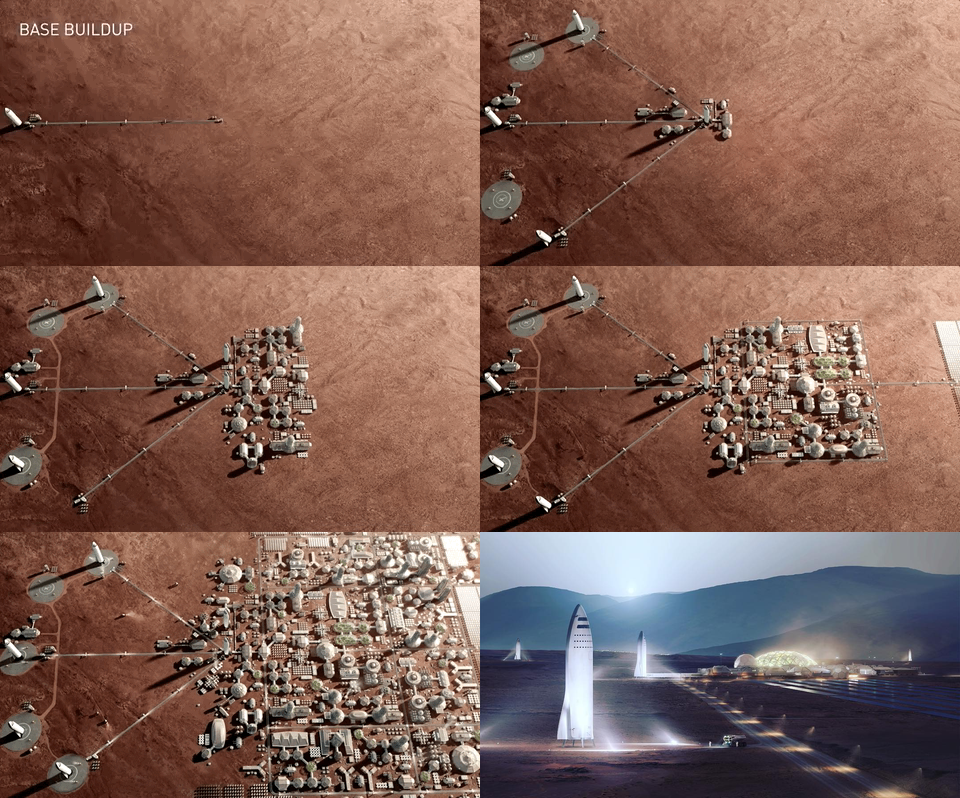
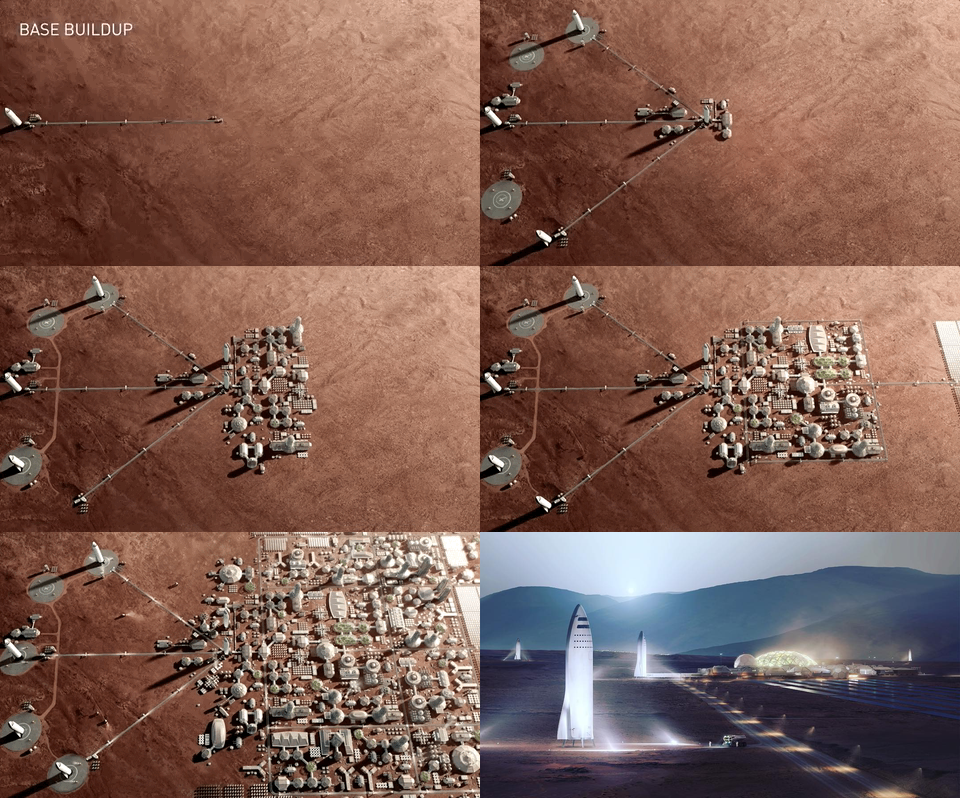
Regular readers will know that I occasionally discuss aspects of Mars settlement. This blog is inspired by some slides presented by SpaceX at IAC2017, which showed a SimCity base growing on Mars. Since Mars cities won't look like this, what will they look like?

SpaceX2017MarsBase.png

The first city on Mars is oriented toward rapidly developing autarky, to minimize exposure to the period of time when the base is dependent on shipments from Earth. This differs a lot from a mostly static Antarctic station outpost, and thus determines a lot about how the city must be planned. No one knows for sure how many people are needed for autarky, but is likely at least a million and will thus require decades of blistering growth. The primary role of fixed infrastructure on Mars then, besides keeping death out, is enabling growth.

In Estimating Mars Settlement Rates, I attempt to estimate growth rates using ship construction and utilization estimates, combined with a population/self sufficiency relation. The Earth Mars launch window occurs every 2.2 years, and initial population growth targets are a factor of 4 per window, later dropping to a factor of 2 depending on ship production, capacity, and reuse.

No city in history has needed or managed to sustain growth this fast. On Mars, the primary task is building more city for impending arrivals, and the primary constraint is labor availability. To maximize production efficiency, construction will need to use mechanization, automation, and wherever possible, a shirtsleeves environment.

All this is fairly obvious. Can we now draw a map? Not really. I don't know what a self sustaining Mars city looks like and I probably will not live long enough to find out. Indeed, attempting to learn from experience that doesn't yet exist is a pointless endeavor. But I will wave my hands a bit about the first decade of growth.

In addition to enabling its own maximal growth, the Mars city will perform every other kind of function from life support, transport, recycling, and entertainment to privacy, education, mining, manufacturing, communication, and emergency management. Some of these functions will be distributed, others more centralized. To maximize the utility of limited living space, for instance, compact apartment geometries can be imported from Earth, while landing and launch operations, and other especially hazardous activities, will have to be separated from more vulnerable or less defensible areas. Practically speaking, all functions span a continuum from local to centralized. Somewhere in the middle of this continuum is a point of mandatory separation, and it is here around which individual pressure vessels, habs, vaults, arcades, tunnels, small domes, and vehicles will be divided from each other.

All of the more local functions (health, education, libraries, sport, food, recreation, spirituality, music, common space, food distribution, non-transformative recycling, life support, temperature control, atmospheric processing, grid stabilization, communications, data storage, residential, non-hazardous industrial live-work spaces, etc) are ideally collocated. Since these all take place in a climate controlled pressure vessel, each pod is self-contained and resilient enough to withstand substantial extrinsic challenges, while nominally meshing and sharing capacity with adjacent systems. Vacuum ops are required only for initial construction and exterior maintenance. Everything else is done in shirtsleeves at minimal marginal labor cost.

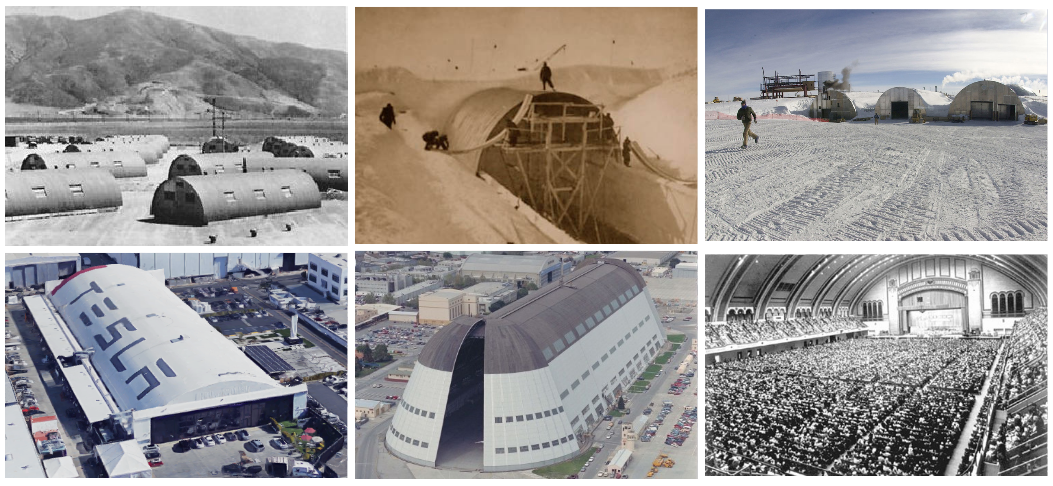
Opinions vary on ideal structure design and material, and methods will no doubt continue to evolve drastically during deployment. My personal preference is for hangar-like structures. A cylindrical roof spreads pressure, requires no internal support, can be shielded with dirt, and unlike spherical domes, has simple curvature and decouples ideal volume from geotechnical concerns in the foundation. With few or no windows, the interior could be somewhere between a modern submarine or a Vegas casino - both structures quite comfortable despite uninhabitable exterior environments. I envision structures ranging in size from Quonset huts to Hangar One at Moffett field and larger.

Arched structures of various scales (lrtb). Quonset huts, Project Iceworm, South Pole logistics archways, some building in Hawthorne, Hangar One, Atlantic City Convention Hall.

They may be connected by sealable bulkhead doors, while the roof can support solar panels or farms, especially the equatorward face of east-west oriented pods. They also have good volume to material/labor ratios. Building materials can range from curved prefab panels to locally produced concrete or brick. Brick vaults may be assembled robotically without formwork using a variety of techniques. Brick and concrete structures are compressional so need preloading before pressurization with several meters of dirt. Numerous other materials and methods are possible, including inflatables.

A growing Mars base, then, could be a densely packed crosscutting network of arched pods, with outskirts being built out at ever more ambitious scale. Manufacturing, chemical work and other non residential activities can be confined to dedicated pods, which can be repurposed (loft conversion!) over time as demand shifts.

Primary demand for water, (nuclear or solar) power, fuel synthesis and storage is associated with launch, so it makes sense to collocate much of this capacity outside the city. Pads with retractable hoses and robot arms can handle ship surface operations at each pad. If the city outgrows the spaceport, construction of new pads and pipes is much less labor intensive than demolishing and/or rebuilding pressurized pods. Spaceports will ideally be located 5-10km north and/or south of the city to keep east-west approach/departure paths clear. On Mars this is well over the horizon!

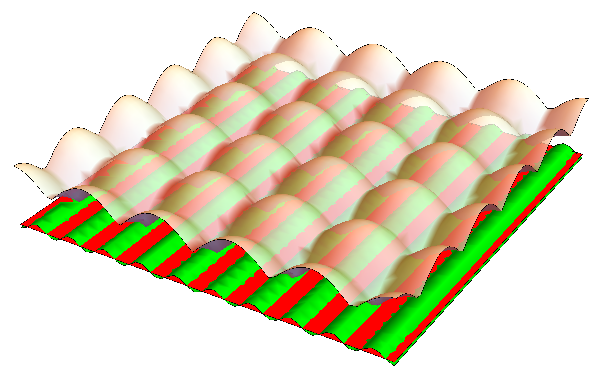
While it may be possible to house a million people under a square km of high rise roofs, and contain industrial processes under 10sqkm, farming on Mars, while not an immediate priority, will eventually require the bulk of covered land, perhaps 100sqkm. It makes sense to operate at the same pressure as the base, rovers, and suits (perhaps 340mbar) but with enriched CO2 for plant growth, and every other trick worked out by decades of dedicated research that hasn't happened yet! The primary difference between farming and habitation structures is that farms need transparent roofs, though ideally still with a layer of water, ice, or glass to mitigate radiation. I like the idea of transparent inflatables sealed to the ground at the periphery and anchored with cables at regular intervals to spread the pressure load into the ground. There's no reason why residential pods couldn't be interspersed between greenhouses. These structures, similar in concept to an air mattress, would look a bit like this.


One final consideration is scaling and congestion. Pod bulkhead doors are natural choke points. While clever neighbourhood designs will keep the base walkable for most activities (food, hygiene, schooling, training, recreation), movement of large equipment or lots of people may require progressively larger thoroughfares. This is a great problem to have, since that many people on Mars implies many other problems have already been solved! I think use of tunnel boring machines for subgrade roads and repurposing of legacy structures will prevent problematic congestion.

This is my first pass at Mars urban planning. I have no doubt overlooked many details and obvious issues. I'm interested in developing sensible system design axioms from which any given city plan can be more-or-less trivially derived. I don't know of much other work done with such an aggressive focus on growth, and I'm curious to get a better understanding.

Thursday, October 26, 2017

Visit to Ohio and Australia

Last week, C and I had back-to-back weddings and excitement. 


It started late Friday evening. We found our way to a conspicuously ultra-baseline economy flight, settled in behind an actual dog, and took the red eye direct to Columbus, Ohio. There, we met C's mother's new cat and celebrated the delightful marriage of E and G, whose subsequent honeymoon was, we hear, rather exciting!

I ate a belated birthday cake and then we flew back west once more, passing over spectacular canyon scenery, various faults, a Hyperloop prototype, and the Ivanpah solar thermal plant on the California-Nevada border. Back in LA the sky was a bruised colour from numerous fires, and we found our way to a lounge in the international terminal. 

Later that evening, we boarded a flight to Sydney. I read a few books, watched the latest Pirates of the Caribbean film, and tried to understand system properties of urban planning in space. On the ground, we were unexpectedly collected at the airport by my parents B&A, and whisked off to our rental apartment. We had planned relatively little for the first few days so that essential tasks like finding suits could be taken care of. I squeezed myself into a sharp blue number, while finding time for a few hikes, avocado toasts, and admiring the luxury cat home my parents transformed their flat into.

All too soon it was time to dress up and help my brother M into a matrimonial state. The wedding went off without a hitch. Or rather, only one hitch! We had readings from Song of Solomon and sang Jerusalem, and I didn't burst into flames. Then out to the harbour foreshore for photos, then the golf club for a fabulous dinner reception. Once again I was required to engage in some gentle brotherly ribbing as I gave a mercifully short speech welcoming my new favourite sister (sorry A) into the family.

C and my wedding in August was conducted on a remote island, so it was fortuitous that M was able to assemble the entire family in one place for C and my convenience so soon after. I enjoyed catching up with all the rellies, recharging my accent, and doing some sneaky research into my family's more mysterious origins on the continent. This will be the subject of a future blog post!

Well, we breathed a huge sigh of relief, borrowed dad's car, and set off on a road trip to see a bit more of Australia than we had on prior trips. Australian roads are good but the speed limits are horribly low and the drive thus extremely boring. We did see a good variety of wildlife though. 

First stop was the NSW central coast, where we gatecrashed my grandmother's choir rehearsal, investigated the giant pelicans, went for a hike, and attempted to avoid being dive bombed by seagulls while rowing around the bay. C and I cooked a huge dinner for my grandparents which was well received. One of the parts were potato latkes, which seem to me to be a lot of work to get out something which is basically a baked potato. 

After a couple of days we set out once more, traveling via Norah Head Lighthouse, where we got the best Australian accent lesson ever, to Buttai, a remote corner of the Hunter Valley where my great grandfather used to "go off the leash" with his brothers in semi retirement, reliving their incredibly poverty stricken childhood. Sooner or later the entire area will be strip mined, so good to check it out while I have the chance. 

We continued up the road, turning off on the Bylong Valley Way, a picturesque route through the Wollemi National Park, and also soon to be strip mined. At the town, we enjoyed a quick snack in the general store and explored a nearby graveyard. Almost all the graves dated from around Australia's regional grazing boom (1870-1930) but there were two fresh graves from 2015 in which a 97 year old couple had been (post mortem) interred.

Nearly there. We arrived in the late afternoon at my aunt G's farm outside Rylstone, finding noone but a lot of dogs and a half-cooked dinner. Perfect for exploration, so we found the new house site, the folly (a whimsical shed to contain us) and, eventually, living humans. 

There was much excitement in town because it was the start of the semi-annual international chainsaw large scale wood sculpture symposium. Later, we met a local who was involved in making a horror film documentary, so all things considered it was an ideal time to spend a few days sleeping in an isolated shed with no electricity, running water, phone service, or much but trees and kangaroos around. 

We enjoyed meeting the sculptors and seeing the incredible art being installed everywhere. We found a lot of large spiders, not all of them still alive. The biggest by far was Mr Tiny, a 4" wide huntsman spider who kept a few eyes on us while we took a shower. Later he refused to stand still so we took him outside. 

Overnight it began to rain, so the next day we suited up and went for a quiet walk down the main ridge of the property. This part of the world has some incredible "beehive" sedimentary rock formations. I have long had a secret ambition to hollow one of them out and build a cozy house inside. Once, I stayed in hollow rocks in central Turkey. It might be easier to build the house and then clad it in rock-like material. Getting useful windows that are invisible from outside would also require some finesse. 

All too soon it was time to head back to the city. We drove south and east via the Three Sisters near Katoomba, then spent a few hours at my old school talking to students about careers in STEM fields. That evening we gathered a few friends and gatecrashed my sister's house for an amazing dinner of purple risotto and music. The following day we relaxed with family, hung out with my old neighbours whose house is full of Antarctic art, and then flew back to the US. About an hour after taking off I looked out the window and saw Lord Howe Island cruising by! It's also a pretty cool place to visit, some time.

Recently it has seemed as though I make it to Australia about once a year. It's odd to see evidence of how much time has passed, but I'm sure the experience is similar for Australian residents who rarely see me! I have a few more years before my grey hairs become overwhelmingly obvious, I think.

Sunday, October 1, 2017

SpaceX update at IAC 2017


Late last Thursday evening I enjoyed watching Elon Musk deliver his second update on SpaceX's plans for Mars, or Making Humans Multiplanetary. If you haven't seen it, watching this video will make the rest of this blog much less confusing. I've written a bit about Mars over the years, and I'm always excited to hear what SpaceX has been up to.

A year ago, I wrote a blog about the plan as then presented, and I'm thrilled to see its evolution and write a bit about my new thoughts. I'm going to split this blog into three parts. The first will deal with the major development - money. The second will discuss the mission profile. The last will deal with Mars urban planning.

Money

In 2016, it wasn't immediately obvious how to pay to develop the Mars rocket let alone run the program. A couple of months ago, I wrote a blog on this topic. And I'm thrilled that not only did I not guess what SpaceX was planning (though I was closish), what they have proposed is a better idea than anything I wrote about there.

SpaceX plans to retire the Falcon and build only BFRs for every mission it can think of. It will redirect all its engineering know how to building the new system, and thus finally find a method to freeze design of the Falcon 9 at Block 5 without further meddling! Why is Falcon a dead end? It is not fully reusable.

SpaceX can build and sell the Falcon 9 for about $65m for a single expendable launch. While their recovery of the first stage can help their business both by decreasing their fixed costs by a factor of perhaps three and increasing the number of boosters available, they can do a lot more. Even if they could refly the first stage hundreds of times with marginal cost per launch, the fixed cost of the expendable second stage, which must be near $10m, means that they can't revolutionize launch completely.

Here comes the realization. At $65m a launch they're already crushing the competition. With the landing of the booster SpaceX lacks credible competition for at least a decade. They could lower their launch cost to maybe $20m a launch and nourish the microsatellite market, but the overall demand for launches is likely to remain fairly static in terms of mass to orbit. This is because thousands of cube sats don't weigh much compared to the really big communications and military satellites.

Enter the BFR. The BFR might cost $500m to build. But if SpaceX charges $65m a launch - the same as it is doing today - and the BFR is entirely reusable, then it can recoup that cost within the first year of launches and then some. The BFR only has to fly about 10 times to close the business case, and there's no reason it couldn't eventually fly hundreds of times. Given that the cost of fuel is somewhere around a million dollars per launch, SpaceX has a huge advantage, because customers have no ability to force the price down against other competition who already charges between four and ten times as much as SpaceX.

The BFR is hugely over specced for any launch currently manifested. With a nominal capacity of 150T to LEO and perhaps 40T to GTO, there isn't a satellite it can't launch. Hell, it could probably launch any existing satellite into the sun. Well, not quite - it turns out that's really difficult. Does it matter that there's no real demand for 150T to LEO launches? Does it matter that the BFR will thus fly 5% full for most launches? Not if those launches are profitable. The airline industry's costs are about 13% for fuel, so a single BFR launch may cost as much as $5m, but SpaceX won't have many of the airlines fixed costs, like hiring pilots. So while the BFR's capacity could enable huge space telescopes or probes to Saturn or gigantic space stations, it can also fly mostly empty, or perhaps carry SpaceX's own cargo (such as fuel or internet satellites) with its excess capacity.

Here's another way to think about it. Given the current cost of launch is 100x the fuel cost, a fully reusable rocket could be 100x too big and still make economic sense. Why 150T, then? SpaceX wants these rockets to be big, for moving stuff to Mars. But really large rockets are harder to build and transport. Elon tweeted that the BFR was sized to fit through a door in an assembly facility. The door size constraint also set the size of the Saturn V.

Since last year's presentation, the performance of the Raptor engine has deteriorated slightly, which probably reflects its development path. It's worth pointing out that while a heavier BFR with a less exquisite Raptor might not be very useful for flying back from Mars, it is still capable of flying there, and more than capable of launching stuff into orbit around the Earth. Big dumb rockets suffer a design constraint which is that small changes in structural efficiency have big (and bad) effects on overall system performance. A good illustration of this is the evolution of the Falcon 9 rocket. When it first flew, it could only just loft 9.5T into orbit. Today, it is rated at 22.8T, even though the underlying plan remains the same. What changed? The engines got a bit better, and the rocket got a bit lighter. Imagine if the Mars ship, designed to lift 228T to Mars, turned out for the first few years to only lift 95T? The mission would be over. Elon briefly addressed this in the talk, when explaining a benefit of on-orbit refilling of fuel and oxidizer. Even if the booster turns out to suck, the spaceship can still be fully fueled in orbit, retiring that developmental risk.

What about the possible use case for high speed transport on Earth? Very roughly, the numbers check out here too. Oxygen and methane cost about $200/tonne, and each rocket needs about 4000T of fuel. So taking the airline numbers again, each flight could cost $5m. If each rocket can carry 150T of payload, that's about 1500 passengers, so the per head cost might come to $3000, which is comparable to current long haul costs. Interestingly, over shorter distances, the spaceship alone (without the booster) could make a flight. So this seems to address current usage patterns and cost structures, though is much more marginal than the launch business. Finally, although Elon would no doubt love a launch pad near every city, they are noisy places and town planners generally did not provision for the 4-6 mile exclusion zone they require. My eyebrows remain raised!

So what are we to make of the other efforts to bring about industrial capture of disruptable industries? Even though SpaceX's plan is to capture the launch market with a fully reusable rocket ("shuttle done right") it has a few other plays in internet satellites (Starlink) and tunnel boring (The Boring Company). I think these efforts are developing technology which is important for the Mars project and may eventually become huge sources of revenue themselves.

Mission Profile

Elon Musk provided a few updates on the mission profile. As an example, the spaceship has enough ΔV to fly to the Moon and back without lunar refueling if refilled in an elliptical Earth orbit. This would take about three times as many tanker flights, first to fill up a tanker completely in LEO, then fly that to an elliptical orbit several times to refill the spaceship. A Mars ship launched like this could also take much more cargo to Mars, though its Mars entry would be proportionately more difficult.

I have heard some discussion about distribution of the engines and their uses. It is important to remember that the rocket is ten times heavier when fueled up, and the bigger engine bells work much better in space. Therefore, while one Raptor engine is adequate to land a nearly empty spaceship, all 31 on the first stage are needed to lift the whole stack off the Earth. Similarly, a fully fueled ship lifting off from Mars needs four high efficiency vacuum engines, while two sea level engines are adequate for landing.

I was fascinated to see the section on the Mars entry profile, as I wrote a somewhat less sophisticated model to study this problem some time ago. Landing on Mars is very difficult for all kinds of reasons, but attentive watchers may have noticed that the spaceship enters the atmosphere upside down. Why is that? It turns out that entering the Mars atmosphere at 8500m/s, as SpaceX plans to do, is easily fast enough to skip off and escape the planet entirely. The spaceship is a lifting body and uses its lift not to fight gravity, but to help gravity pull the vehicle closer to the ground as it tries to skip off the atmosphere. In my model I computed that the spaceship would have to fly below about 40km to be able to beat centrifugal force. In this way, the entering vehicle curves around the planet. When its speed drops below Mars orbital velocity (~3700m/s) then it gradually rolls to a nose up attitude, where its lift continues to dissipate speed until, falling straight down it lights the engine and performs a flawless landing on the surface. The 2017 spaceship has really pointy legs, so I hope they pick a really hard flat surface to land on.

The LEO refilling concept has also been simplified. Rather than two spaceships flying close along side like mating whales, they now back up to each other. A small thruster creates enough force for fuel to drain from the tanker to the ship. Alternatively, if the parking orbit is low enough, residual atmospheric drag could provide some ullage force.

Although this was not explained, I presume that the landing pads build on Mars have hatches beneath which coiled hoses can be lifted to the spaceship for autonomous refueling. For this and related reasons, I think the spaceship might need a robot arm. Similarly, while a crane on the ship can lower cargo to the surface, an established Mars base would have to have mobile gantries that can be rolled alongside like siege machinery to facilitate rapid unloading and loading of cargo.  

Mars urban planning
Finally, Elon had a couple of slides on how the Mars base would grow. I like the images. I like all space-related concept art. www.humanmars.net has some of the best!

SpaceX2017MarsBase.png
But these images are very Sim City. Will a Mars base actually look like that? What will a Mars base look like? Why? I talked a bit about Hab design principles in my Mars book. But Mars urban design is not an established field, and I think Elon was trolling us with this design. Indeed, I think SpaceX's main goal at present is to systematically derisk a human Mars mission to entice NASA and Congress to bite. Designing Mars bases is a few steps ahead. Moreover, SpaceX would like other titans of industry to join in and collaborate on these issues.

In particular, all those glass domes are just 200m from the landing pad! How far from the landing pads does the city have to be? What are its primary functions? What are its design principles? All these questions are good topics for a future blog. But clearly balancing primary needs for transport, power, water, fuel, and above all growth, are non-trivial!

Conclusion
I can't wait to see what comes out over the next year. This, the settling of another planet, remains the single most challenging, exciting, and worthy problem for all of humanity. I firmly believe that if my generation doesn't achieve this, the eventual extinction of humanity is all but certain. For more in this vein, check out these epic Wait But Why posts.