Saturday, July 21, 2018

The High Frontier: A Technical Critique

The High Frontier: A Technical Critique
Casey Handmer

"The High Frontier," published in 1976 by physicist Gerard O'Neill, remains the text on space industrialization. The culmination of a series of studies through the early 1970s, it presents a compelling vision for life for millions of people beyond the Earth. Today, in 2018, its themes continue to resonate. As several space companies position themselves to launch humans into space on a permanent, sustainable basis, I decided to write a technical critique of "The High Frontier." What works, what doesn't, and how will companies using it as a blueprint, including Blue Origin, have to adapt its ideas after 42 years of intervening discovery?

In this critique, I will:
  • Begin by restating O'Neill's arguments in the strongest possible light.
  • Examine the assumptions that underlie his quantitative estimates.
  • Identify any misperceptions in need of correction.
  • Establish feasibility bounds and figures of merit, in comparison to the original assumptions.
  • Explore ways in which the vision could be extended with a more modern perspective.

What is the High Frontier?
O'Neill paints a compelling image of gigantic cities in space. Consisting of large pressure vessels capable of housing thousands to millions of people, they would rotate to provide artificial gravity. Separate sections would be used for industry or high intensity agriculture with 24 hour sunlight, enriched CO2, and precision hydroponics. The living sections could be landscaped in any desired style - O'Neill is a particular fan of Tuscan architecture. Thus protected from the vacuum of space, people could conduct routine commerce and industry of practically any sort, freed from the constraints of Earth's gravity, limited resources and available space.


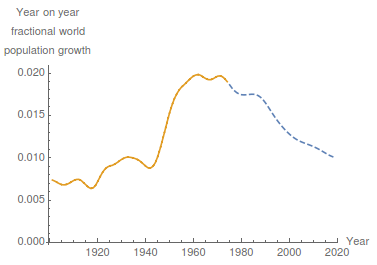
In 1976, Earth's resources seemed more pressed than ever. With population growth since 1945 averaging 2% per year, and energy consumption 7% per year, it seemed quite likely that by the early 2000s, Earth would be consumed by the throes of a Malthusian catastrophe. Expansion of industry to space, with its substantial resources, was a relatively cheap alternative. Not long after the book was published, growth stabilized at a more sustainable pace, and in the last few years energy and economic growth seems to have begun to decouple from hydrocarbon extraction, potentially freeing humanity of a major energy constraint.


A gigantic rotating space city would weigh millions of tonnes and could not possibly be launched in one piece, or even in sections from Earth. Once in space, it would continue to require a variety of raw materials to make up for gradual entropic losses, and a versatile, vibrant industry to process raw materials into any of the thousands of products needed to keep this island in the sky functioning.

While launching supplies from the Earth is possible, there are other sources of bulk raw materials in space with much less gravitational binding energy, including the Moon and asteroids. O'Neill envisioned an electromagnetic mass driver system that could launch small slugs of partially processed moon rock from a series of mines on the Moon, to the city somewhere nearby. He and his students even built a series of mass drivers to demonstrate the technology, which is today considered reasonably mature. Extremely high accelerations over short distances reduce the amount of infrastructure needed, while a stream of 1kg packets fired every second or so is adequate to provide a city with enough raw materials to make up for loss and use. Today, we know of numerous low energy transfer orbits which could convey material from the moon to almost anywhere in cis-Lunar space.

With industrial self-sufficiency sketched out, O'Neill turns to the question of economic self-sufficiency. Building and operating a space city would be enormously expensive, and would continue to require shipments of specialty components, such as computers, from Earth, essentially forever. What, then, could the space city offer Earth in order to complete the trade? While the city has a supply of moon rocks, O'Neill recognized that there wasn't concentrations of sufficiently valuable minerals on the Moon to make it worthwhile for selling in an Earth-based market. The city in space had become a solution looking for a problem.

O'Neill settled upon space solar power as the source of space-derived value necessary to balance the trade. Space solar power has certain advantages: The product could be beamed to Earth without having to go through the trouble of re-entry. The product was available essentially 24 hours a day, while on Earth the sun sets at night. Recall that in 1976, energy storage technologies such as batteries were barely on the horizon.

In addition, with 7% per year growth in energy demand, the US and every other country was looking at major infrastructure investments to meet demand for the foreseeable future. The entire grid would have had to have been overhauled every few years, at significant expense.

The final part of the problem that O'Neill examined was bootstrapping. What was the minimum viable space city that would have to be launched from Earth, could support enough people to build most of its structure from Lunar material in space, and then grow from there? Over a series of studies, O'Neill and his team were able to reduce the size of the minimal investment to only 250 shuttle launches, or 6500 tonnes. In 1976, the shuttle had not yet flown and 250 launches was thought to be about five years worth of flights, which seemed quite reasonable even without expected follow-on improvements in launch technology.

Quantification of assumptions
Thus far, O'Neill has sketched a compelling vision, a future for humans in space, unfettered by the limitations of Earth. At no point does settling the High Frontier require any miracles of technology, warp drive, or an investment equivalent to the entire GDP of the Earth for 100 years.

That said, there are still a number of assumptions, all of which need to be true, for O'Neill's vision to be viable. The most crucial of these center around the economic question.
  • Space power needs to be lucrative.
  • Space launch needs to be cheap.
  • Space industry needs to be compact.
  • Overall, the space cost multiplier needs to be low.

I will begin with the space cost multiplier question, since it's the highest level estimate possible in this case. In 2018, the per-person-day-in-space cost of the space program is about $4m. The per-person-day-on-earth cost for people of equivalent qualifications is about $400, so the human space operations cost factor is about 10,000. It is not necessary, or particularly useful, to be more precise than this. On the other hand, the value of the solar resource in space is about 3x higher than on Earth, since about ⅔ of the sun's light is blocked by the Earth during the night, or by terrain, clouds, or atmosphere. For places close to the poles, this number can increase by perhaps a factor of 10.

So even if it were possible to build gigantic solar arrays in orbit, and to capture and transmit the power to where it was needed on Earth with zero losses, the operating costs in space could be no higher than 3x that on Earth, in order to remain competitive. This is the major problem with space-based solar power. Fundamentally, the sun's light is not scarce enough on Earth, nor valuable enough on a per-m^2 basis, to make it worthwhile.

While beyond the scope of this essay, I will point out that there is no practical constraint on available area for solar panels on Earth. Solar will always use a small fraction of the area devoted to agriculture, because eating plants is about 10,000x less efficient than solar for producing mechanical work.

In fact, if we examine current and near-future commercial uses of space, the vast bulk of the industry is supported not by high power transmission of raw microwaves containing electricity, but by low power transmission of structured microwaves, containing information. The per watt value of microwaves is the fundamental question, and beaming TV, GPS signals, phone calls, and internet, is a much more sustainable business model than beaming raw power which is freely falling down anyway!

The problem with space-based communications as a a business model for space cities is that satellites are much cheaper to build and launch from Earth than to build them in space, since they are of quite small size and involve advanced, complex manufacturing.

There is an additional source of risk for long-term space infrastructure project financing, which is that not only is solar power very cheap on Earth, with a record low wholesale price of $0.023/kWh in 2018, it is getting cheaper by leaps and bounds every year. Even if a space solar power concept was valuable on paper in 2018, there is every chance that continued investment and development on Earth will lower the price so much that, like gas-powered peaker plants, a space solar power station will become a stranded asset and major loss.

Let's examine the other assumptions in turn, while bearing in mind that the total cost increase for space based power can be no higher than 3x that on Earth, corresponding to the relative value of the solar resource under the generous assumption of zero losses in transmission.

The cost of space launch must be cheap!
In 2018, the cheapest space launch was by SpaceX, at about $2000/kg to LEO. For much of the previous 3 decades, 10x this was commonplace. Yet, in "The High Frontier", O'Neill speculates that regular flights by the shuttle will reduce launch costs to the order of $100/kg. The math on reusability is much the same today, but despite recent advances in this area, improvement by another order of magnitude remains in the realm of speculation. By comparison, the cost of shipping bulk products or materials around the world on ships and trains and trucks is about $0.05/kg. At that price, an Earth-based solar panel can be shipped through every country on Earth during its production process and still have negligible increase in marginal cost compared to launching it to space.

Space-based industry must be compact!
O'Neill doesn't write from experience with industrial processes either in the 1970s or today. However, our modern economy splits machine and human labor about 1000:1 in energy terms, and as a result, any further developments for space applications will require even more automation/mechanization than is used today. There just aren't that many factories that make complicated things that aren't so big one needs a bicycle to get around. I've written at some length (https://docs.google.com/document/d/1pJzvdbtHaej9SKmNoggIrqVx-GgJO2VmpN2z2cxejPA/edit) about the difficulties of space-based industrialization, and it's not clear to me that any metal-processing nearly self-sufficient city can get by with fewer than, say, 10,000 people. The practical upshot is that throughout the bootstrapping process, the space city will remain dependent on bulk shipments of supplies from the Earth, unless and until a compact primary and secondary manufacturing paradigm can be demonstrated. It is worth stating that such an industrial system would be extremely valuable for nearly any country or city on Earth, and that despite dozens of attempts, no geopolitically isolated country has achieved it.

Resynthesis
At this point, the view is rather bleak. It turns out that O'Neill's space solar power gold mine is not viable. Does that mean the dream of millions of humans living and working in space is dead? Not quite. In this section, I explain how future technology development can help bring this vision about, through:
  • Money consumption assumption relaxation
  • Value-added manufacturing
  • Cheap launch
  • Compact industrialization

First, there is an implicit assumption that replicating the entire industrial stack in a pitiless vacuum has to make money, and on the same sorts of time scales as other large projects. Yet there is an obvious difference in scale between, say, a large bridge or chemical plant, and building an industry larger than all but a few nations on Earth. Moreover, large scale infrastructure investments are routinely made by nations with no prospect of any sort of short term return. Expenditure on health, education, defense, and other big ticket items is maintained for a variety of other reasons. Indeed, the largest expenditures by governments promote the general welfare of the nation and wider economic benefits.

I personally think there is no way to mine the moon, asteroids, or build cities on Mars and make money while doing it. I think it's worthwhile to find ways to maximize the results of a given expenditure, but fundamentally any large scale movement of humans into space will be a net consumer of wealth, to the tune of many billions per year, for decades. This expense, which is quite affordable at the national level, will employ and develop many industries on Earth, and will likely involve many of the same contractors and people as the current big ticket defense contracts do! In other words, it will not necessarily involve any new expenditures, just a slight change of course from weapons systems toward space factories.

This is not to suggest that it is pointless for cities in space to sell things in Earth-based markets, even if selling at a loss. The problem is to identify things that are worthwhile enough to bother. This is a tough problem, since nearly everything that humans needs on Earth can be found on Earth and at competitive, commodity prices. Humans in space will need to extract resources, grow food, and maintain their machines with asteroid- or moon-derived raw materials. But while such primary manufacturing is necessary to build a city in space, it's unlikely to be competitive on Earth, which has its own supply chains and breathable air.

What, then, does a good product for production in space and sale on Earth look like? It must be
  • Not readily and cheaply available on Earth. So, not a bulk commodity, like water, dirt, salt, electricity, humans, good TV, or anything in the McMaster-Carr catalog.
  • Not incredibly difficult to make, or requiring lots of human labor. Advanced composite aircraft, cars, aged care, childhood education, cutting edge silicon, medical imagers.
  • High value-added manufacturing. That is, something where the sticker price is much, much higher than the cost of the constituent components or raw materials. The German economy is built around this sort of manufacturing, and it is a comfortable middle ground between bulk commodities, on which there is no margin, and manufacturing nightmares, which require huge scale.
  • Transportable to Earth, if a physical product. So not hugely susceptible to the shocks and forces of reentry. Also, quite small in size, and with a very high value per mass. It is possible to estimate how valuable per kg something would have to be on the Moon to make it worthwhile to transport to Earth, and it's on the order of $10m/kg. This is comparable to enriched plutonium or tritium, and those markets are very elastic. That is, their value is linked to rarity. Also, the Moon doesn't have any bulk deposits of enriched plutonium lying around. With mass drivers and space cities, this cost premium would come down, but not by much. As a rule of thumb, it must be at least as valuable, in bulk, as any vanishingly scarce commodity on Earth. Perhaps the elixir of eternal life?
  • Relatively easier to make in space than on Earth. Perhaps some weird zero G crystals? Optical fibers? Unique tourist experiences?

It is hard to say in advance what advanced manufacturing might be possible and valuable in space. This is another reason to build a city in space with a primary mission of self-sufficiency, and a secondary mission of trying to be useful.

Finally, cheap launch and compact industrialization. These relate to the two main factors for the cost of building a city in space. How much stuff is needed, and how much does it cost to launch?

In my book on Mars industrialization (linked above), I estimated that a million people and a million tonnes of cargo would be needed, over several decades, to achieve full self-sufficiency. For a space city near the Earth, full self-sufficiency is not required, but overall mass requirements are higher as there is no readily available raw material. A million tonnes sounds like a lot but that's only three fully loaded container ships of the largest size. Additionally, it accounts for high technology equipment, and is separate from whatever cargo is launched from mass drivers on the Moon.

A million people and a million tonnes is actually a substantial reduction over the current state of the art, representing a further advance in mechanization of labor equivalent to the total advances to date since the industrial revolution. This industrial compactification is necessary to achieve (near) self-sufficiency in an adversarial environment, in just the same way that nuclear submarines weren't possible before steel was invented.

At current launch costs and technology, a million tonnes to LEO would require on the order of 100,000 launches at a total cost of $5 trillion dollars. If launch is to be, say, 10% of the overall program cost, and the program is budgeted at $10b/year for 50 years, then the total launch budget is $50b. This requires a reduction in launch costs of a factor of 100. To put that in perspective, that's close to the long-term goals of the SpaceX BFR or the Blue Origin New Armstrong, and could only be achieved through complete and rapid reusability of the launcher. This is not forbidden by the laws of physics, but it is a big ask.

Giant cities in space are possible, but require ongoing nation-state level funding, continued aggressive technology development in both launch and industry, and a willingness to think well outside the box when it comes to monetization.

Thursday, May 3, 2018

A new car and various lucky breaks

As I approach my first gigasecond, I've recently enjoyed noting a number of traditional "life milestones" occurring, vaguely on schedule. But just how "on schedule" should these milestones be? Given that there's only a dozen or so in a lifetime, it is reasonable to assume that there might be, among a population, some shot noise. Shot noise is where random jitter leads to apparent clustering.

So I'm excited to share that in the last six months the following good things have happened:
- C and I are expecting a sprog in August.
- C started a new job at JPL doing cybersecurity for Europa Clipper.
- We moved house to a lovely new place with awesome neighbours and lots of plants, and crucially more space.
- I started a new job at JPL developing a next generation GPS receiver for all kinds of cool science.
- We bought our first car together. It was C's first new car and my first car, and it's an electric car - the Tesla Model 3. 

It's really pretty. We accidentally drove it to the top of a nearby mountain.


It's also awesome to drive. Normally driving in LA induces tears of frustration interspersed with moments of round-eyed terror, but in the Tesla I find myself actually *looking forward* to driving. Obviously it's fast, comfortable, and has an app with which I can remotely set the interior temperature. But somehow it's more than that. 

Our previous car, a hand-me-down Infiniti G35 2005 sport sedan ("space car") fulfilled roughly the same segment 13 years ago - a fast 5 seat medium sized car with heated seats. I was just getting the hang of stick shift! Like all cars, its various features found an equilibrium that was heavy and sometimes challenging to drive, particularly in heavy traffic.

The Tesla is based on an entirely different architecture, and so its inevitable engineering consequences result in a much more driveable car. And not just because two taps on the drive stalk engages autopilot!

Of my peers I am by far the greatest laggard when it comes to buying a car, particularly in LA, where car ownership is nearly universal. For many years I was fortunate to live and work within walking or biking distance, and more recently I've occasionally used Lyft or Zipcar to go on longer trips. As someone who worked in the transportation space at Hyperloop for two and a half years, I'm keenly aware of the terrible toll that cars take on our lives and our cities. 

Cars exist as entities that are fundamentally incompatible with human bodies. They are much heavier, much faster, and much larger. The practical consequence is that designing a city that functions effectively with universal car usage and is also walkable is impossible. Even a city of any size that is car only is impossible. Like satellite internet, there is an optimal population density of about 100/sqkm (sparse suburb to semi-rural), beyond which either congestion or infrastructure costs become serious problems. Even a city like Houston, where about 70% of the land area (many billions in real estate terms) are devoted to roads, highways, driveways, and parking lots, suffers from crippling congestion. Cars can eat the whole city and still be hungry for more. 

Moreover, it's fairly clear that widespread autonomy will only make highway congestion worse, as the marginal cost of being stuck drops, encouraging yet more road usage.

But there's only so much that a lonely crusade can achieve. With our family growing and our work place being surrounded for many miles only by houses that cost many millions of dollars, some degree of driving will be inevitable. So - a car.

Why a Tesla? It's really expensive, even including the TSLA stock I bought back when it was trading at about $30/share. The trade in offered us $500 for our old car, which has a few scrapes. We could get a car worth 10x as much, such as a 2015 Prius and still be WAAAY ahead on cost. There are a couple of reasons.

First, let's consider what Tesla is trying to do, and what industry more broadly should be trying to do. Gasoline (petrol) costs, on an energy basis, about 100x less than food. This is why it's possible to run something as big and heavy as a car on a modest wage. But gasoline is expensive in other ways. Money is, in some sense, only the first moment of value. By historical accident, gaseous waste products can be dumped for free, in a way that solid and liquid wastes simply cannot anymore. 

Look ahead 100 years, or 1000 years. The world, if a sensible technological civilization still exists, will have transitioned to renewable energy. Today, newer, less harmful technology is expensive, because the customer (me) has to internalize some costs that competitive legacy products externalize. Do I mind paying a bit extra? No, not really. If people like me are prepared to open their wallets for a better future, then we have a hope. In other words, what is good for my personal enjoyment is also good for building a market demand for less environmentally destructive industry. I don't think this is a new concept, but it is a concept that needs continuously shifting targets to be meaningful.

Second, it's just so damn cool. The future is electric. Ever since I saw my first Model S prototype way back in 2011ish I've been hooked. This isn't even my first blog about Tesla. I even use battery powered power tools because I'm fascinated by wireless stuff and being able to work even where the cables don't reach. The ultimate expression of this idea is battery powered flight. Just this week, European aeroplane manufacturer Pipistrel obtained regulatory approval to sell their electric plane in the US - the first mass produced electric plane in the US. The Pipistrel has a lot of oomph, but again, think ahead. 

When I was a child, electric RC cars were a lot of fun. My brother and I salvaged a few and had many fun hours zooming them around the place. Battery powered cordless drills were also entering the market. And today we have a mass market human-sized electric car that crushes the competition. According to Tesla's earnings call today, the Model 3 is poised to become the highest selling premium sedan, and might even eventually eclipse the rest of the sector *combined*.

About 10 years the Syma 107G toy electric helicopter entered the market, and today almost anyone can save and buy a professional quality drone quadcopter. Their capabilities are already pure scifi - the Skydio can autonomously track a moving human while flying through trees and branches. Some models are designed for long flights of more than an hour, while others are designed to fly quickly through obstacle courses piloted by humans using remote radio-transmitted video. 

A few years ago I got my pilot's license flying antique Cessna 152s. The Cessna is, mechanically and electrically, stuck in the mid 1950s. The general aviation market is tough for innovators in all kinds of ways, but pushing that bucket of bolts through the sky while flying a $50 drone around my house made something click. What electric power has done for cars it can do for aircraft too. Today, of course, electric aircraft can't fly very far, but batteries are improving and there is more to flying than crossing oceans. I look forward to affordable, ecologically sound supersonic flight using electric power. 

Back to the car, for whose name I am thinking "skylab". I've been thinking a lot about manufacturing and industrialization recently. It turns out that car manufacturing is, in many ways, a gold standard of a mature industrial economy. Making cars is really, really difficult. Making them well is even harder. The Tesla Model 3 is a miracle of manufacturing. No, it's not *flawless*. There are quirks of design that are well documented, and ours has slightly bulgy headlights. It is, afterall, one of the first ever built, since I queued up on day one more than two years ago. 

Persian rugs traditionally are hand made with a small imperfection so that the artisan can avoid the envy of the gods or hubris. In some ways, minor imperfections serve as a reminder that the car did not simply spring into existence, fully formed. It was made of obstinately uncooperative atoms forged in a supernova, mixed by geological processes, mined in nearly every country on Earth, and formed together into a single shiny, fast package only by the ingenuity and effort of humans. 

When Elon Musk announced the Model 3 two years ago, mass production was to ramp up in 2020. In response to more than 400,000 reservations within 24 hours, somehow they brought that timeline in two years. There is, of course, no shortage of skepticism in the press, but let's not forget that there are very few people who could speculate authoritatively about this car even six months ago, and even fewer who would. Yet dozens of self-appointed experts have rained a constant stream of pessimism since the earliest days of Tesla, 15 years ago. "Electrical cars are impossible." "American manufacturing is dead." "Tesla will fail before 1/2/5000 units of the S/X/3 are produced." "Tesla will run out of cash." "Consumers will never spend the money." What utter rot!

The car exists. I encourage you to take a ride as soon as possible!

Monday, April 16, 2018

Tiny 3D printed jets

Regular readers may know of my enthusiasm for 3D printing, particularly science datasets as wearable jewelry. Photos of almost all my designs can be found here: https://goo.gl/photos/QDC1s7YoVRRNanj87

I should add that I enjoy collaborating on new projects if anyone has a fun idea!

Over the last year, I've been thinking about where to take this hobby next, as I feel like I've *done* topographic prints of planetary surfaces. One area of interest is in dynamic models, or really cool things that move.

One project that is ongoing is a 3D printed fully functional capstan table - a table that rotates and changes size. See example here: https://www.youtube.com/watch?v=mKEOYfYQO08


But the first completed dynamic project is, I'm happy to say, a conditionally functional jet turbine engine about half the size of my thumb.


In designing this engine, I drew heavily on model jet engines employed in expensive RC planes (such as https://www.youtube.com/watch?v=DPGDAZyQ44k), but working out how to contract the size by another factor of 4 was a real challenge. I felt that if I could fit the entire thing into an old school film container, that would be cool. I remember thinking about jets of that size when I was about six. 


As a warm up, I designed and printed a Tesla turbine. My initial plan was to build a jet around a Tesla turbine because they're conventionally understood as high speed rotating machines that are easier for non-specialists to build. Later I realized that 3D printing meant I could design arbitrarily complex compressor blades because I didn't have to CNC it from a solid chunk with a toothpick. Still, the Tesla turbine spools up enough that the bearings leaked all their lubricant and the gyroscopic effects are very noticeable. Here's a short video about the Tesla turbine: https://www.youtube.com/watch?v=3LKHJRukbQg


This is the last hand sketch I made before switching to CAD. This design, the size of a film container, had internal fasteners and the fuel manifold near the rear turbine shooting forward, as well as some nozzle guide vanes which sadly were overlooked in the final design. It included the two part drive train with a central bearing to enable assembly, though. 


Later, I realized I could make it less than an inch long, while staying within the material requirements of i.materialise's high definition stainless steel. They raised an eyebrow when I asked to print it, but it came back almost completely as expected. There's always some thermal deformation during sintering, but nothing that can't be fixed with a bit of force. Small size is also important because of cost. These parts cost about $250 to print, and cost scales up with the cube of size. Film container size could cost $1000!

I performed CAD work using OnShape, a free in-browser CAD program that is similar to solidworks.


The final design had 5 3D printed pieces, plus three teeny tiny bearings, and is held together with four axial M3 bolts and nuts. 


This 3D printed material typically comes with about 20 microns of "fluff" or rough unfinished extra surface. For the convex pieces I removed this in minutes with a drill and a file. For the concave pieces, I cursed my stupidity and went at it with the wrong dremel tool for hours. Eventually I was able to make it all fit together, and turn freely. I had to use some model wire to make the world's worst gasket to seal the "compressor" section, which had retained about a mm gap even after all the fitting work. Precision manufacturing, this is not.


But let's not kid ourselves - this is a keyring fob first, and slightly functional demo second. The lax tolerances in the compressor stage alone render it miraculous that it actually moves air in a particular direction.

During test I spooled up the compressor with canned air, and separately tested the combustors without any of the nozzles or rotating parts. 

For final system test I decided to apply the old maxim "Don't try this at home. Try it at a friend's place instead." Particularly since the friend in question (@risknc) had awesome cameras and an air compressor I could use to spool up the rotating part, while handling fuel and ignition separately.

This picture shows the final test before I disassembled the test stand. Here, the wooden block is charring, which greatly simplifies the re-light procedure. 


Fuel was delivered from a butane refill bottle and a long hose. During operation the flow of fuel did manage to keep the system turning, and as we got it dialed it we did see some combustion occur inside the engine. 

Several design flaws were already apparent, in addition to the bearing housings being too small. The engine operates naturally in "flame out" mode, but the fuel injector doesn't introduce enough turbulence to keep the flames in the actual engine. I found it difficult to operate the engine sufficiently lean - a better fuel pressure regulation system is in order. Second, in design I had neglected to include nozzle guide vanes, which meant that the turbine was really under powered. Third, the bearings *really* didn't like the environment, although to be fair it was never meant to operate for more than a few seconds.

I have updated my CAD model to address these design flaws, but I don't have any near term plans to do another print. I have too many other projects to build first. If you would like to adopt this project in an intentional way, please reach out!

One final comment! Over the last few years I've watched a few inspirational makers on YouTube. These very clever people encouraged me to try more ambitious projects and to document them, albeit nowhere near as well. In particular, I have loved watching Adam Savage morph from the goofy Mythbuster to a slightly curmudgeonly glimpse of my own future, only with an amazing shop and incredible collection of props. 

It has not escaped my attention that when I first watched Mythbusters I hadn't learned trig or calculus, my inner nerd was only just forming and, growing up in rural Australia, I was only dimly aware of engineering as a career. Since then, I've enjoyed climbing the ranks of nerd-dom and recently achieved a lifelong goal of working at NASA JPL on space robots. If I think about it, it kind of blows my mind! On social media, I've made no secret of the fact that, of my projects, I think this is by far the best bait to nerd snipe* Adam Savage. So, Adam, if you read this far I hope you enjoyed this account of the tiniest (and only) jet I ever made.

* Nerd sniping is when you think up something really wacky especially to confound a nerd, and thus distracted, enact some other agenda. https://xkcd.com/356/

Monday, March 26, 2018

Cassini memorials

Dear reader(s), some of you may recall the inevitable yet tragic demise of Cassini in September 2017. This mission was in flight for 20 years, and in development for long before that. It was one of the most successful deep space robotic missions of all time. 

Here's a video animation about its last moments in flight: https://www.youtube.com/watch?v=68vxYRAony8 

Cassini was built and flown from the Jet Propulsion Laboratory, in Pasadena, California. Because I also live in Pasadena, I am lucky enough to know a few people who worked on Cassini! I found that over the last year, many of my friends and colleagues have been trying to understand the space left by Cassini. 

Into this void I have added just a few cute ideas, some developed with friends, to function as reminders and memorials of this exquisite mission.

The first was an idea by Morgan Cable, executed collaboratively. I've made rings before with surface features including Mars and the Sierra Nevada mountains. For this one, we decided that the outside of the ring should be the interesting parts of the surface of Enceladus. Enceladus is a tiny icy moon of Saturn, and Cassini discovered that Enceladus has hundreds of ice volcanoes, revealing a potentially habitable ocean beneath the ice. 

The interior has a relief sketch of Cassini itself, and a profile map of the rings of Saturn, ordered so that as the parts that stick out wear, they become brighter than the background. We chose stainless steel by i.materialise for the material, since it boasts really high resolution. The surface is a relief map focused on the south pole terrain. Because there is no publicly available (even within NASA) map of Enceladus topography, I wrote a program that took images of the surface and converted them to topography, using assumptions about surface brightness and solar angle. The map I have is not absolutely calibrated, instead I set the min and max altitudes so that the ring would have plenty of bumps on every side, but none too sharp! 
Cassini is inside the ring.

The fat part is the South Pole Terrain, showing the four "tiger stripe" fault lines where the cryovolcanic activity is concentrated.

The next project was a Cassini plushie. Late one night awash in Cassini-related sadness on Twitter, I was devastated to realize that there wasn't a tangible Cassini soft toy to hug. Because we live in the future, I was able to find a company that made custom plushies online, send some design notes, and then build it. I think it was the first time they had made a space robot (perhaps they based the design on a bee!), but I was very happy with the final product - I even added some eyes on the instrument platform.

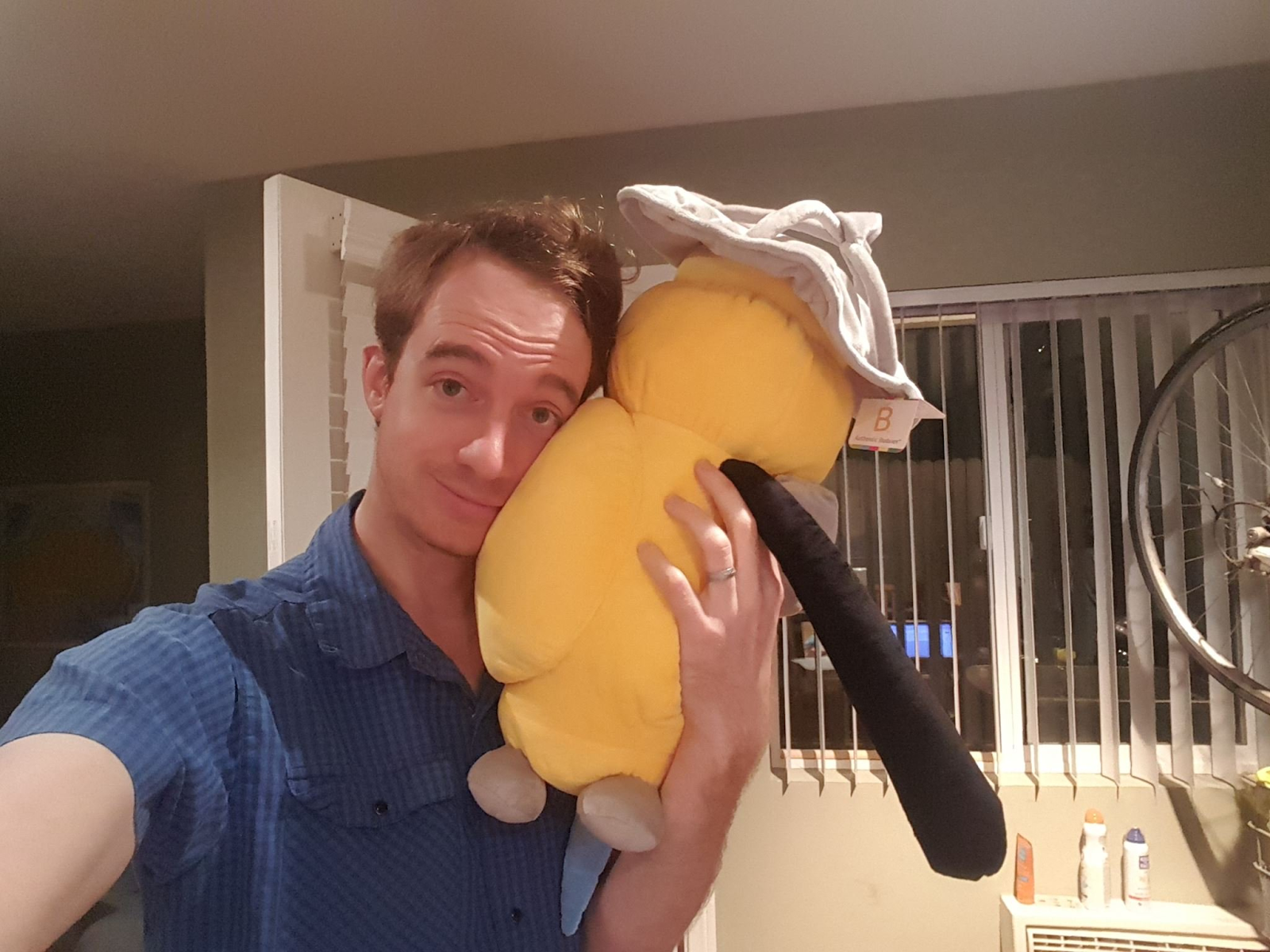
Here's me with the Cassini plushie. It has a magnetometer boom, a Huygens probe (an ESA-provided probe that landed on Titan), 3 RTGs, a little rocket, a high gain antenna, and an instrument platform. *sigh*

The final project (thus far) was inspired by Cassini's orbits. This image was taken from this video (https://www.youtube.com/watch?v=g2-7BFMLUuA) showing all the orbits of Cassini around Saturn. The final 10 years of the mission used the last percent or so of the fuel, so the mission planners had to be VERY clever about using Saturn's moons and their gravity to maneuver Cassini where it needed to go with just the tiniest orbital changes.

The last segment of the mission (in red) involved diving the spacecraft between Saturn and its rings for 22 last orbits before crashing into the planet. 

A former Cassini mission planner and friend from Caltech theatre days David Seal suggested a version of his belt buckle with the orbits inside. It was non trivial extracting orbital data from the relevant database, but then I picked an orientation, squished it vertically, wrote some code to extrude the curve into a solid tube, then integrated it with a frame I drew up in OnShape. I've had some trouble printing the final version. Like many of my designs, it's right up against the limits of what these 3D printers can do. But I'm optimistic we'll get there.
Here's an image of a prototype conformity check.


I'm always looking for new ideas for 3D printed stuff, so if you have an idea get in touch and we'll see what we can do.  


Tuesday, March 6, 2018

India 2018

Two weeks ago I went to India as an invited speaker at several student-organized technology festivals. I had a great time in India (as usual) and really enjoyed the experience - except the flights around the world, which were pretty tough. India is a long way from the USA. But it's better than walking.

Photos: https://photos.app.goo.gl/y7L6YNcdOpvjsHnn1

Transcript of the talk: https://caseyexaustralia.blogspot.com/2018/03/footprintstrystpragyan-speech-transcript.html

This whole episode began when some students from NIT Trichy, a technical university in southern India, invited me to speak at their festival, called "Pragyan". I cleared the time in my oh-so-busy schedule and agreed. Then they asked if I minded going to a few other places too, and they could share the cost with other universities. I thought this sounded sensible, so in the end I was lined up to speak at three places: "Footprints" at MSU Baroda, "Tryst" at IIT Delhi, and "Pragyan" at NIT Trichy.

My flight left in the afternoon. The usual litany of complaints apply: My Lyft driver was scary. Check in took forever. Security was even more slow and pointless. The gate lounge was overlit, noisy, and crowded. The flight was delayed an hour. Eventually I found my seat, which was a window on the left side. As I had hoped, as we flew over northern Canada I was able to watch the aurora out the window for about 20 minutes. Unfortunately my phone camera wasn't able to capture it, even with fully manual control. The light on the plane wing got in the way, but it was still pretty cool. The only other time I saw the aurora was flying back from India on my last trip. Any flight in the northern hemisphere that will result in terrible jetlag, is conducted during the northern winter, and leaves at the right time of day will fly over the pole in darkness, which is a pretty good opportunity to look for the pale green washes of light.

The sun rose as we cruised past Iceland. We flew over the Shetland Islands and I saw a bunch of oil platforms in the North Sea, the coast of Norway, the edge of Denmark, and a bunch of gigantic windmills. In the haze of exhaustion, dehydration, and tiny seat compression I had a remarkably clear vision of how I could adapt the Australian parenting philosophy to my own questionable life choices. "First, we'll go to Australia to play with gigantic poisonous snakes. After, we'll decompress by hitchhiking to Siberian gulag." We flew over Turkey, and Iraq, where I saw the Tigris river. There's something special about the northwest corner of the Indian Ocean and early civilization.

Two days later we landed in Abu Dhabi, where my fully loaded long haul 777 flight on Etihad, the state flagship carrier, was forced to unload down a single mobile staircase. I had about 90 minutes to clear security and immigration for transit, and as usual it was complete bedlam. Of course the departing flight was sneakily delayed, so I did make it. The seat next to mine was filled by a very broad shouldered man who snoozed and leaned over, bracing me securely against the bulkhead, where I was able to doze.

In Delhi airport there was, of course, no signage anywhere in the gigantic terminal, but eventually I found a corridor next to another corridor with 6 different kinds of unlabeled immigration lines, handed my passport over, and had arrived. Delhi is a bit of a tough city to visit - though it is improving. I wasn't overwhelmed by the heat, pollution (which stings your eyes before the plane even lands), supposed scams, terrible traffic (still better than LA), but by a general feeling of institutionalized bureaucracy, which seems to affect every capital city I've ever visited. Delhi is just on another level in terms of scale.

Fortunately in Delhi I was met by a couple of the IIT students at the airport and transported to the connecting terminal for my next flight. It was about 5 miles away and had no formal connection system, just a sea of taxis. The security line had a bag X-ray, gender segregated metal detectors, and a frisking system. In practice this meant giant piles of baggage blocking the whole thing up due to multiple interlocking deadlocks. But what's the rush? I eventually found my flight, boarded, and had been traveling for just over 24 hours. The last flight to Vadodara was mercifully short, as the plane was full of mosquitoes and my repellent wasn't accessible. Let's just say I was ready to be out of planes!

Fortunately the plane landed and let me out, and the trip got dramatically better. I was met by three local students who took me to the hotel, where I was in my room by 8am. I thought the students might be tired by their early start, but they were so excited in the lead up to their festival that they, and about a hundred other student organizers, hadn't slept much for days. I took an incredible shower, changed my shirt, then attacked the buffet breakfast in the hotel dining room. By 10am I had met A, a student assigned to look after me. I like to walk around a bit in blinding sunlight to help the jet lag set in, so we walked to the engineering school, sussed out the schedule, and said hi to everyone. The level of preparation for the opening the following day was at fever pitch.

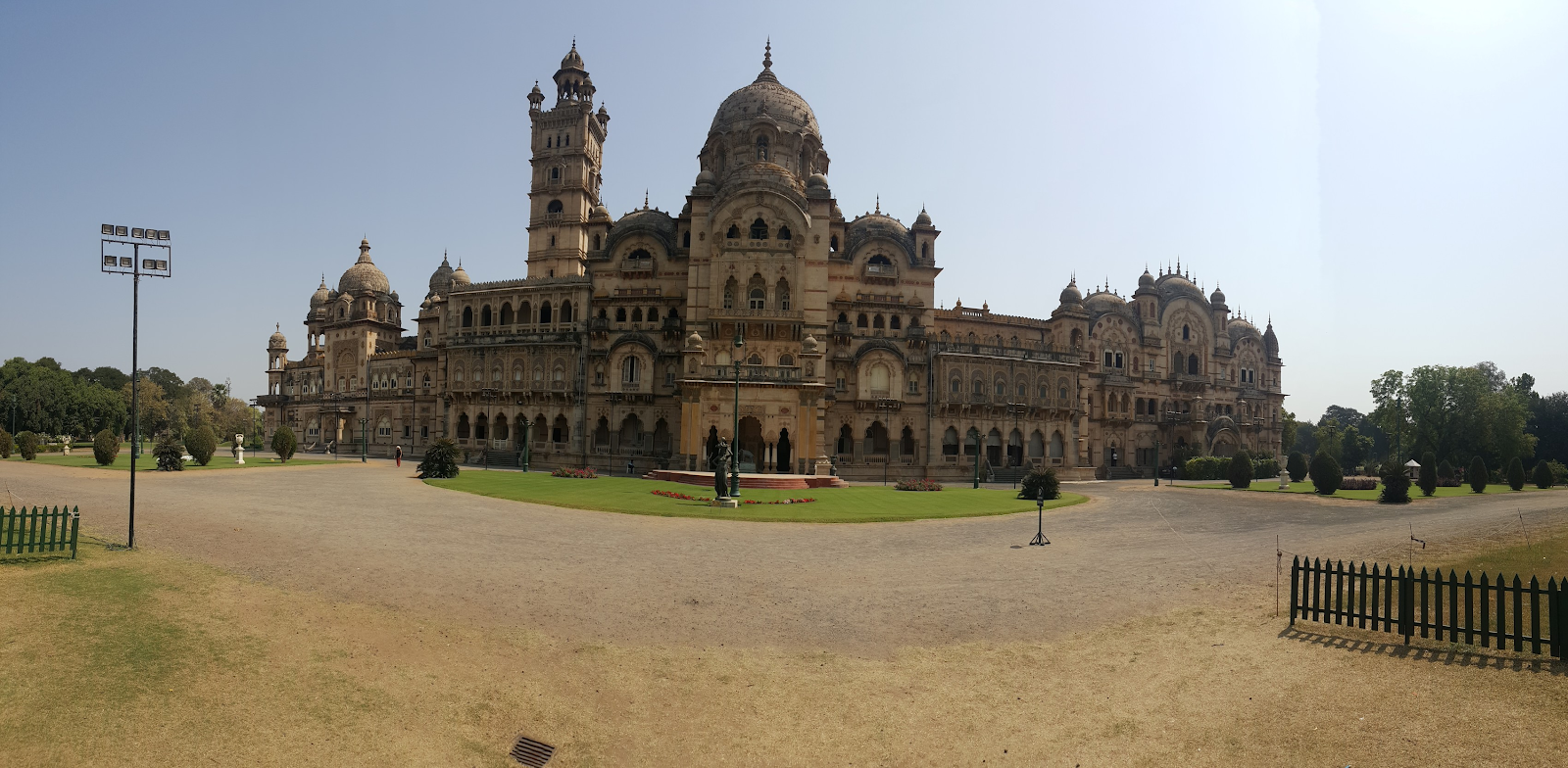
That afternoon we walked to Laxmi's palace, the closest monumental palace open to the public. It was built by the Maharaja in the late 1800s, has more than 500 rooms, and all the latest technology, including elevators, lighting, electricity, air conditioning, and a gigantic golf course. The armory, containing about a million exquisite Indian steel swords, was a particular highlight.


I had plans to go to dinner in the evening, but I was mostly insensible by about 4:30pm, then slept in until 6am the following day. I took the opportunity to write a few words for a new book, then got dressed and headed to the festival opening ceremony. There I met another speaker, the neuroscientist Dr Vaughn, the various deans, and the university Chancellor, Shubhangini Raje Gaekwad, who lives in the palace I visited the previous day. I spent most of the rest of the day taking photos, signing things, talking to people, visiting various booths, checking out fighting robots, and watching the talks by Dr Vaughn and also Vineet Mehta, Tesla's power train specialist.

The following day, I woke up early, practiced my talk, then traveled to the venue, a large auditorium in part of the local hospital complex. I was a bit nervous, but I got to the end with plenty of time for questions. The floor microphone failed, so I jumped down and ran my microphone to various people asking questions, which was a lot of fun! I felt like a TV reporter. After the talk, I bailed to the green room, changed into cooler clothes, and went to a sponsoring restaurant for lunch with everyone, which was amazingly good dahl and roti.

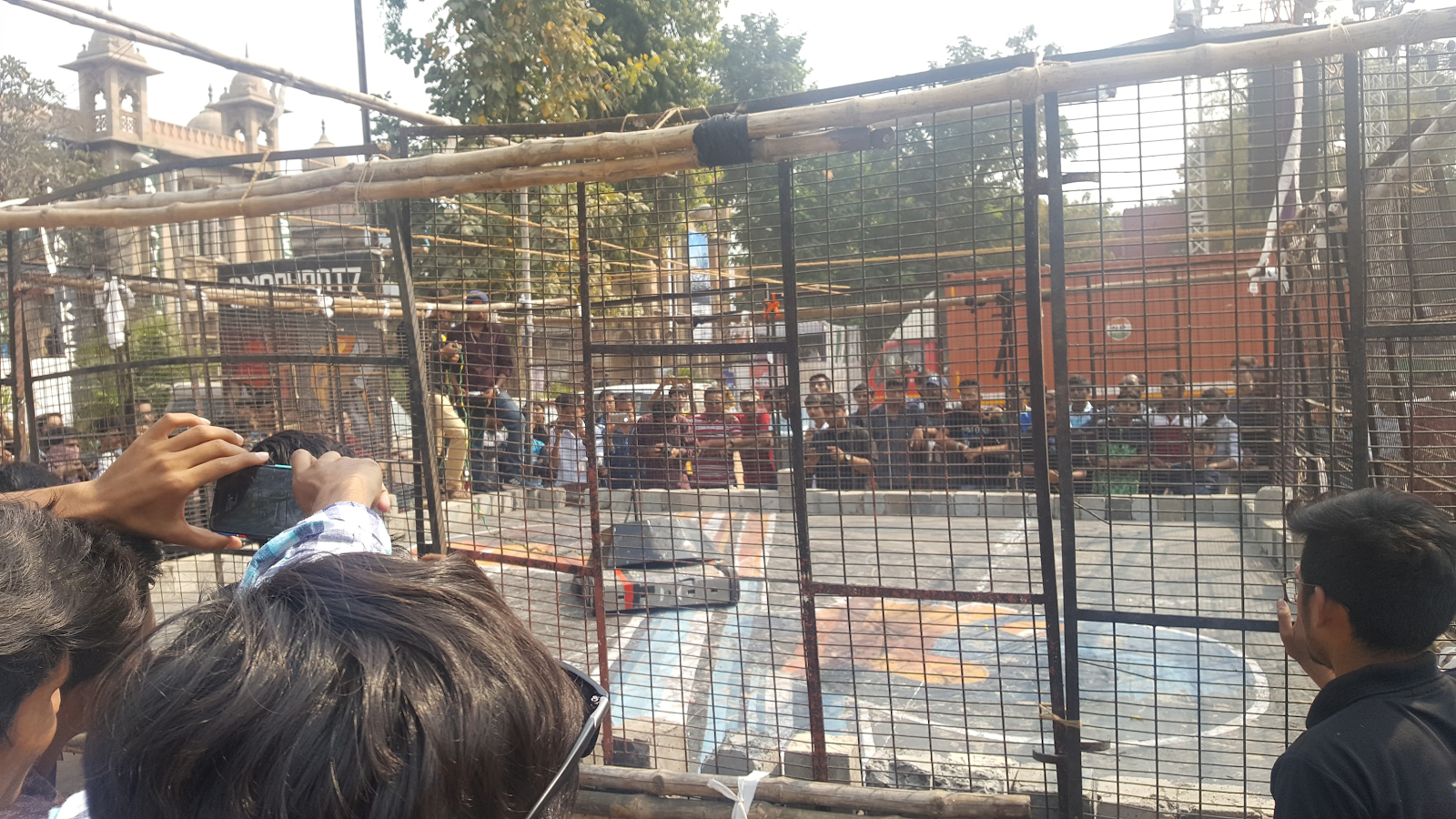
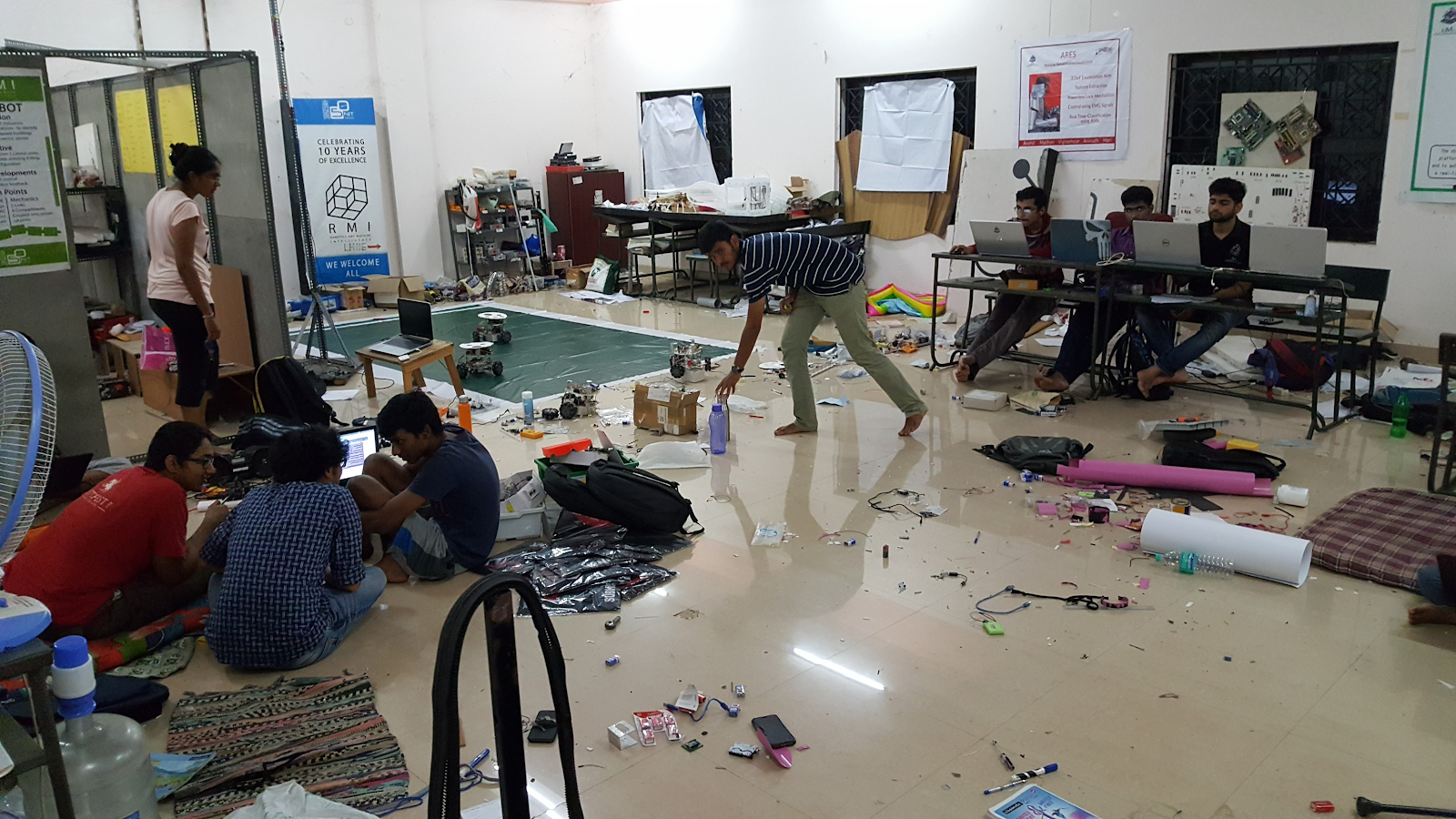
Back at the school, I checked out the robot fighting arena. A raised platform with a mesh screen to catch larger bits of shrapnel, the robots were sometimes direct DC drive remote controlled via thick cables. D:


My hosts asked if I would like to rest. I insisted I was fine, but they found an empty room, carried in a couch, and politely insisted that I take it easy. I guess a lot of their guest speakers are more distinguished people from colder climates who drop like flies in the early afternoon? I probably should have napped, but instead just read for a while, then took a car to the airport, performed the now familiar security contortions (don't put your boarding pass in the scanner) and waited for the flight. Back in Delhi, the students found me again, drove me to the IIT Delhi guest house, where I failed to operate the hot water heater, washed some clothes, and passed out.

The following morning I was woken by the strains of a brass band at 5am, so I took the opportunity to wander around the university incognito and try to get some context and detail for my talk later that day. I saw many peacocks, including some that were flying, which was pretty amazing. Also prominent at all the universities were multilingual signs explaining the zero tolerance ragging/hazing and sexual harassment policies - an encouraging sign!

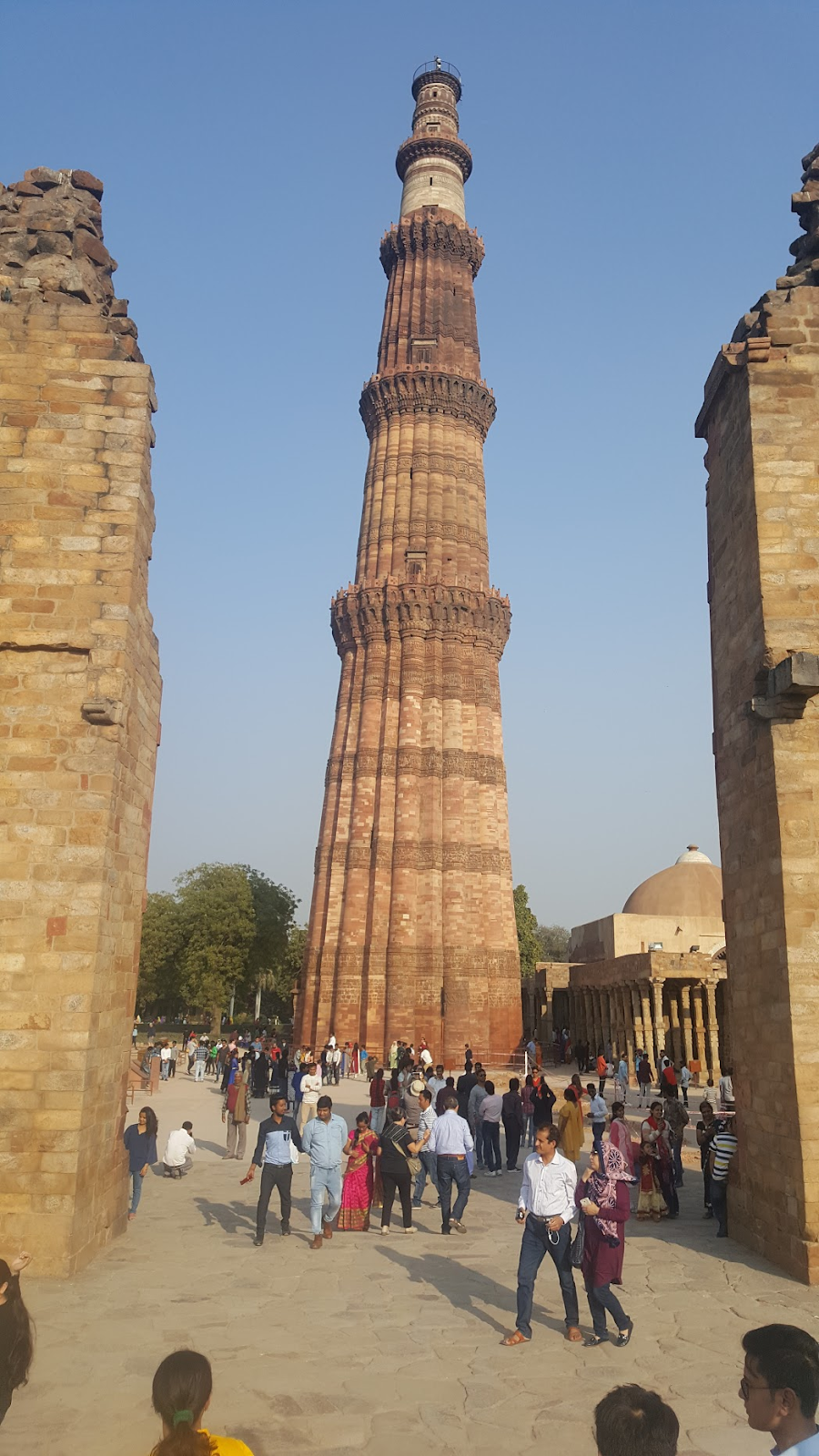
I found the lecture hall and, the talks being sequential on a tight schedule, showed up in plenty of time. For some reason, the students ushered me to some separate room so by the time we got mic'd up and started it was 20 minutes late. So I cut the more depressing parts of my talk and then bailed out for lunch. I considered running away to Agra to see the Taj Mahal, but instead wandered around talking to some students, then decided to call an Uber and get out of dodge. I traveled to the nearby Qutub Minar, an 800 year old semi-ruined mosque. Particular highlights include the 72m tall minaret and the Iron Pillar of Delhi, a 7m tall iron post that is thousands of years old and rust free. It was pretty amazing. At the entrance, though, were two separate lines. A very busy line for Indians, and a short line for foreign tourists, who pay about 20 times as much to get in. It reminded me a bit of Cuba, which has separate currency for locals that is intended to provide cheaper goods and services for tax-paying locals, but in practice renders foreign money irresistible.


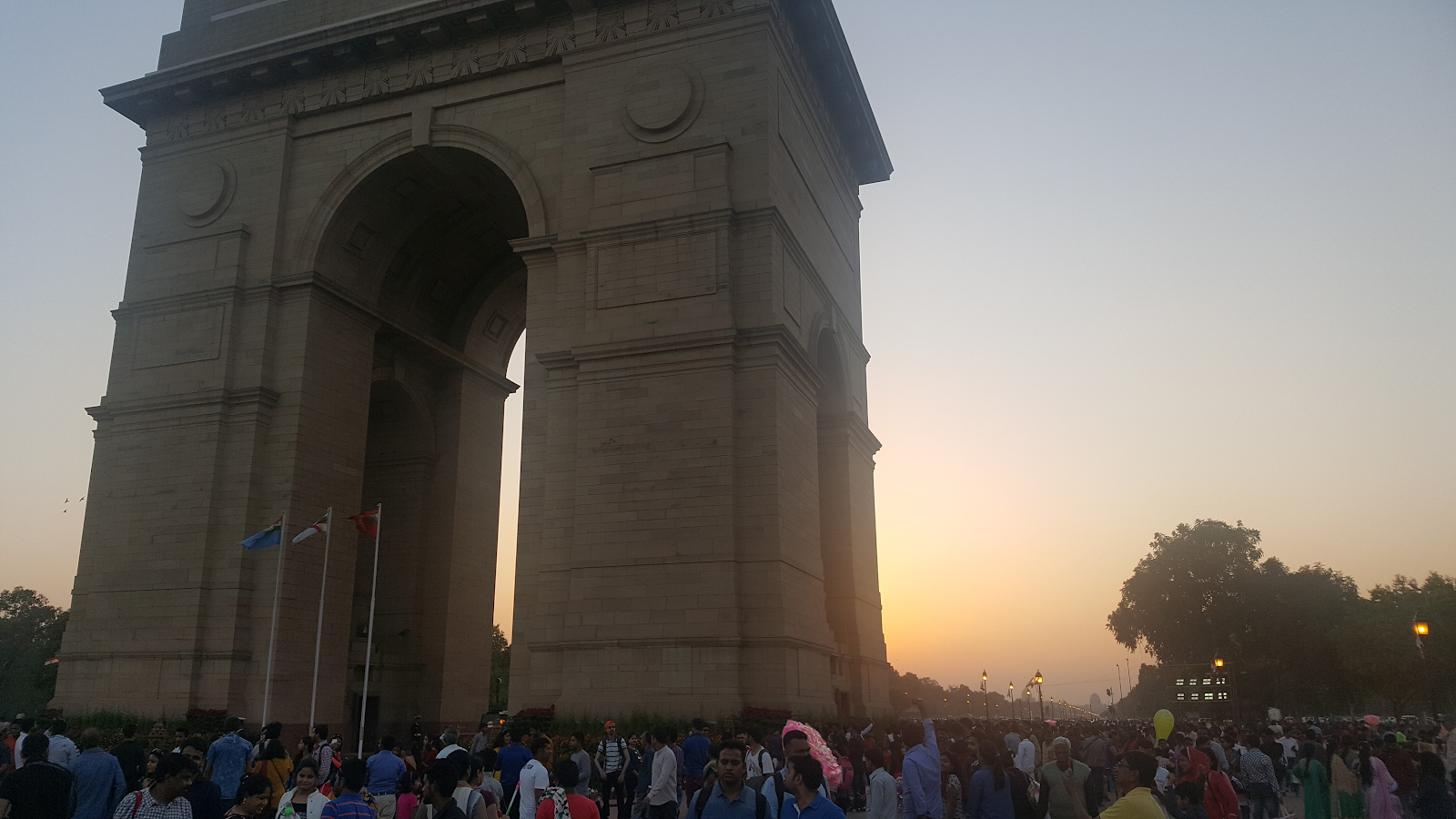
I found my way to the nearest metro station, then zoomed on the modern, efficient metro to Central Secretariat, in the middle of New Delhi. Here, I walked through a local park to the India Gate, and then up the road to Connaught Place, a very intense shopping district. All too soon it was time to return to the university by metro, grab dinner, and put my feet up. I walked about 17km that day, and I felt it. I think I must be getting soft.


The following day, I went into the festival again and saw Robert Metcalfe's talk. He invented ethernet, the lowest level of the tech stack that powers the internet. After lunch, we teamed up and traveled into town to visit the American Center, where UT Austin and the US State Department have teamed up to build Nexus, a startup hub that's focused on training various incubators to help bootstrap the local ecosystem. Apparently there are about 400 incubators in Delhi! The local contractor had lived all over the world and had some amazing stories.

We considered heading to the Red Fort in Old Delhi, but cut our losses and instead took an autorickshaw to the Lodhi Gardens, a landscaped park around 4 ancient tombs dating back to about 1500. Delhi is the site about about 11 ancient cities, many of which were partially or totally destroyed, built over, and left a variety of ruins, monuments, and other stuff. I found it fascinating how urban planners drew lines around the densest collections of monuments, which are now tourist sites. And, in the surrounding areas, unrestored tombs of often forgotten people lurk in people's backyards. Somewhat like Athens, one can't take a photo or turn a clod of Earth without hitting some aspect of 4000 years of history.

That evening, Robert and I were pretty wiped, but wanted to have dinner with the Tryst organizers. For some reason, finding a restaurant that wasn't an hour's drive away was impossible, so we piled into the guest house dining room, had a quick chat, then beat a hasty retreat. By now I had applied my decades of catastrophic over education and activated the hot water system, so had a decent shower before going to sleep.

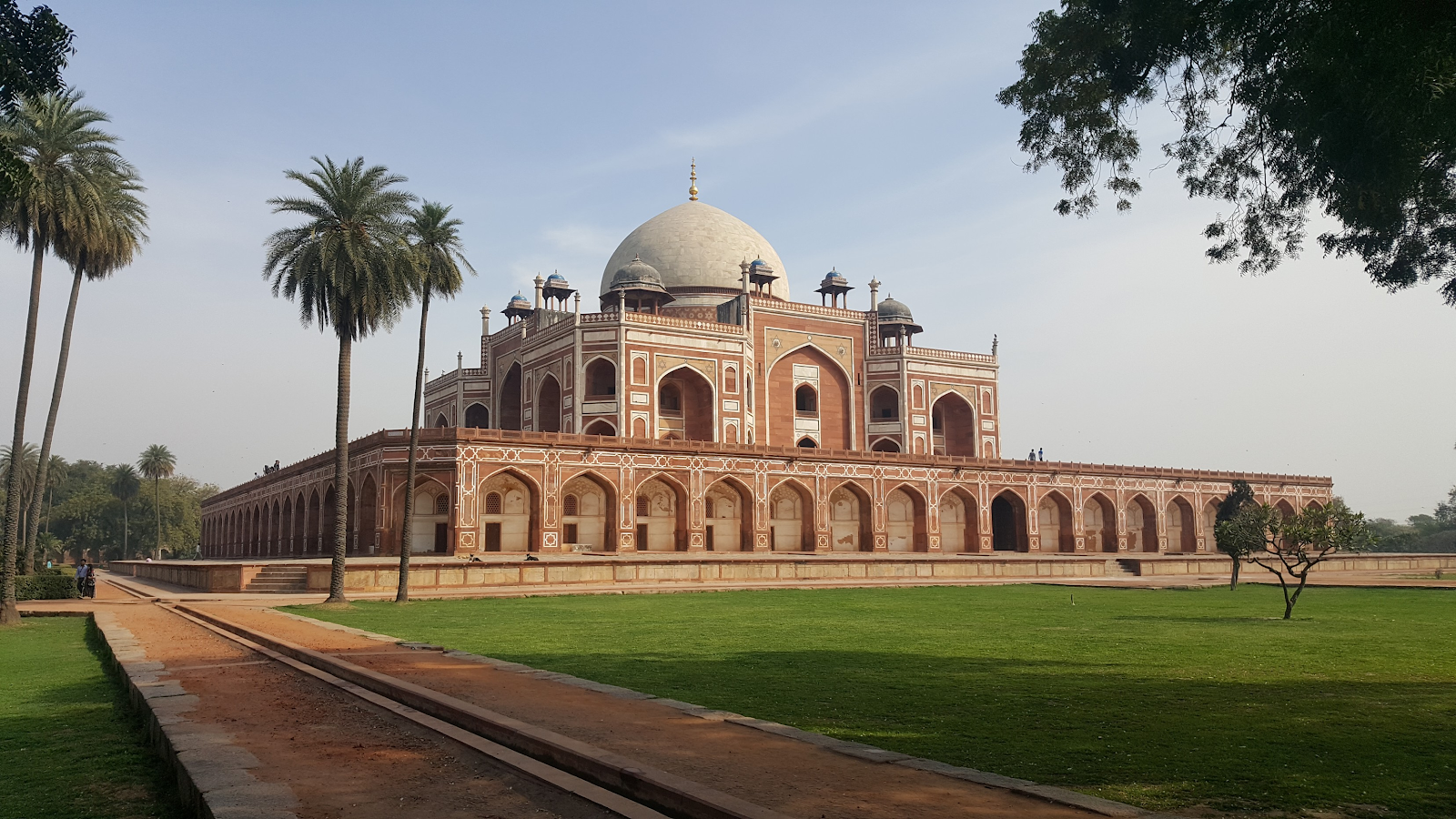
My flight left in the mid afternoon of the following day. Robert took off for the Taj Mahal, but I packed up then took a car to Humayun's Tomb, built a couple of generations earlier and, in some sense, a prototype. The wild traffic sharpened slightly as my car clipped a motorbike! For a place where accidents are reasonably common, few riders wear helmets. Accidents are much less common than you would think, though. It's not unusual to see trucks, autorickshaws, cars, bikes, pedestrians, dogs, cows, and even amputees on wheeled skateboards all sharing the same highway.

I arrived about an hour before the tour busses and hordes of people all trying to take exactly the same photo. The complex has a large Persian style garden, about 10 tombs in varying states of repair, and a never ending scheme of conservation and restoration. It must be difficult to do, since the original construction was never documented and even obfuscated. The centerpiece is the tomb of Humayun, which looks similar to the Taj Mahal, but made of red sandstone rather than marble, and was monumental in every sense of the word.


I headed back to the guest house, ate some lunch, then headed to the airport. There were two connecting flights to get to Trichy, with a layover in Chennai. As usual, the layover involved buses, passing back through security, navigating the airport without signs, and a boarding zone order of 1, 4, 3, then 2. All I'm asking for is door-to-door super hypersonic suborbital transportation. I don't see what's so hard about it.

I got a nasty headache on the flight, but fortunately was well met at the airport and taken to a very nice hotel in Tiruchirappalli, where I dosed up on Malarone and Tylenol, then had an incredible mushroom dish called "kulcha" and bread. I washed some clothes again and had precisely zero difficulty falling asleep.

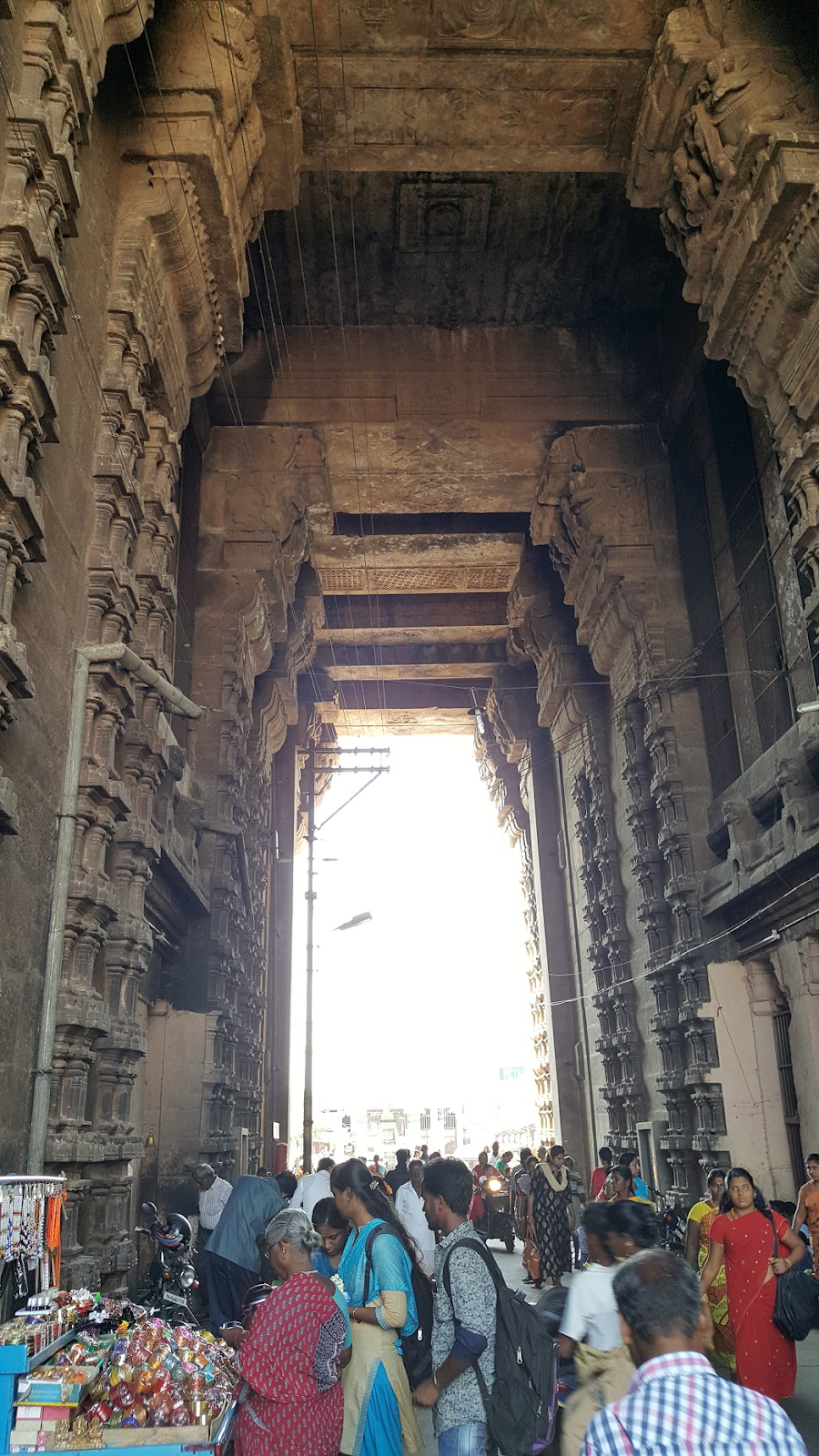
The next morning my gracious hosts apologized and asked if I would wear long pants, since we were going to visit some local temples. The first one was Ranganathaswamy Temple in Srirangam, an ancient temple to Vishnu on an island near Tiruchirappalli. We cloaked our shoes and then walked in through the first of seven concentric gates and walls around the central deity. The complex contains about 20 towers, was mostly built about a thousand years ago, and has several cloisters and halls with thousands of monumental exquisitely carved granite columns. The tallest tower, completed in 1987 after 400 years of intermittent progress, is 73m tall. The gate beneath, which is part of the original structure, is so tall it has powerlines routed through it.


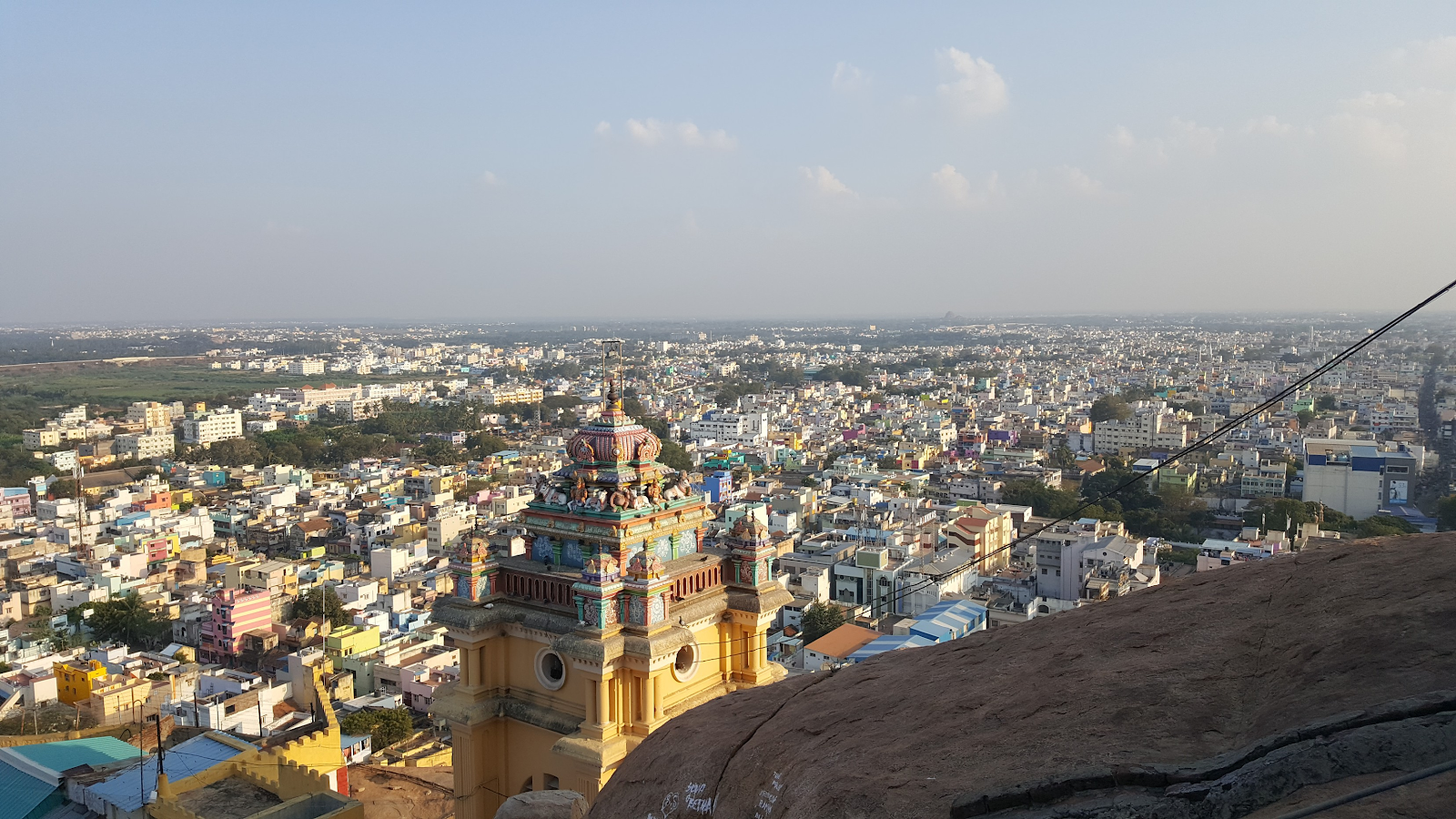
Following this we visited a butterfly park and an ancient water control feature, used to supply irrigation, before overheating and getting some lunch in the hotel. That afternoon, a different pair of students appeared to take me to the Rockfort temple, right in the middle of the city. This is actually a set of temples built around and inside a monolithic granite hill, with over 300 (mercifully shaded) carved stairs to get to the top. There was a great view over the surrounding area from the top, with a decent breeze and many brightly colored buildings. Once back at street level we went to a few different shops, full of all sorts of things I couldn't fit in my bag! That evening I once again skipped dinner to sleep, and did not regret it.


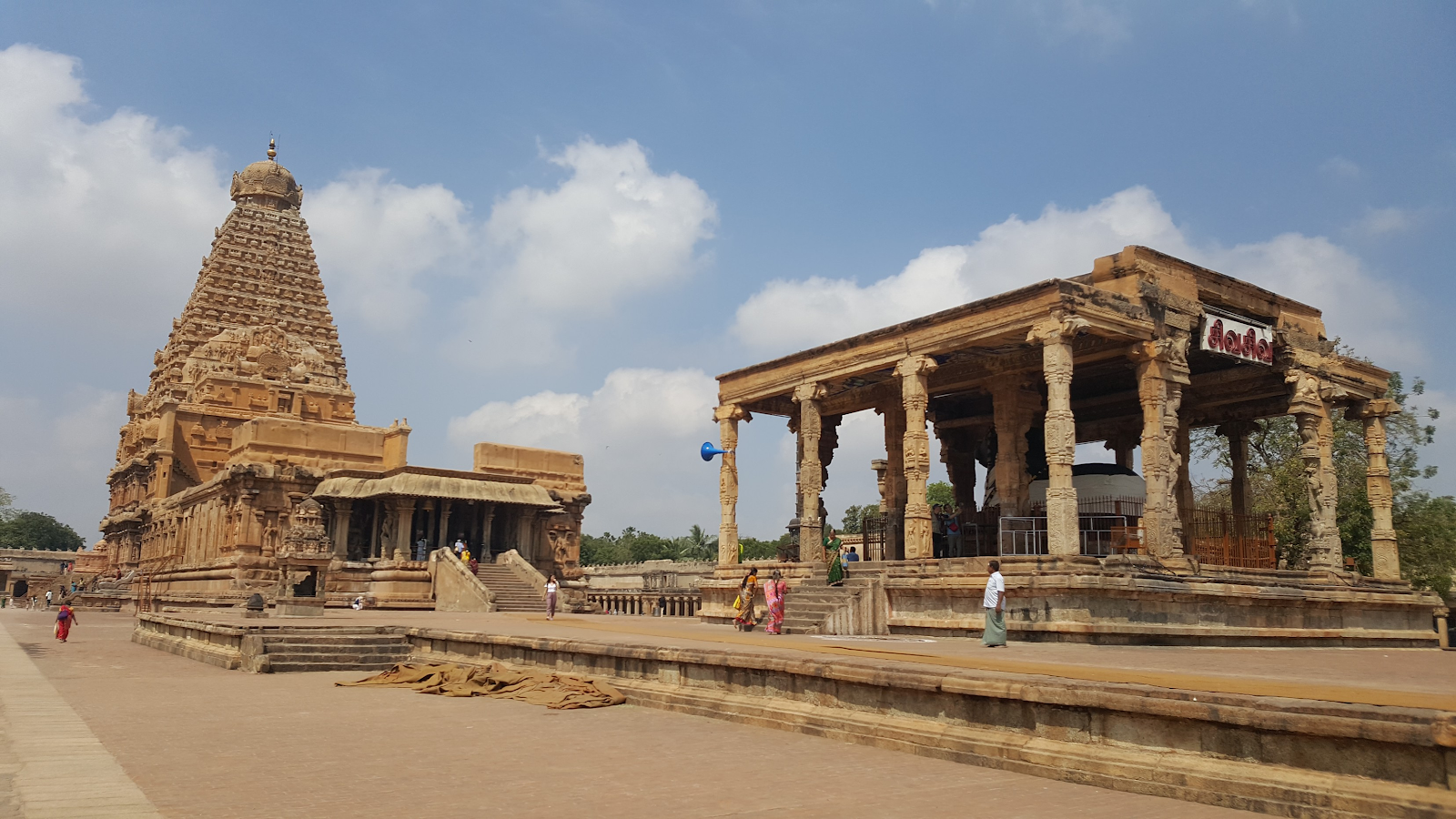
The following day I caught up with Robert Metcalfe at breakfast, then drove to Brihadisvara Temple, another famous, ancient temple (among hundreds!) in the area. This one is devoted primarily to Shiva, and is most famous for its giant gopuram, or tower, with an 80T monolithic globe on the 60m tall peak. Noone is quite sure how it was built, but it is believed the entire complex was completed in only seven years. The structure was built without arches, and I'm really impressed by how the lintels were built without (mostly) cracking. It manages to be both enormous without being overly oppressive. One other detail which stuck in my mind was that in Hindu temples, most deities are also depicted with their "mount" nearby. Shiva's mount is a bull, so there's an adjacent shrine containing a very large carved bull. Like the Lascaux paintings, this animal depiction is stylized and contains a compelling animal character, almost like movement. I generally don't buy arguments that ancients knew more technical information than we do - in particular claims that modern engineering couldn't reproduce, say, the pyramids are quite silly - but I am always impressed by the artistic finesse of ancient art right back to the earliest known examples.


That afternoon, we drove to the main campus to look around, look for animals, meet people, check out the robot construction lab, and attend the opening ceremony. The highlight of the inauguration, for me, was a terrific talk by Dr BN Suresh, former director of ISRO's Vikram Sarabhai Space Center, who spoke about the Indian space program. I was also amused by someone videoing the ceremony from a drone, flying inside the auditorium. Back at the hotel I prepacked by bag, practiced the talk, and fell asleep again.


The next day was already my last day in India. I had two breakfasts to smooth a logistical issue, then traveled to NIT Trichy. I was dressed, shaved, combed, and I had a busy schedule of talking to student journalists, a couple of classes of mostly mechanical engineering students (I learned a lot!) and then gave the talk in an capacity lecture hall. After the talk I took a lot of questions, took the obligatory photos (selfie production line), received some lovely gifts, and then returned to the hotel to eat, shower, and pack.

All too soon I was stepping off India back into a plane for the first of four flights, over 36 hours, back to the USA. Once again, my grumpiness was well induced. I had lactose free cheese sandwiches. I had gate lounges with inscrutable whistling covers of insipid Andrew Lloyd Webber. I had bad air quality. I had numerous frustrating interactions with unhelpful uniformed bureaucratic loafers. I spent many, many hours in various lines waiting for nothing to happen. I went through layers of security to access elevators that went nowhere.

And, as usual, I somehow ended up seated in a section of crazy people on the long haul flight. There was the guy playing games on full volume on his phone, and then setting alarms that would go off throughout the night, waking everyone except him. There was the usual croaking chorus of tubercular coughing types. There were the chronically uncoordinated who insisted on shaking every chair as they staggered endlessly up and down the aisles, when they didn't grab a handful of hair by accident. There were the trash hoarders who somehow filled the underseat space with a mixture of half crushed water bottles, used wet wipes, unlabeled medicinal herb containers, and sputum. But the piece-de-resistance was undoubtedly the domino of people in my row who, as soon as I got up to go the toilet, immediately annexed my seat and fell into an unrousable horizontal sleep. And, when they got up, the next one in line annexed all three seats, same deal. I ended up standing by the exit door for about 5 hours, reading and looking out the window for polar bears.

One person sitting next to me, after trying to treat their randomly targeted endless coughing and strategic sleep-destroying poking with some inscrutable mix of tea leaves, which mostly ended up on me, asked about an hour into the flight "Are we nearly there?" On arrival, 16 hours later, they asked if I would call their spouse to let them know we'd landed, but it transpired they didn't know their phone number. They always find me! How do they find me?

The plane came down into LA, miraculously smog-less after a week of rain, I headed for the exit, and miracle of miracles one of the eight security screens ("Please remove your cash, shirt, belt, laptop, shoes, loose change, pancreas, IN THAT ORDER") in Abu Dhabi was pre-immigration, so they let us right out into the airport. I was home after only 40 minutes of terrifying driving.

India! What an amazing place! I feel like I could spend a lifetime in a single state and still not scratch the surface.