Friday, May 30, 2014

Zion National Park

Memorial Day weekend saw another instantiation of the legendary Ge136 field trip. This trip has taken me out and about all over the south west US, and is always a blast. My recent trip to Zion was no exception!


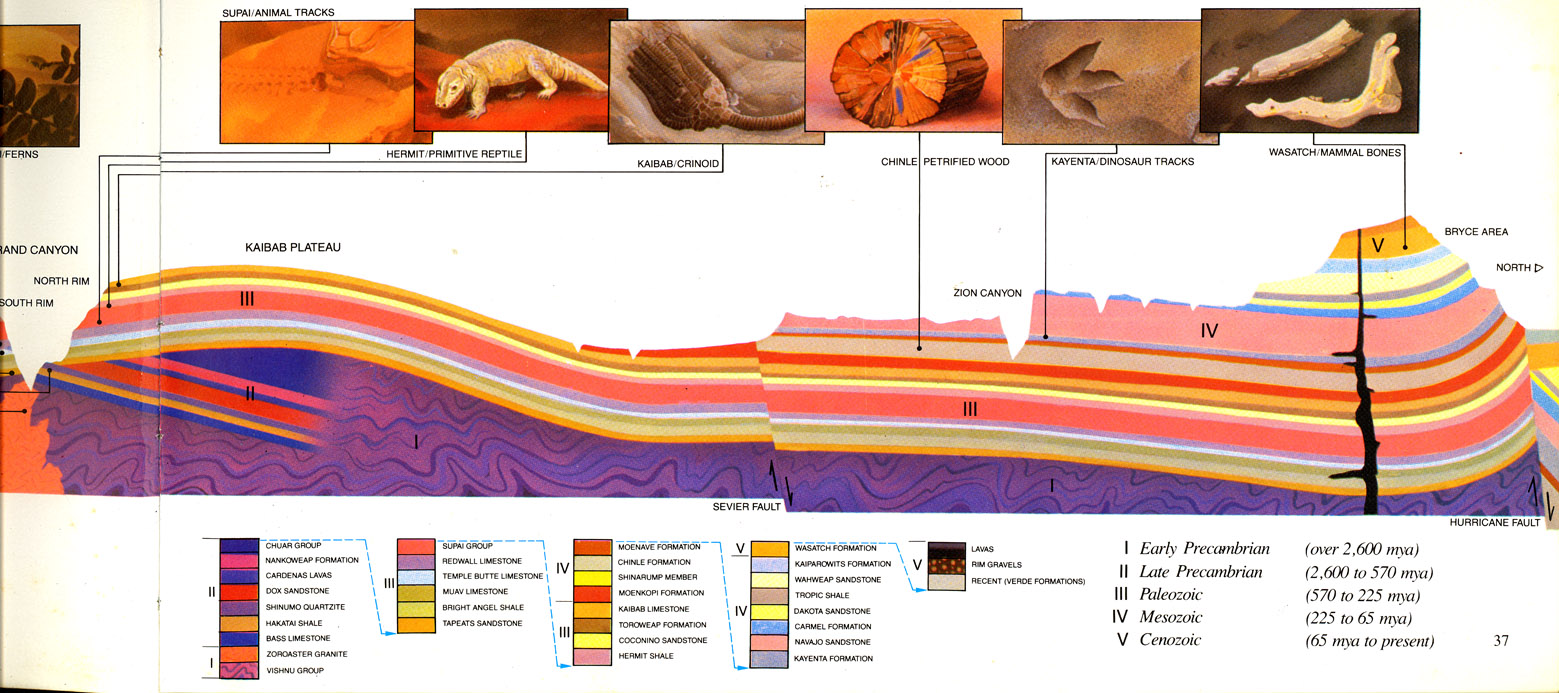
Zion Canyon and area stratigraphy:


Friday morning I collected some food supplies, snuck (one of) my secret payload(s) into the truck, assembled a compelling team of passengers and copilot, and headed for the expressway. Even at midday on Friday before memorial day, the traffic was slow going at times, though we managed to avoid a terrible snarl on the 15 by diverting up the 215. Before long we cruised through Apple Valley, Barstow, Baker, Primm, and Vegas, continuing past a crash on the 15 to Valley of Fire state park, where, rather unusually, we arrived at the camp site well before sunset.

Caltech's master of all things culinary Tom Mannion and a few friends had come to cook us an incredible dinner that took two days to finish. Surrounded by eroded rocks eroded from the fossilised Navajo formation dune fields, crossbedded, incredibly red, and eminently climbable, we discussed the upcoming meteor shower, the possibility of monopole detection, and the slightly overcast skies. I sat on a ledge overlooking the fire and tried to imagine what Zion canyon might be like.

That evening, sleeping on a camp stretcher beneath the stars the clouds cleared for long enough to see a few meteors including a very bright fireball, but not the thousands we had anticipated! At some point an EMT van showed up convinced one of us had managed to fall off the rocks, but everyone was okay.

Next morning we woke and while stuffing ourselves with leftovers talked about rocks while I flew my video drone around and between them. Soon enough we loaded up the cars and drove north. The 15 north of Las Vegas cuts through an incredible canyon as it climbs up the Colorado plateau. A relatively stable chunk of crust, the Colorado plateau has some of the most interesting sedimentary sequences in the world, all revealed in devastating clarity within the grand canyon and others as the plateau was lifted and incised about 60mya. 

Beyond this canyon, the town of Hurricane lies next to the Hurricane fault, a normal fault that in the last few million years has resulted in relative lifting across the Virgin river of up to 800m, which caused the formation of Zion Canyon. We stopped in Hurricane for a presentation on the Pah Tempe hot springs there, sadly defunct since an earthquake and drilling project led to their abatement.

The 15 diverts through Utah before cutting east across northern Arizona above the grand canyon north rim. We turned off on the Turroweap road and followed a friendly geologist down to a breccia pipe. Some of the grand canyon sequence contains limestone, and its selective dissolution has lead to the formation of vertical pipes, somewhat like a filled sinkhole. These pipes, filled with sediment, have inward dipping bedding layers and often act like chemical reactors as different pore fluids from different levels flow up and down and mix. In particular, these breccia pipes contain a reductant that leads to the precipitation and concentration of uranium oxide, a mineral essential to the nuclear power industry. On the surface, the breccia pipe appears as a gently sloping bowl shaped area about the size of a football field, but beneath the surface disrupted rock extends for thousands of vertical feet. Over the next decade, the ore will be extracted, leaving the surface largely undistrubed.

Sadly we didn't have time to drive the 60 miles to the grand canyon rim and back, so we continued east and then north back into Utah and into Zion canyon. We arrived near the top, which are the youngest rocks dating from the early Jurassic, around 180mya. As we continued through the park, we went back in time. The campsite was near Moenkopi formation, dating from the beginning of the Triassic, right after the greatest mass extinction of all time, roughly 250mya. 

Our first stop was checkerboard butte, a large conical slab of Navajo sandstone crosscrossed with stress fractures. Unlike the rocks in Valley of Fire from the same formation, these had been bleached white by a reducing pore fluid which dissolved the iron oxide right down to the level of the water table. As it moved through the rock, the minerals occasionally formed hematite concretions, small spheres of rock stained and hardened by a hematite matrix, and thus protruding from the sandstone face. Similar features have also been found on Mars.

We continued on through the canyon to the group campground, when S, TA emeritus, showed up. We knew we were in for a treat. Later that evening, the professor Joe told us the story of how he named his eldest son 'magnetite' in Japanese (a very auspicious name - the Kanji character means literally 'power stone'), and I set up my telescope to look at moons of Jupiter, the disk of Mars, and the rings of Saturn. Despite my best efforts I couldn't find comet Panstarrs, which was supposedly underneath the flat part of Ursa Major.


Next day, we had a full day of activity in the park planned, and even better, no driving! I produced a small jar of Vegemite at breakfast, which I shared with a few brave souls, though none asked for seconds! We caught the shuttle up to the grotto, where most of us zoomed up the well maintained trail to Angel's landing. Angel's landing is a tall promontory of rock sticking out of the middle of the canyon floor, more than a thousand feet high, and accessible only via a narrow, exposed trail with a chain to hold on to. After waiting in line while some rather silly people gradually realised that their ambition outclassed their ability in the same way that my flashlight is outshone by the sun, we made it to the summit and drank in the amazing view up and down the canyon.

On our return to the canyon floor, we had located a swimming hole. Fortunately my boxer shorts that day were brand new - the elastic more than competent, so I was able to swim without fear. The water was cool and refreshing and the bath highly recommended. S found a pair of glasses on the bottom. K lost her sunglasses. While sticking my toes into the freezing mud on the bottom, I found K's sunglasses and returned them to the light. 

Soon enough it was time to return to the shuttle, where we climbed up into a cave covered with dripping water and hanging gardens. Flowers sprouted from the roof and a humming bird sipped the nectar.

Our last stop for the day was the narrows, the pointy end of the canyon, where the walls gradually close in, necessitating wet feet. We had a talk about desert varnish, a mysterious amorphous black coating on rocks, made of manganese oxide, occasionally found on Mars, and of unknown origin. I helped some canyoneers fix a rope on a waterfall for their descent. After a while we reached a good turning around point and walked back to the road, and, in due course, returned to the camp ground. I set up a timelapse, rehabilitated my drone after a recent crash, and made an alcohol fuel stove from an empty aluminium can, without covering myself blood! When dinner arrived, incredible quantities of pasta, I found to my dismay and confusion I had room for only one plate. That evening the stars shone overhead, a cool breeze blew down the canyon, and I snuggled in my sleeping bag as the events of the day played over in my mind.


The next morning, we packed our things and drove out the bottom of the canyon. Pausing near the rocket test track, we examined the lowest layers of the Zion canyon formation, including some rocks deposited during the poorly understood PT extinction. Later, near Quail Creek reservoir, we drove up an eroded anticline and had a good look at cryptobiotic soils, a common surface covering in non-sandy deserts. Built by bacteria over up to 50 years, it helps to retain surface moisture.

We drove back to Vegas. Traffic monitoring suggested the 15 and 210 from Vegas to LA would be stop and go for hours, so we diverted to the north, circling around the nuclear weapon test facility and stopping at a road-side shop that celebrated both Area 51 and one of the few legal brothels in Nevada. At Beatty, we turned west and crossed into Death valley, running around some dunes in 45C heat, then climbed a vertical mile before dropping into the desolate Panamint valley. A year ago, I saw it from the Hunter mountain saddle stretching below, and now we drove south along it. At the southern end we passed a pretty desperate looking borax mining town, reminiscent of some of the abandoned cities I saw in Russia.

From here the sun set and the story is all freeways and bad drivers. What an amazing weekend! Geologists have all the fun!

Wednesday, April 23, 2014

E visits LA (again)

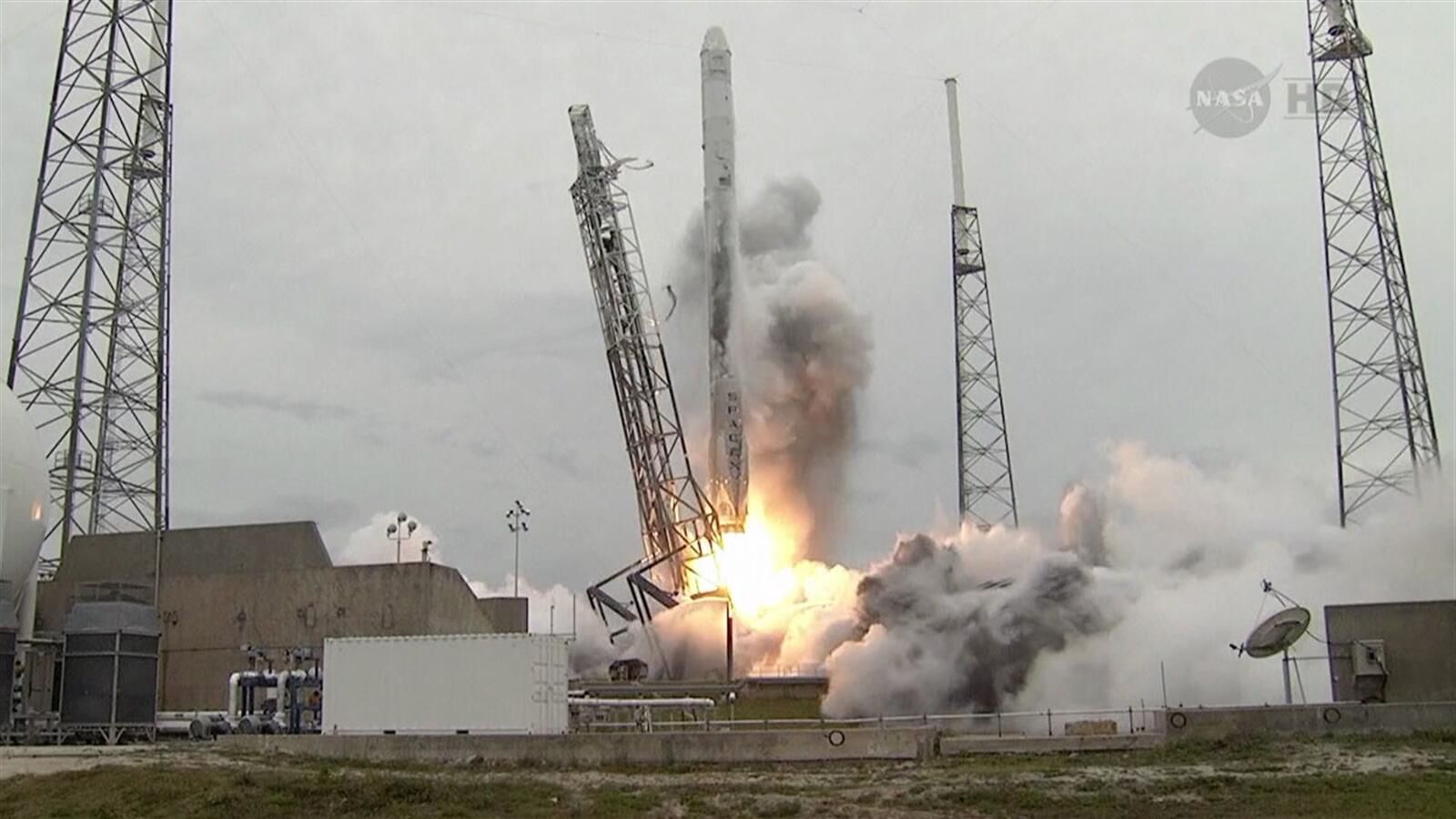
Terminal countdown had begun. I removed my earphones and played the live webcast through my laptop speakers, enthusiasm trumping office decorum. SpaceX's prototype F9R rocket stood on the pad in Florida, belching clouds of water vapour as its cryogenic tanks pressurised and prepared for flight.


It had been a few months since the last launch. This one had been delayed a few times, and was supposed to test the leg deployment and soft-landing innovations SpaceX is desperately striving to develop. If you can rapidly and completely reuse your rocket, it will cost much, much less.


Two minutes to launch. At that moment, E walked in the door. Friends since high school, E now worked figuring out how to attach Boeing 737 wings in Seattle. He instantly comprehended the gravity of the situation and sat down to watch the proceedings.

Boom! The rocket sprayed itself with water from the acoustic suppression system and rapidly cleared the tower. Within minutes the first stage had detached and the second stage continued to blast the Dragon spacecraft towards the ISS. Just before the video feed cut out, we were treated to a view of the Dragon capsule drifting away from the second stage following SECO 1.

What an excellent start to an adventure!

20 minutes later, Dr K Radhakrishnan, chief of the Indian space program (ISRO) was in town and giving a lecture just across the road. We got into position and listened to his talk with great interest. If you thought NASA had difficulty answering the question "why rockets when food?", ISRO has a much more definite statement. Dr R delivered one of the most convincing justifications of space exploration I have ever seen, laying out with great precision the evolution of India's Earth observation satellite programs for communication, disaster management, farming efficiency treatment, and so on, building up to the current development in lunar and Mars exploration, as well as the development of a manned space program in response to China's spacewalk.

E and I stumbled from that lecture, jumped in a conveniently located car and zoomed up to JPL, where we met D, E, and E's mother. D, a theatre friend who does mission planning at JPL, required our assistance in smuggling an electric piano, and in return gave us the insider's tour of JPL. What's JPL, I hear you (singular, hi mum!) cry! JPL is the Jet Propulsion Laboratory, a Caltech administered NASA center (the largest of about 10) that specialises in space robots, including the Mars rovers.

We all piled into D's zippy Nissan Leaf (Zero Emission Vehicle) and drove up to the top of the lab, where we found our way into the 25 foot space simulator chamber. A large vacuum chamber designed to test structures in a simulated vacuum, it was also capable of delivering a megawatt of artificial sunlight to bear on, in this case, a solar panel prototype. It was cool to look around the room at photos of all the missions developed there, replete with shiny gold NASA quality space blanket!

Next up was the electric propulsion development lab, which had several glass cases filled with prototypes, including a Hall thruster from the USSR. Electric propulsion is much more efficient than chemical rockets, but basically incapable of delivering substantial thrust, so only useful on very long duration (obviously unmanned) deep space missions. They are still an area of active research and the lab contained what seemed to be a giant submarine, which was, of course, another vacuum chamber.


Blinking, we emerged into the sunlight and jetted off down the hill to check out the Mars yard. The Mars yard is a yard where rover drivers can practise driving rovers. Also, they can test how to drive up steep sloped, how to get unstuck, and how to not damage the wheels too much in a controlled, repeatable environment. While there, we had a good look at one of the Curiosity stunt doubles, whose wheels had been rather banged up! They had a regular pattern of holes which print the Morse code for "JPL" onto the surface of Mars, everywhere it goes. Mars is a really long way away - it's pretty incredible to think about this car crawling all over it.


We followed that with a visit to Mission control, where giant projection screens showed blips of information still arriving from the Voyager craft, launched in 1974 and now 19 light hours away. Following that, a trip to the high bay, where missions are constructed. Currently in the hot seat was SMAP, a remote soil moisture sensing satellite, complete with a giant rotating deployable dish. Finally, a quick turn around the museum and von Karman hall, with all its highly excellent models of spacecraft, including MRO, Voyager, Cassini, Galileo, and SMAP.


We returned from JPL and were, as you can imagine, slightly tired. But no rest for the wicked - E managed to procure an ice cream sandwich from the pre-frosh weekend club fair taking place at Caltech. Soon after, P appeared and we drove to Lake St for a dinner at Abricott, a repeatably good French/Vietnamese restaurant.


The next morning I could barely move. Age has, it seems, at last caught up with me. Being a spritely 24.999, E left for an Art Deco walking tour in downtown LA, followed by a turn around the Getty. Later that afternoon, P and I picked him up and we drove out through the late afternoon to a nice walking place in the Santa Monica mountains, which includes a labyrinth and an excellent view.


On the way back, we opted to go to the Korean Night Market. But 5 blocks away there was already a huge queue of cars and people. Thinking quickly, we headed for the nearest Korean bbq, only to find it too had a long queue of hopefuls. Likewise the second and third Korean bbq. Eventually we found a Korean soon tae cafe, where we sat and pointed at the most interesting thing on a pictorial menu. The two large screens played endless repeats of stock footage concerning the recent ferry tragedy, and in short order our dishes of meat, kimchi, soup, and rice+blood pork sausage appeared. Safe to say we were safe from Jewish vampires that evening.

The next morning P and I rose absurdly early to drop her at LAX. With no traffic at 6am I was soon back in Pasadena, where I picked up E and another friend E2, and we headed for an altogether closer airport, El Monte. Unfortunately R's Mooney M20 was out for its annual, so we took a neighbouring Piper for a quick spin. I piloted on the flight out to Catalina island, skimming over coastal clouds before descending through a break to circle around the steep walls of the island, incredibly picturesque in the (by now, according to E) typical Southern Californian sun. After a few circuits including a school of fish and a whale we zeroed in on the airstrip.


Built on the summit of a long ridge, the Catalina "Airport in the Sky" has a disconcerting bend in the middle, which leads to an illusion of falling off the end. Fortunately I had some help and was able to coordinate landing gear, flaps, trim, manifold pressure, propeller pitch, throttle, and a cross wind to put her down on the narrow, pitted strip. We taxied to the parking area and walked to the tower, where we were informed that none other than The Garrett Reisman, Caltech Flying Club and NASA alumnus, astronaut extraordinaire, and current SpaceX director of crewed flight was on the island. Which of the 15 or so planes could be his? I later discovered that I had not managed to guess correctly, but can confirm he has excellent taste in flying machines.


Although a quick scramble to a deserted beach was mooted, we very wisely decided instead to eat bison burgers and, being all redheads, squint at the view. Soon enough it was time to return to LA - this time E flew the plane back to EMT, while E2 and I sat in the back seat and lamented the lack of microphones there. E landed with a bump but no screaming protest of twisting metal (always the preferred option) and before long we were back in Pasadena. E, keen to soak up yet more sun to last him the next few months in Seattle headed to a nearby park for a nap, while I prepared feverishly for the next enormously ambitious activity.


First, the weather was a-okay and the atmospheric conditions perfect. Next, nap dispatched, E and I drove to a nearby bar and met with the bulk of our co-conspirators, a motley bunch including the Nerd Brigade and many of my friends from various activities around Caltech. With one or two last minute substitutions, it was time to fill the cars and head for the mountains.

Indeed, our target that night was none other than the famed Mt Wilson 60" telescope. Built between 1893 and 1908, it was, for 6 short years, the largest telescope in the world. In 1914 it was surpassed by the 100" on the next hill over, and together the telescopes made a series of fabulous discoveries, including galaxies, the expanding universe, and a bunch of other things. Today, enthusiasts can rent the telescope for an evening for a price that is reasonable, if divided by 25 participants!

The cars gradually arrived at the top of the mountain and waited in the lot by the gate. From a nearby road there was a great view of the LA basin, including the distant bulk of Catalina island through the haze. 


At the appointed time S, our session director, appeared in a jaunty red beetle and led us into the telescope grounds. We parked, enjoyed a quick briefing, deployed our snacks, and watched the dome grind its way open as the sun went down.

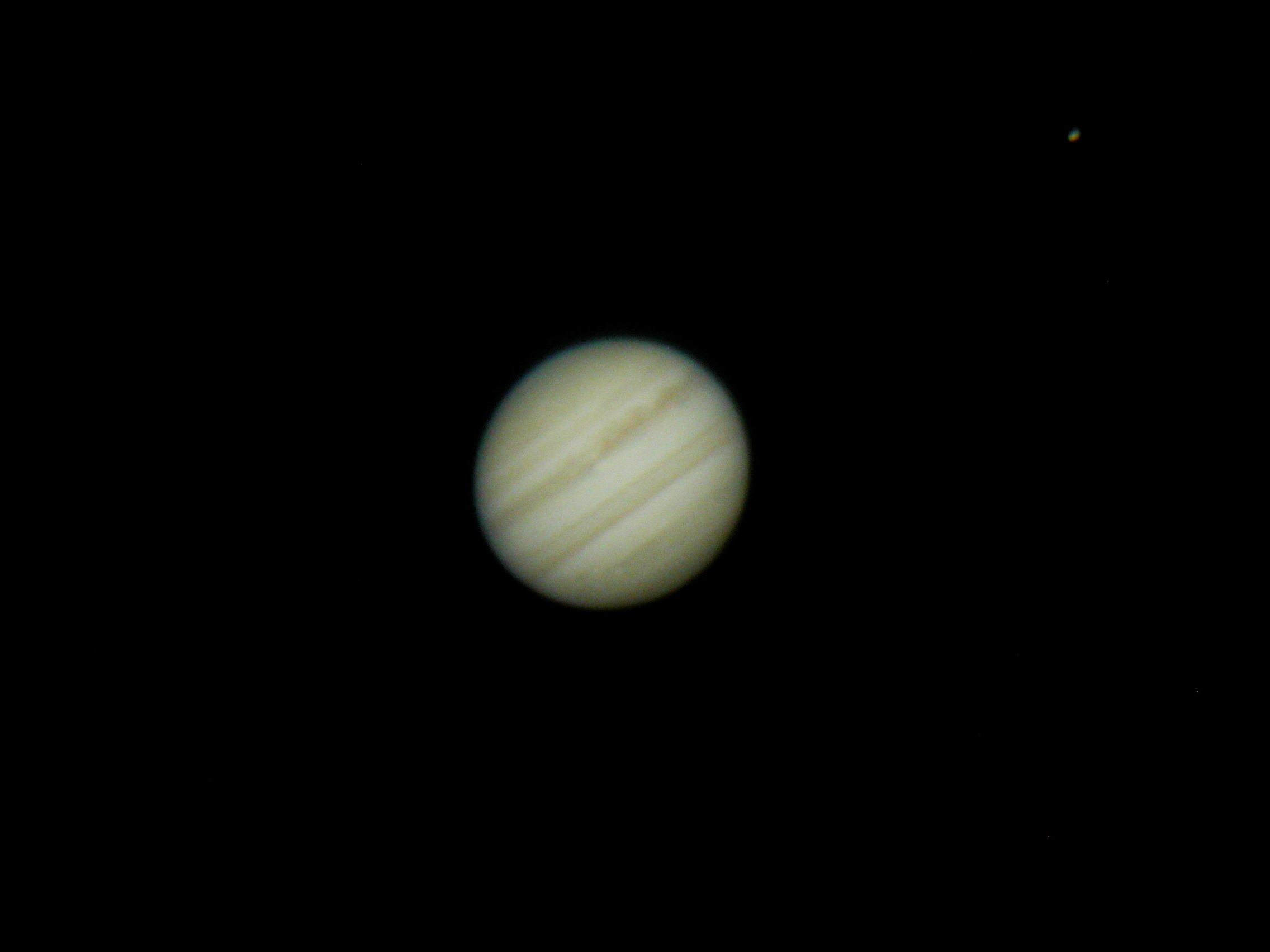
The first order of the day was Jupiter. The telescope was so huge we had to climb a ladder to reach an eyepiece larger than my (rather powerful) binoculars. Bending over the lens an image swam into view. 


The planet, appearing the size of a tennis ball with 4 bright Galilean moons surrounding it, had obvious bands. Our distinguished telescope operator M proceeded to drive the telescope like a luxury sports car from object to object. In the course of the next 5 hours, we viewed an incredible array of objects with our own eyes. I didn't take any photos of the objects, but google image search has allowed me to find photos showing the same level of detail, which I copy here.


The double star Iota Cancri, one blue, one red.


NGC2392, the clown face nebula.


An Iridium satellite flare. The satellite has reflective panels which can flare as bright as a quarter moon, really annoying astronomers. This one we watched from outside the dome.


NGC3242, the ghost of Jupiter nebula.


M44, the beehive cluster. An open cluster that was so large most of it fell outside the field of view!


M81, Bode's galaxy, a spiral galaxy. The galaxies are rather faint because of low surface brightness and bad light pollution, but still pretty cool.


M82, the cigar galaxy, complete with a reasonably recent supernova (pointed to by the line).


Y CVN, a bright red star otherwise known as La Superba.


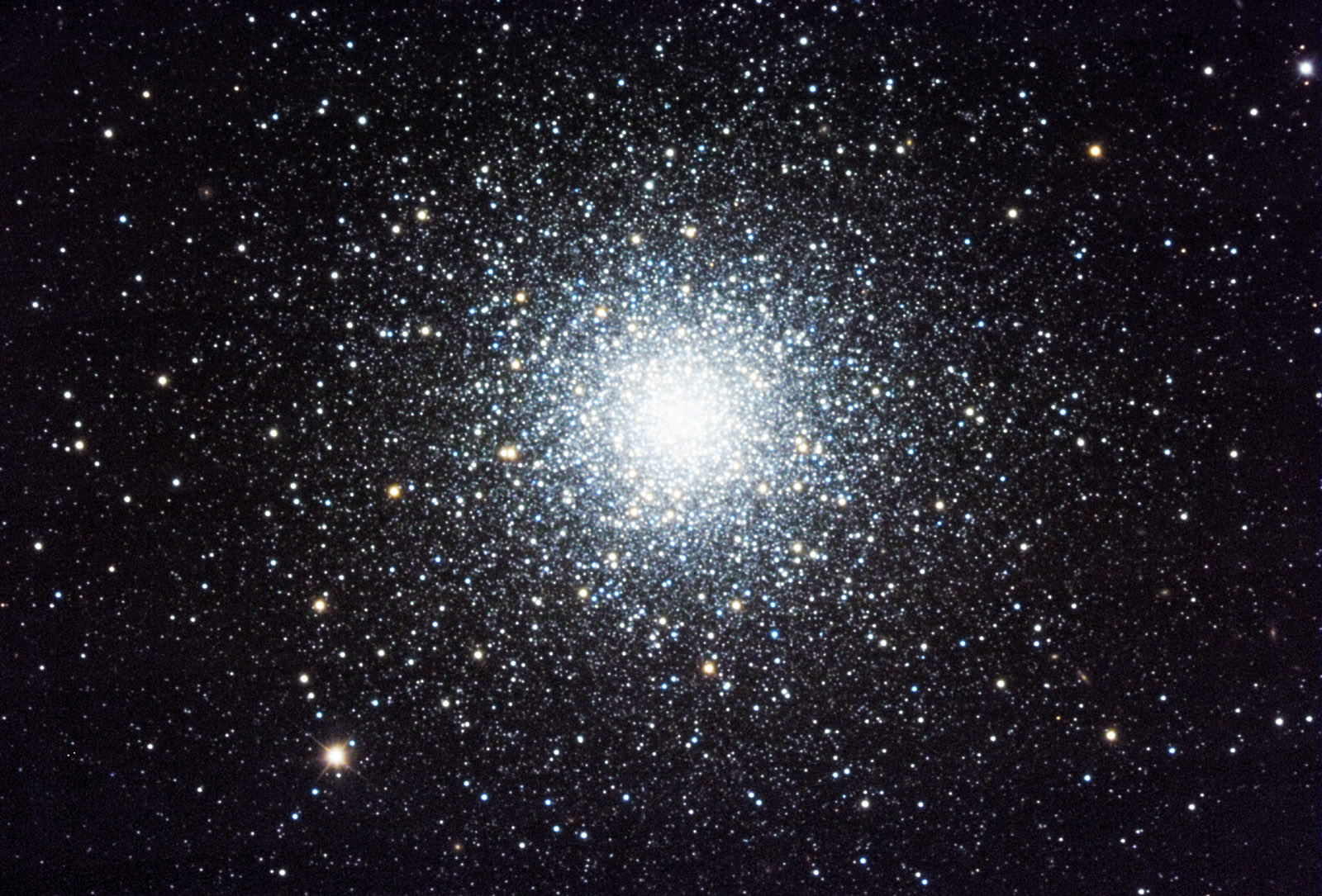
M3, a globular cluster of hundreds of thousands of stars. Lots of wows on this one.


Vesta, the largest asteroid, currently in opposition in Virgo.


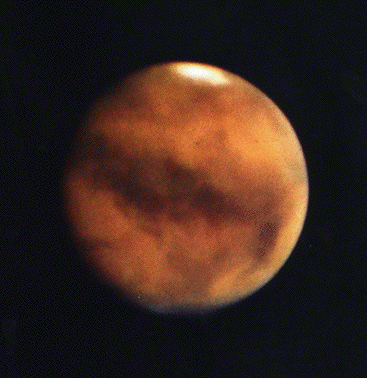
Mars, also in opposition in Virgo. This was the main reason for the trip, as Mars is best viewed this month out of the next two years or so. Through D's telescope a month ago we viewed the northern polar cap, seasonal CO2 frost in the Hellas Basin, and the dark lava flows of Syrtis Major, but this time Mars was facing the other way, so we got a good look at the Vastitas Borealis, including the Acidalia Planitia, Argyre, the various Plani south of Tharsis, and a bit of Syrtis Major again. I found this incredibly exciting. It looked like an actual planet, even though it appears smaller than Jupiter, it is much closer.


Finally, Saturn crept over the horizon and came into view. By far the most exciting of the gas giants, Saturn was so low we had to climb the ladder and straddle the telescope to view it. At 22 tonnes, no mere human would make the view shake. Saturn, its rings, gaps in the rings, and at least 9 moons were quite visible. Everyone was so impressed with Saturn we decided to pass on the last object, M13, another spectacular globular cluster. By this stage everyone was practically catatonic with pure nerd joy, marking a great end to a pretty awesome day.


They say after you look through this telescope you go home and throw away your existing telescope, no matter how amazing it is. Well, I don't even have a telescope! But the good news is that atmospheric distortion limits the resolution of any telescope larger than about 14". Larger telescopes can see faint things better, but on any given night, you'll see planets just as well through a 14" telescope as anything larger. Of course, if mobile phones and quadrocopter drones are any indication, commercial adaptive optics is the next big thing!


Come 1am, I shooed everyone out of the dome and we drove back down the mountain admiring the lights of the sprawling metropolis below. E was to fly out at 6am, so it made no sense to sleep! The night was only middle aged, it was time to party! E packed his things and we headed toward the airport. First, we dropped K in Santa Monica, then we cruised down the 1 toward LAX. Passing under the runway, it occurred to me that SpaceX might not be far away. The launch's recent rescheduling meant my planned factory tour had been cancelled, but we could at least admire the huge factory from outside.

We finally found the SpaceX complex. Visible through the fence was the final rocket assembly area, brightly lit and all action. Not bad for 3am on Easter Sunday. I remembered the crucial presence of a supercharger next to the Tesla design studio so we even drove in the driveway to check that out. A few more glimpses of rockets being created and stray parts hanging around, and we returned to the 105 and, dodging buses oddly persistent despite being empty, we said our farewells.

I zoomed out onto the near empty freeways and was tucked into bed probably before E even made it to the check in counter. I had only been awake for 24 hours.

It is always good to have an excuse to throw an extended and extremely nerdy party, and I'm glad that people like E occasionally visit and always say 'wow' at the right times!

Tuesday, April 15, 2014

Conferencing on the East Coast


In April of every year, physicists around the world gather for the meeting of the American Physical Society (APS). This year, the conference was held in Savannah, Georgia, and I was to give my first APS talk!

The flight was uneventful and, arriving in Savannah, I managed to collect my rental car while dodging 4 consecutive attempts to upsell me. The econobox Ford Focus was electric blue and had leather seats, which is just fine by me.

I drove straight to the convention center, which is just opposite the old town on the river bank. A cavernous space concealed numerous meeting rooms and incessant millings of physicists, while a giant glass wall occasionally gave a view of gigantic container ships cruising up and down the river.

The first day seemed focused mainly on education, with one interesting talk given about using the hyperloop and other awesome ideas as a segue to estimation problems. After lunch, I paid for staying up all night on the plane with a quick nap, then returned for the welcome reception, and one final town-hall meeting on 'Re-imagining the April APS meeting'. 

As it happens, APS traditionally holds two meetings a year, one in March and one in April. The March meeting has grown to about 10,000 people over the last few decades, while the April meeting has gradually shrunk to about 1300. Much hand wringing and questioning followed, but given the various issues brought up during the session, I'm surprised it hasn't vanished entirely! As an example, APS April meeting usually covers high energy physics, but there's a bigger conference called DPF in Europe, and most high energy physicists work in Europe, because they have the LHC, so most of the fancy results get announced at DPF. Other traditional mainstays of the April meeting include nuclear physics, which outside of North Korea has been on a long decline ever since all the elements were discovered. Additionally, the April meeting was once held traditionally in Washington DC, to afford better access to congressional members, but is now seen as too costly. Instead, the meeting, which is still not cheap, jumps around each year and is now seen as a good venue for professors to give their students practise giving talks. There were many suggestions, but most were remarkable only for their inability to actually address the key issues.

Speaking of talks, there was, as usual, a wide spectrum of talk quality. Something I've become more aware of over the years, I took some notes of particularly egregious elements and compiled them into a recent blog post entitled "The worst conference talk ever". http://caseyexaustralia.blogspot.com/2014/04/the-worst-conference-talk-ever.html 

Soon enough, it was time to drive back to town and try to find my couchsurfer. During conferences I prefer not to stay in a hotel, even if someone else is paying. Soon enough I located J's place, a nice cottage with a few garden blocks next to it, containing an intimidating dog, an aloof cat, and, of course, J. J is an art professor at Savannah College of Art and Design (or SCAD for short) and had some incredible paintings in his house and studio. We went for a drive that evening and J showed me the old town's 24 squares, some fancy old houses spared during the civil war, and the ~100 buildings owned and restored by SCAD, which has apparently reversed the fortunes of this town.

Next morning I bounced out of the air mattress at the first sound of dog claws coming to wish me good morning. Soon after J pilfered some eggs from his chickens and we ate breakfast. I drove through the foggy morning beneath tree-lined tunnels festooned with spanish moss to Whole Foods, where I raided their counter for lunch supplies. The conference center had only one rather dubious kiosk selling incredibly fast food, so I was sure to bring several loaves of bread.

If Saturday went slowly, Sunday picked up a lot. I gave my talk, entitled "Spectral Characteristic Evolution: A new algorithm for gravitational wave propagation", in which I spent most of the time talking about the problem and constructing an elegant coordinate system, and a couple of minutes showing convincing looking results. After lunch there was another town hall session on APS corporate reform and open access publishing, which about 20 people (including me) attended. I've always been interested in open access, but the issue is extremely complicated and divisive. To be sure, there are now MUCH cheaper electronic publishing models, but peer review still takes time, not that the reviewers are paid, of course. Adding to the complexity, countries which fund a lot of science research, like England or the US, have indicated that they will compel public access to publicly funded research within the next few years, possibly simultaneously with its publishing in (mostly) library subscription funded journals. Like everything else, the situation is in a state of rapid change. I'm a relatively new entrant into physics academia, but I can count the number of times I've gone to a library to borrow a book or ask for a journal on one hand. Of course, some types of research use the library system far more than mine, which is mostly new, mostly cutting edge, and mostly done at Caltech. 

Still, the attitudes to for-profit publishing has taken a hit in recent years as the various practises of the Elsevier publishing group have been widely seen as opportunistic and exploitative. I recall once asking a senior member of the Caltech administration if they'd consider making a statement in support of open access, as many other university leaders had already done, and they assured me that the traditional model was the only viable model for protecting the strength of peer review. How so sure, I asked, and was told that his colleagues on the board of one particular publishing group and he were quite certain that their model was the way to go!

And if I hadn't already had enough of introspection, I was recruited to be part of a focus group looking at internal publishing of the APS. In particular, it publishes and mails out a news paper and glossy magazine once a month to all ~50,000 members. In most labs I've seen they're stacked up like cord wood, and are even occasionally read. The group helped APS to understand what the non-tenured (ie 99%) of APS was after, and mostly it concerned job openings, career stuff, meetings, funding for meetings, and so on. Towards the end, a new print publication was mooted which I strongly critiqued on the grounds of expense, environmental harm, and broad irrelevance. The readership of accurate scientific reporting has greatly increased in recent years via facebook and twitter, but articles need to be written and published online within hours of a result to be shareable or clickable, and print media just doesn't cut it. There's an online version of the various existing publications, but as if to underscore my point, an article that just made it into print in APS news talked about the impact of tensions in Ukraine to NASA/Roscosmos cooperation in space and on the ISS, and largely downplayed it. 48 hours before, a NASA directive to discontinue all non-ISS related work had leaked and had already trickled through all the blogs, facebooks, etc and disappeared. That is, even the most up-to-date reporting currently existing in the popular APS literature was at least 3 days out-of-date. And there is a terrible need for science articles written by people who won't get 50% of the detail wrong.

With that out of the way, L, S and I decided to explore Tybee island, a coastal town at the mouth of the Savannah river. We drove down over marshes and wetlands, eventually reaching a nice looking beach with a big wooden peer. As soon as we stepped out of the car, we were nearly blown back to Savannah. We dodged seagulls and a few brave pigeons practically disintegrating in flight and went to the end of the peer. It must not be a very good peer, because the (rather small) waves were breaking beyond it, but we watched a few ships track in and out of the mouth and enjoyed the view. Before long, L's hair was a complete disaster threatening to attain sentience and secede, so we struggled back to the car and drove into town. With a quick detour via a very fancy ice cream shop, I stranded them in town and drove back to J's place. 

Monday morning started with a talk about Ice Cube, the neutrino experiment in Antarctica embedded in a cubic kilometer of ice. Apparently it has detected some astrophysical neutrinos, which is quite exciting. Next up was Neil deGrasse Tyson, talking about physics in the twitterverse, his recent show Cosmos based on the original series by Carl Sagan, and a few other rather amusing things. One of his best lines was to get a show of hands who votes Republican. The room of about 1000 people included half a dozen brave enough to raise their hand. He turned the premise on its head by reminding the audience that as many anti-science people vote democrat as republican, only the democrat types tend to be crystal healers, astrologers, new agers, and so on, who generally lack a political dimension to their crushing inanity.

The rest of the day unfolded in its usual way, including the regular poster session. Poster sessions are a mixed bag, varying between the odd undergrad who hasn't got enough material for a talk or doesn't know how to integrate something, right up to 'independent researchers', or the usual cosmic crackpot background. Especially for someone who works in gravity research, crackpots are a part of life. Yet talking with them is often just as frustrating as talking with an antivaxer or young earth creationist, and not usually as fun. Humans just find it really hard to practise questioning everything, starting with themselves.

That evening our topical group GGR (gravitation stuff) had its meeting, where we talked about growth. Apparently we're right on the cusp of having enough people to qualify as a division of APS, with all the associated benefits and privileges. And if LIGO works, who knows what will happen.

The next day, Tuesday, was the final day of the conference. With no big closing ceremony or formal dinner, most members had already left and it was rather quiet. All dues-paying members can present a talk if they so choose, and so most of the crackpot talks got bundled into a couple of sessions on Tuesday suggestively entitled "New Directions in Astrophysics" and "Frontiers in Gravitation". In one of those sessions, the chair hadn't even bothered to show up, which was perhaps a mercy. No two crackpots are quite the same, but a good number often mention similar ideas, which gave me an idea for playing bingo. Any mention of the phrases "Einstein was wrong", "Stephen Hawking says", "Steady-state model", "God", etc earns you a point, while any mention of a relevant physicist or a correctly used equation loses a point. S, J (different J) and I hightailed it from a talk about "Creator God Rules The Universe Because Hawking Built The Big Bang On A Foundation Of Quicksand" to the airport, where our timely arrival was rewarded with significant flight delays. I eventually made it to NYC after only a few loops around the Jersey shore, while J, S, and B were all stuck in JFK airport overnight.

Arriving at an airport is always slightly disorienting, as though you're consciously aware of the different latitude. Probably just an effect of altitude and dehydration. I stretched my metatarsals and strode to the airtrain and subway, disappointed to find my pass from 2012 had somehow 'expired'. With a slight feeling of vertigo, I realised I was on the NYC subway without a map, for the first time ever. I only got slightly lost before finding my friend K's place. K and I first met about 4 years ago on a different couch surfing adventure, and have stayed in touch ever since. When I'm in town we usually catch up, which is just frequently enough that there's usually a new house, new job, and so on to catch up on!

By this time it was dark and the apartment above a bottle shop was cozy and warm. We made a strategic foray to a laundromat across the street, ate pasta, and consumed some Game of Thrones.

Next morning K had already gone to work, so I stumbled out of bed and caught a train into town, getting off at Times Square. Walking through NYC, it's always easy to fall into the belief that it's a very sophisticated tableau or post-modern drama being enacted in front of you at all times. I'm not sure if I think NYC is the best place on Earth, but it's certainly unique. People with incredible accents screaming at kids or dogs, crowds of comically short people milling around, towering sky scrapers, the hustle and bustle. I worked my way down town, pausing to check out the blade runner building over the tracks on 10th and 33rd. I'm still not sure what it is, but it looks much less imposing up close. 

Down the high line, then across town to Stuyvesant Town. Walking past I had always found the aspect rather intimidating, but this time ventured inside to find a lot of playgrounds. I continued to the south to check out the alleged locations of Rent. Even though Jonathan Larson and his friends all lived in Greenwich. Still, Tomkin's Square Park is there, and the yuppie infested coffee shop where Life Cafe was, and the lot next to the building on 11th and B, now the Toyota Early Learning Park. Soon enough it was time to head home to relax a little before heading back to the Flatiron school in Very Lower Manhattan for a lockpicking workshop. It was good to have an expert (Schuyler Towne) on hand to explain some of the subtleties I've never appreciated.

Around 9pm it seems like it's time to sleep, but NO. K's friend A, with whom I originally couch surfed in NY, was having dinner at Lot 2 in Park Slope, so off I went on the R line and enjoyed a lovely lamb dish with A and her friends B and J (different different J). A was doing some incredible grad school stuff, J was about to start making harpsichords, and B had escaped Christian fundie home schooling and seemed to find my geological ramblings interesting, which is a first. After dinner I pointed out Jupiter and Mars (in opposition!) and then walked back to K's place, where another excellent sleep was awaiting!

Next morning I woke rather late, packed my things, and took the subway to the upper east side where I met an old friend S, with whom I used to sing in Fluid Dynamics. Now studying medicine at Sinai, she brought a nice friend with her, and shortly joined by an old Australian friend C working in New York we raided a buffet style Indian lunch restaurant. It was so tasty I had not one but two full plates, but then again, I was eating breakfast and lunch in parallel. The girls had to disappear to "study" for an "exam", whatever that means, and C and I retired to his elegant raw brick lined apartment to examine cats, contemplate complexity theory as applied to music, and compare notes. Of course, C once had the misfortune of being my lab TA, so it's always good practise to reinforce his mistakes and feelings of regret by making purposeful arithmetic errors and suggesting inefficient algorithms. I was, I must confess, a demanding student at times.

On the way back to collect my things I stopped by Kee's Chocolate Shop on Thomas and Spring. Now a mere satellite for the main business, they make chocolates so good I once ate a few despite the allergy induced discomfort I was to endure for a week or so. This time, however, I managed to restrain myself and delivered the package complete with a pasta repayment (with interest) to my generous hosts. I packed the last of my things while slightly bewildered by the sound of one of K's housemates laying down rap tracks, and headed for Penn Station with only a short detour to return the house key. Walking through the financial district wearing my Occupy Mars shirt drew a few odd looks. Opportunities for travel and renewing old friendships are somewhat intermittent, and as I rattled under the Hudson another whirlwind trip drew to a close.

Google had suggested that trains to Philadelphia could be had for between $100 and $200, depending on speed and comfort. Remembering another route which was about the same speed and somewhat cheaper, I bought a NJT ticket to Trenton. For the first time, the scale of abandoned industrial might in Newark really dawned on me and I wondered where it all went. Part of the Rust Belt, the shift away from northern heavy industry is something I still don't fully understand. I suspect a rapid period of city and infrastructure building was spurred by high levels of immigration across the north east, but lacked the generational renewal necessary to keep the forges hot. Transition to a zero growth economy is still regarded as one of the more difficult economic problems.

At Trenton I bought another ticket to Philadelphia center city, for a total ticket price of $24. Of course, the bus is much cheaper, but trains are trains! I freakin' love trains. In Philadelphia I found my way to my cousin J's place. J (different different different J) lived in a central part of the city and worked in sustainability, which is pretty awesome. I found my way into his building and up to his flat as he came down to meet me, which had the somewhat odd result of me sitting at his kitchen bench as he came in the door. We hit the streets and headed north to chinatown for a well deserved bowl of ramen with assorted sides. Yum!

The following day I got up during the mid morning and walked to the nearby Macy's store. Extraordinarily thorough readers of this blog will already comprehend the significance of the central Philadelphia Macy's store, but for the casual reader who has somehow got this far, I will give a quick summary. Originally the Wanamaker department store, the building is home to a few oddities, including a 2500lb bronze eagle and the world's largest playable pipe organ. Occupying a series of chambers around the central six story atrium, the organ boasts around 30,000 pipes, including an insanely amazing string division. The console is helpfully located in the women's underwear section. At noon each day a 45 minute recital is given, following which I set out for Rittenhouse square feeling downright strange.

Eventually it dawned on me that I hadn't eaten breakfast or lunch, so I found a shop and bought a meat sandwich of the sort that Philadelphia is famous. Apparently it's called a "hoagie", though without cheese, of course. I continued my trek through the city, eventually stumbling upon the Franklin institute, one of two science museums one block apart. It seemed to contain 4 different theatres including a planetarium, an Imax, a 3D, and something else. A moving exhibit on Pompeii was excellent, as it contained all the cool little stuff that wasn't there anymore when I visited in 2006. Jewelery, surgeon's tools, and other shiny objects, complete with the requisite dramatic music and CGI eruptions. The rest of the exhibits were rather dated, including one section on space exploration where the styling was nearly as retro as the ethnographic museum I once saw in Hovd, Outer Mongolia. Part of me suspects that I'm no longer at the optimum age for these museums. Part of me is in denial. They also had a pretty cool Tesla coil suspended from the ceiling.

Walking back from the museum I dodged skateboarders in Love Park, guerrilla gardeners in various empty lots, and found my way to the Navy Yard shuttle.

So it turns out that Philadelphia has the oldest navy yard in the country – even older than the country. It has been built on a few times since then, including a bunch of dry docks and a few gutted air craft carriers. But, for the most part, its industrial machinery is cold and its buildings empty. Trying to promote urban renewal, the city has granted tax breaks for innovative companies with a sustainability focus, including the one J works for. Urban Outfitters has also retrofitted a bunch of buildings down by the river with an ultra modern factory, complete with indoor gardens, art installations, skylights, and all the other stuff that finally seems to be gaining a foothold in some places it's desperately been needed for a long time.

We walked to the nearby stadium and, courtesy of a friend of J's, watched a baseball game between Philadelphia and Atlanta. From where we were sitting, we had a great view of the play but basically no idea of the score, which was just perfect. We understood the rules just well enough to have a vague idea of what was going on. A massive selection of food suppliers behind us kept us stocked with food and drink, and we enjoyed several hours to catch up on perhaps half a decade of news between us.

Just before it started to rain we strategically retreated and found our way back to the apartment where J and I studied our Australian accents with the help of renowned comedian Jim Jefferies.

Next morning I woke early but relatively refreshed. Eventually we set out for a food truck for a bacon and egg sandwich (health food!), and then walked to the Mutter museum. I had been once before, but they've moved some things around, and given a bunch of the placards a fairy tale theme, with all the awful horrific stuff left in. Which is appropriate, given the subject matter. Of course, the Mutter museum is the College of Surgeons' Museum of Abnormal Anatomy. Lots of skeletons, body parts in formaldehyde, and plenty of peculiarities and curiosities. J, who is not normally queasy, found the plasticized veins and arteries quite difficult to look at. Of course, I had all this stuff instead of Sesame Street as a kid, so I'll probably only have nightmares for a few weeks.

On the way back we stopped at the market, where I located an excellent olive and thyme loaf of bread to consume during our walk to the Liberty Bell and other assorted historical stuff of which I was vaguely aware. At some point we noticed that Benjamin Franklin's name was basically everywhere, and in honour of the great man, we read his letter of advice concerning older women. I was then entertained to discover that he had met Casanova when representing the new republic in France and they had discussed the issue of steering balloons. At the time, of course, the laws of fluid mechanics were not well understood and it was thought (despite evidence of ships at sea) that balloons were fixed in the wind. Barring external power or rapid rotation, this is basically true.

We headed back to the apartment for a quick nap, then went for a final afternoon walk to the Delaware river and a local antiques market, before I found my way to the station amid a sea of extraordinarily good looking young women enjoying the extraordinarily good weather, and headed out to the airport. The usual TSA theatre and hassle and I boarded the flight back home. Otherwise uneventful, we had some fun turbulence over the Rockies and lightning flashed out my window for nearly the entire flight. My customary welcome back to LA was complete when my pre-booked airport shuttle was 40 minutes late!


Friday, April 11, 2014

The worst conference talk ever...

And how to avoid it being yours!

Huh? Isn't this blog usually about travel and merciless self-promotion?
Yes. But this entry is different. Nothing I say here is particularly original, but I'll attempt to synthesize into a shortish article containing some pointers for speakers. The subject matter is conference talks, but a lot of what I have to say applies to any public speaking event.

Communication!
A conference talk is about communication. Communication takes two parties - the speaker and the listeners. Fundamentally, you must ask yourself mercilessly if what you are doing is communication, or if you're improving the extent to which your talk is good communication.
Is my talk communicating well?

Context
A conference talk is not like a lab talk, a journal club, or a lecture course. At a conference, people working on similar or different things are getting a broad overview. In a 10 minute talk, there is not really time to give a comprehensive view. A conference talk's role is to update the audience on the state of research and knowledge, and to pique their interest to discover more. They can always find you over bagels or read your papers if they need more detail. The audience are generally professional physicists, but they know less about your field than the average peer reviewer, and that should be kept in mind.
What does my audience want to hear? What don't they already understand?

The speaking bit
Speaking is the most important part of a talk. You'd think, given the name "talk", that this would be obvious, but most people tend to treat what they say as optional ambiance for their slide show. This is a fundamental mistake. A good talk is well written and can stand on its own without slides. It could be read over the phone or heard on the radio. 

If you are not accustomed to public speaking, you should practise. A lot. Basic concepts include clarity, grammar, projection, speaking slowly, and so on. Many of the audience members will speak English as a second language, and are sitting some distance away. Repeat audience questions. Encourage the audience to wave if they can't hear. 

The content of the speech is also incredibly important, but often neglected. Many speakers read their slides. Words cannot convey how wrong this is. A speech should read like a pithy, preferably witty essay or short story. Given time constraints, it pays to think carefully about what you want to say, construct a compelling narrative, use evocative language, and synthesize ideas and concepts with the central topic regularly. Unless your results are perfect, acknowledging shortcomings with self deprecating humour is usually a plus.

Is it easy for people to listen to what I'm saying? 

Presentation
Comb your hair and wear nice clothes. People should feel comfortable looking at you and your face - it's very important for communication. Similarly, room lighting should be bright enough for people (even ancient professors) to read fine text. A lot of the conference is about networking and recruitment.
Dress up for a job interview or better.

Slides
This is by far the most abused part of conference talks. There are many ways to screw it up. Fundamentally it comes down to communication. A sequence of slides is great for telling a story with a strong sense of chronology, so write your talk accordingly. A sequence of slides is terrible for illustrating connections in complicated systems, so be careful.
Does my slideshow actually contribute to my talk?

Quantity of slides
If you try to split a paper or thesis up into a slideshow, you will have too many slides. As a general rule, one slide per minute of talk is about right. Less is fine. More is definitely not fine. If you have difficulty fitting your 10 minute talk onto about 10 slides, the answer is not to make your figures smaller. Break your talk up into 6-8 key concepts or results, and have a slide for each.
Does each slide actually add substantially to the whole?

Use of slides
What are slides good for? People can speak and listen more quickly than they can read, but a good diagram speaks better than thousands of words. As such, slides should be used almost exclusively for diagrams, figures, graphs, plots, and so on.
Is each element of my talk contributing the best it can?

Slide dos
Do use big diagrams. Do label diagrams appropriately. Use labels rather than keys, label axes, title graphs. Title each slide with a short, pithy, and specific label. Keep it simple. You can always answer a question with overwhelming detail and erudition.
Is my slideshow an exercise in communication?

Slide don'ts
Don't use bullet points. Especially don't use hierarchical bullet points. Don't use 'introduction', 'conclusion' or any other generic term as a slide subject. Don't use block text. Never read text on the slide.
Have I done anything which will make the audience want to shoot themselves or me?

Good figures
There are many resources on the art of making good figures. But in general, you know a good figure when you see one. Colours are used to transmit information. The colour palette should be chosen so that colour blind people won't be too confused. Diagrams and graphs should be devised to be as simple as possible. Axes should be clear but unobtrusive. Information should be dense. The most important basic information should be immediately obvious; subsidiary detail should not dominate the figure. Tables are better for small data sets. The take home message should be obvious. A figure might require explanation - that's why you're there, and that's okay.
Is my figure a work of art?

Lolcats
Visual punctuation is important, especially for didactic talks. If you want people to remember things, a change of tempo is a good idea. Eg "lolcat says always check your dimensions" is a lot more memorable than anything else. That said, overuse cheapens the effect and shouldn't be necessary at all in many contexts or with a sufficiently well written speech. Be aware of political correctness when executing any naughty jokes.
Am I comedian? How do I want to be perceived? Will people tune out?

Title slide
The title slide is important, since it'll sit there while you're being introduced. It should have a relevant figure on it, preferably enticing and visually stimulating. It should also contain the title of your talk, your name, your collaborators (be inclusive), your institution, and the conference you're at. This is to remind you what you're talking about, and to help you check you have the right slide show. A double title slide is a trick where you have two nearly identical cover slides. While you're being introduced you can switch between them to check the show is working, without distracting the audience too much.
Is my title slide a throwaway? Is it worthy of the subject matter?

Audience participation
Audience participation is generally a good thing, as it promotes engagement. The best talkers regularly pepper their talks (especially longer ones) with anecdotes and refer to people present in the audience, and even ask questions (especially in a lecturing context). When I'm giving a lab talk, I usually start by polling everyone in the group on their knowledge of the topic. It generates a framework. In the context of a conference talk, asking people to raise hands if they can hear you, especially if you prefer not to use a microphone, is a great way to turn their brains back on after hours of semi-comatose sitting. If your talk concerns something of a mystery, getting people to take a guess at a unknown result is also a useful way to engage. Eg "Show of hands who thinks the Higgs mass is between 120 and 130 Gev?" In a smaller seminar, get and keep everyone talking.
Do I have any evidence anyone is listening to me?

Lasers
Never under estimate the importance of lasers. Technically, you should be able to give a talk without a laser, but I find it's much more fun to secretly have a laser pointer capable of de-orbiting the space station. It helps to foment a feeling of awe in the audience. You can also claim its astronomical cost against tax. On the other hand, if you ever point it anywhere except the slide, you're an asshole who is gambling with people's vision.
Can I afford a bigger laser?

Flexibility of presentation
If the talk before yours introduces the same material and it's the same audience, skip your introduction. There is nothing worse than hearing "Professor Y spoke about this, but it's on my slides, so I'll go through it again anyway". There is nothing better than saying "Thankyou Professor Y for introducing my talk so well, this diagram is exactly the same as blah, next slide". If someone asks a good question during the talk, change the talk as necessary. Have spare diagrams at the end of your talk that you can jump forward to if you need to.
Is my talk structure more important than its purpose?

Audience etiquette
So now we know what makes a good show. How to spread the word? What is the best way to stage an intervention in a terrible talk? Some people walk out. Some people openly criticise. Some people play guerrilla laser tag with their laser pointer. Unfortunately I do not have any answers for this. But at least every time you see someone do something silly, you'll know not to do that yourself.
Is my life long enough to put up with this affront to informational aesthetics?

Sunday, April 6, 2014

Long lost blog update

So I haven't done anything hugely spectacular since new year. But I've done a lot of smaller things, which I'll attempt to summarize now!

Flying! I've been learning to fly. It's taken a bit longer than I expected, due to being busy with everything else. But here are some photos from my various cross country solo flights:

Australia! I went to Australia in late January to hang out with family and show P the sights. One highlight was a tour of the Town Hall organ. Photos are here: https://picasaweb.google.com/105494084231616659850/Australia2014

Mars stuff! Some of my friends are involved in driving robots on Mars. One of them recently took this awesome panorama looking out at the crater walls.

Full size: https://www.flickr.com/photos/106629967@N06/13652263093/sizes/o/

3D printing! I've been spending some time 3D printing things. This is a 3D model of 12 DNA basepairs. Spheres proportional to atomic size. 100,000,000 times actual size.

Sunday, November 17, 2013

Mexico 2013 field trip


I was thrilled when I found out that the Fall 2013 Ge 136 field trip would be going to Baja California again. Regular readers will know that this is my favourite class by far. I have now done it 6 times. In fact I have done it so much that we're beginning to repeat material. For grad students like myself who lack a car, time, and silliness, the field trips are a perfect opportunity to find out about the land from those who know it best!

The previous trip to Mexico occurred in November 2011 (http://caseyexaustralia.blogspot.com/2011/11/ge-136-field-trip-to-baja-california.html), and was the last time my old camera and lasers worked properly. There was a violent rainstorm that caused everything to get wet! The forecast this time was somewhat better. 

Thursday evening. I stumbled out of a class on matrix beam theory and, collecting my gear, headed for the trucks. Lined up gleaming in the dark purple twilight, each had a full tank and an empty trunk, but not for long. The TA H had allocated me as the driver of all the undergrad girls. Punishment or reward, I wasn't certain.

We hit the road. After an hour we emerged from the traffic jam and, cruising south on the 610, made it to the campground near the Tecate border crossing in just under 4 hours. My gamble with the route had, for better or for worse, had no effect - we arrived within 5 minutes of everyone else! I ditched my bag on the party tarp and sat around the campfire. By 10pm, Jupiter had risen, so I cracked out my binoculars and showed people the moons. Three were visible as specks of light around Jupiter's impossibly bright disk. The moon was also visible and cratery.

Aware of the long drive the following day I headed to my luxurious bed - a blanket folded over 3 times under my sleeping bag - leaving the rest of the class to tend the fire and their collective raging thirst. As something caught fire, the leaves above me twinkled in reds and oranges.

During the night, I woke with a start. A roaring sound and the earth shook. Leaves fell from trees - could this be another earthquake? I sat up and looked around. I was surrounded by dark seal-like sleeping bags on the ground. Then the roaring started again. Someone was snoring next to me. I lay back down and strategically accidentally-on purpose sleep-kicked them, and they rolled over. Crisis averted.

I was greeted by a bright clear morning. I retrieved my supply of naan bread and quickly warmed it over the gas cooktop. Sunnies firmly in place, we convoyed to the Mexican border and drove under a boom gate. Ten minutes later we were outside Tecate on the open road. The road snaked between massive outcroppings of boulders. The mountains here are the eroded roots of a batholith, an exhumed granite mass of rock. Periodically we stopped for talks, and before long we had sped to Ensenada and Cicese, where we resisted the pull of roadside stalls and picked up O and J, two geology students from the University of Baja California. To the south of Ensenada, Punta Banda sticks out into the Pacific Ocean. A narrow spit of land broken out from the peninsula and thrust to the west, it has some particularly excellent rudist remains, as well as a series of paleo sea terraces. But today we were not going to Punta Banda, we were going to its mother fault, the Agua Blanca fault. Lunch was set up, and people took photos of the picturesque mountain range. At some point someone said 'that's an interesting off-set'. Indeed, the mountain featured a series of straight v-shaped valleys which abruptly kinked near the base, marking the location of the Agua Blanca right-lateral strike slip fault.

Punta Cina looked like an unlikely bet. There's a fabulous fossilized reef being turned into cement in a factory, and the owners are less friendly than before. Fortunately our Mexican guests knew of another exposure in a canyon behind the next campsite. We cruised south toward Santo Tomas, site of the oldest vineyard in North America, started by Franciscan monks as part of their perhaps well-intentioned and certainly highly effective program of cultural and racial obliteration. We struck out towards the coast and our first campsite. 2 years ago, it was under water and I didn't see that much of it. This time though, gently rolling plains swooping down towards herds of cattle and the sea. We stopped by a lighthouse for some talks, then proceeded to our camp site. 

A quick scramble down the sea cliff and we were on the beach between gently sloping cretaceous sediments and the gentle waves of an ebbing tide. Of course the cretaceous sediments contained more than a few fossils (though you'd have to know what to look for), giving a real insight for how the environment changed over a few million years as we walked down the beach. Generally speaking marine deposits shallow over time as more silt accumulates, however subsidence or sea-level changes can rapidly change the character of species and even the rock type in one strata. I even managed to skim a few chunks out through the breakers, though missed the seagulls in the process. Half way up the sea cliff is an cretacious-paleogene unconformity. Though there are a few tens of millions of years missing, somewhere in between the dinosaurs died out. Today this gap is marked by a narrow ledge, covered with the seabird descendants of the only surviving dinosaurs. Even better, the next bay has a few hadrosaur ribs here and there...

That evening we had a fire constructed, fold-out chairs deployed, and mountains of the only appropriate dinner (pasta) duly produced. I was feeling slightly skittish, so took my camera and tripod up a nearby hill to take photos of the camp and so on with long exposures. My plan was to capitalize on the excellent stars and produce my first all-sky night-time panorama, but unfortunately some clouds blew in and the setting moon washed everything out a bit. Still, I found a nice cactus to sit the camera on. After a few minutes as my hill-climbing heat leaked away, I heard the youthful voices of some undergrad friends making their way up the hill. We took a few photos together and I headed down. At about that moment some fog blew in, but my friends were determined to finish their climb without lights. Soon after their absence was noticed, which caused quite a lot of excitement. But half an hour later around the campfire, all (and then some) was thoroughly forgotten.

I found a stretcher in the back of one of the trucks and, setting it out on a nice flat patch, curled up inside my sleeping bag as the stars ground past overhead and, occasionally, a shooting star shot across the sky. Fortunately, there were no tremors that night.

The next day I took myself out of my sleeping bag, my trousers out of my sleeping bag bag, then placed myself in my trousers and my sleeping bag in its sleeping bag bag. This is not as technical as it sounds. Soon I was packed, eating breakfast, and running around like a epileptic monkey with my camera.

The convoy headed for the homestead, where we met the ranch owner, admired his collection of derelict cars, and headed for the canyon upstream, where, legend has it, an ancient coral reef is exposed between rocks with pouring water. We made our way up canyon, climbing up several waterfalls and balancing on logs across muddy springs until we popped out in the head of the canyon, finding a cave full of ash and rat droppings. In the roof of the cave was preserved the shells of rudists, ancient reef-building clams that died out a long time ago.

Next stop was a rock outcrop to the south. Strata dipped at 30 degrees, with a thin layer of limestone preserving several excellent fossils of coral. Above and below, volcanic ash. Indeed, 100 million years ago, these rocks were the shores of a volcanic atol, and we even found chunks of reef broken off and entrained in basalt lava flows.

Soon after we found a beach highly worthy of a long lunch break. Long mainly because two of the vehicles became stuck in sand, providing much mirth and hilarity in between a short dip in the rather fresh ocean to provide some free space for fresh layers of dirt to accumulate. From here the road continued along the top of a precarious cliff and we, now radioless, drove south to San Quintin, where we parked behind a sand dune and ferried our camping gear to the top of the hill. 

Once again a fire was duly lit, only to realise that we were perilously low on firewood. After a stunning dinner of tortillas with enough left-over rice to keep hunger at bay for whole hours, I went for a walk down the beach to find some wood. I returned with a respectable bundle of sticks, only to find in my absence an enterprising geology grad had sourced a few palettes, which, for the record, burn really well. Later this was augmented by a half dozen tree stumps, for the best camp bonfire I've ever seen. Initially there were about 8 of us on our knees around the fire pit, close enough to high five over the top. By the end, we could have sent signals to Mars.

Then it was time for the shovel-olympics. Being errant geologists, we had no fewer than four shovels. 7 nationalities were represented, though sadly, as always, I was all alone representing the southern hemisphere. The with a large representation of Americans, there was a few defections, in particular to China. The events consisted of shovel javelin, shovel discus (which was more like shovel evasive action), digging a hole, dizzy shovel (shotgun a beer, run around shovel 10 times with face on shovel, then run to the water and back), shovel limbo, and shovel possession knockout. I even remembered to fill in the holes afterwards so noone died.

Next morning we packed the vehicles then prepared for our most distant talks. Just behind the dune was a microbial mat, one of the more ancient types of environments on earth, today preserved only in saline environments. Consisting of bottomless black ooze topped with a 1mm thick rainbow layer of living phototropic bacteria, it's one of the most productive biomes (in terms of biomass accumulated) in the world. It's also thought to be one of the main mechanisms by which oil is generated. My foot-width to height ratio was just high enough that I could walk across the surface without punching through the crust, but many people punched, and some punched gloriously, sinking to the waist. S attempted a body slide, with scratchy results. 

Soon it was time to head back, with only one more stop along the way. We drove down a wash towards a small but pretty beach, a few ramshackle houses dotting the hill above. On the right, a layer of soft gray sediments was topped by a hard red conglomerate. Nearby, the grey contained ammonites, and the red contained shock-quartz, generated by a meteorite impact. A short erosional unconformity, but otherwise a perfect place to finally give my talk on radioactive space rocks. 

Nearly all rocks are made of minerals with oxygen. Oxygen comes in three stable varieties, of respective atomic weights 16, 17, and 18. The 16 isotope is MUCH more common, so looking at the ratio of 17:16 and 18:16 is illustrative. The relative concentrations get moved around by mass-dependent reactions and symmetry-dependent reactions, forming discrete regions. Different space rocks start out with different amounts of oxygen, because oxygen is made in old dead stars and spread into space on grains of dust and as gasses, and each planet is made of different amounts of gas and dust, so each planet and asteroid family has a different root composition. Put together, you can work out where any meteorite came from. For instance, a thin layer of clay around the world at the K-Pg boundary is a mix of about 90% destroyed coral reef and 10% meteorite that wiped out the dinosaurs, except birds. By counting how much space-rock is in that layer, we can estimate that the relevant asteroid was about 10km in diameter. That sounds small in comparison to the size of a city or even a marathon, but remember that when its face touched the ocean surface, its tail was still in the stratosphere. There's also a growing family of meteorites that are recognised to have come from Mars. Magnetic analysis tells us they never got hotter than 50C or so either during ejection, flying through space, or Earth atmospheric entry. Cosmic ray analysis says they were in space for a few hundred thousand to a few million years. In other words, even today Mars rocks are raining down, and in the past, many, many more would have, more or less guaranteeing that if life originated on either planet, it could now be on both. I think that's cool!


Concerning Mars, MAVEN, an atmospheric satellite is going to Mars in the next few weeks. It's going to try and figure out what happened to Mars' atmosphere. We know it used to have a thick, wet, warm atmosphere, but it's been lost. Either it's frozen out on and in the ground, or it was blown away by the sun. Both are possible, since Mars lacks a large magnetic field (though it certainly once had one). It's thought Mars was warm and wet until 3.8 billion years ago (with possible short warm periods since), while for comparison the earliest life on Earth was 4.2 billion years ago. It's possibly Mars lost its magnetic field, then enough of the atmosphere blew away to start a run-away icebox effect. Of course, the Sun is about 25% hotter today, so maybe we could reverse that effect. My personal suspicion is that oxygen producing microbes evolved on Mars, as they did on Earth. On Earth, the oxygen oxidised minerals on the surface until saturation, producing the banded iron formations. Tectonic and geologic activity ensured a large supply of oxidizable rocks, but eventually things saturated about 2.4 billion years ago. The atmosphere lost much of its CO2 and methane as microbes poisoned themselves with oxygen, and in the process, a lot of the greenhouse effect. Earth went through several phases of mass glaciation, known as snowball Earth, because a nitrogen oxygen atmosphere is not as warm as a CO2 heavy one. My personal opinion, completely unsupported by evidence, is that the same process occurred on Mars, but it occurred faster. Mars has geological processes, but they're about a million times slower. As a result, the time taken to oxidize minerals at the surface was much shorter, at which point the microbes effectively punched large heat-windows in their own atmosphere and froze to death. Unlike on Earth, there wasn't enough time to evolve oxygen-using microbes that could exploit the oxygen and stabilize the atmosphere, at least, not on a planetary scale. We shall see.

But, I digress. We loaded the cars and headed back to the road. K copiloted and provided conversation to keep me awake. In return I tried to teach her to solve a Rubik's cube, with the added complication that I was unable to see it. But we nearly got there.

We spent only 1.5 hours at the border waiting to get through. Fortunately our car had a nice guard who wasn't too mean, but some of the other cars were flashlighted rather aggressively. Then onto the main road, a brief stop in Temecula In 'n' Out, and zooming back to Caltech on the 15.

As always, an extraordinarily fun, rejuvenating weekend.


Thursday, October 10, 2013

The Tesla Model S: What's all the fuss about?

Published in the California Tech October 7 2013


Model S in Silver, Desert Road


The Tesla Model S: What's all the fuss about?

Casey Handmer


Push the accelerator. Feel the power tilt you over and suck your eyes into your head. In complete silence. Electric cars are the future, and in Tesla's revolutionary Model S, the future is here.


For those who live under a rock, Tesla has successfully brought their second generation sedan to market. Sleek, slippery, sexy, and stuffed with semiconductors, it may finally be the computer industry's answer to Detroit.


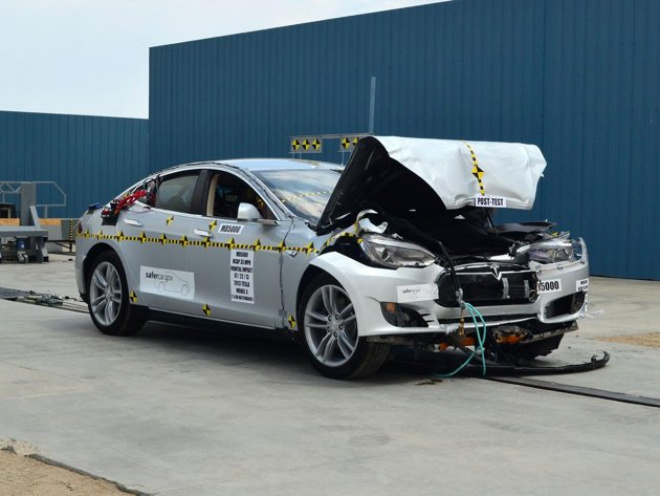
Tesla's CEO Elon Musk gave the Caltech commencement address in 2012. In case you forgot, he mentioned that in building the Model S, Tesla set out to create a car that was superior to its competitors in every way. One year later, it has scooped three major industry awards; Car of the Year from both Automobile Magazine and Motor Trend. The third was self-awarded, when an analysis of their test results revealed the Model S was the safest car ever tested by NHTSA.


Whereas most other electric cars on the market are glorified golf carts with all the performance and allure of Caltech's own electric fleet, Tesla somehow managed to optimise in the opposite direction. An analysis of this achievement is illustrative for anyone with an engineering or problem solving bent. Indeed, in proving the naysayers wrong Tesla finagled a short squeeze of their own stock, enabling a follow-on stock offering and the raising of an additional US$1.1b.


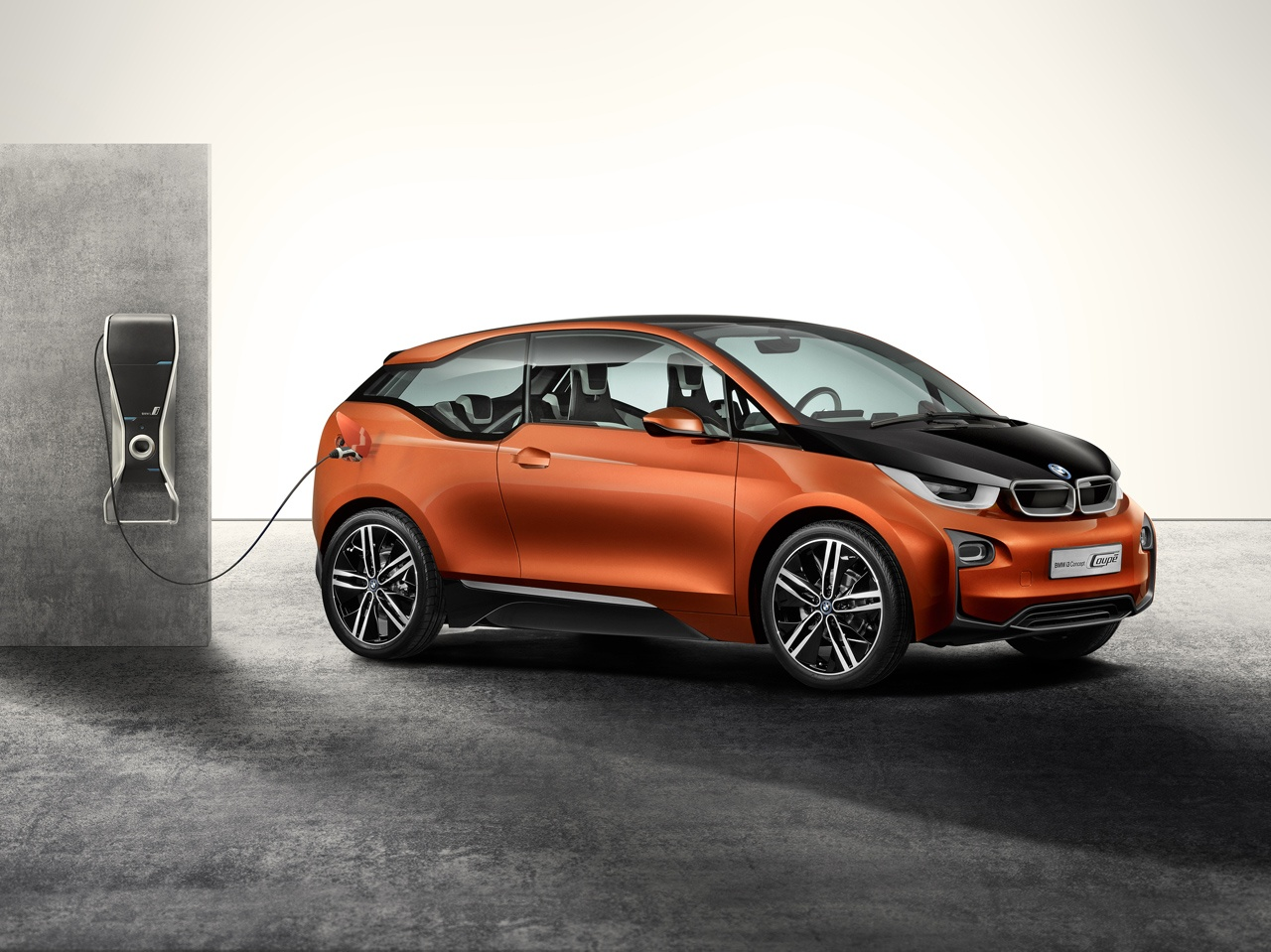
The most prominent electric car released since the Tesla is BMW's i3. While its carbon fibre chassis does feature some reasonably innovative ideas, its styling is an echo of the pre-Tesla era. All car manufacturers that operate in the United States have to deal with interlocking state-by-state compliance issues of Byzantine complexity.


One of the most effective is California's requirement that a certain number of electric cars be produced, presumably to spur technology development by reluctant and largely calcified giants that only 5 years ago required taxpayer-funded bailouts to remain solvent. The general response to this was to produce a series of cars of underwhelming utility, price, and attractiveness. Unsurprisingly and, indeed, by design, these cars have not sold well, despite aggressive and loss-inducing cuts in price.


After the compliance car program ran its course, it is a safe bet that industry lobbyists would be parroting their 'market has spoken' mantra, with dismal sales figures across the board suggesting that California's absurdly green and possibly communist electric car policies be repealed. In case the crummy range and worse performance of these mostly compact conversions wasn't enough to do them in, designers gleefully decked them out with a variety of gag-inducing styling decisions. No doubt this appeals to the particularly hard-core Hollywood advocate types, in that owning one of these cars (the Mitsubishi iMiEV comes to mind) is incontrovertibly honest signalling that you are very, very serious about the environment.
Can you imagine being a recently graduated engineer assigned to work on one of these hopeless Potemkin car electrification projects? I wonder how many of them were caught vainly licking the terminals of a 400V battery pack.


When the Nissan Leaf and Chevy Volt were designed, Tesla was a peculiar Silicon Valley venture producing a few hundred fast and quiet Lotus Elises (the Roadster) a year. In 2008 they laid off a bunch of people and nearly went out the back door. At best, a curiosity. By the time BMW sat down with their designers, Leaf and Volt sales data all but confirmed that the consumer wasn't biting. All that was needed was an unsuccessful offering from one of the most respected manufacturers in the world, and by the end of 2014, these cars would be nothing but a footnote in a book about unsuccessful meddling in the free market.


I can almost imagine a meeting amongst the BMW i3's product development people. Someone who's new on the job asks "But what about the Tesla WhiteStar?". The room erupts in laughter. The Roadster was out of production. A few rumours swirled around robots in the old NUMMI plant. Tesla stock was the most shorted on the exchange and lurched unsteadily ever lower. The CEO was rambling about launching rockets, but so far had mostly only blown them up. Even people signing parts supply deals with Tesla were buying good insurance and snickering behind their hands. Several respected automotive industry analysts had predicted that Tesla would produce no more than 3000 cars, before inevitable problems, glitches, and perhaps a fatal fire or two would trigger the final death spiral.


If I had to guess at what point the phones started ringing, I would guess May 8 2013. Tesla had forecast a profitable third quarter. Instead, the sale of emissions credits had pushed it over the line in the first quarter. Within days, panicked hedge funds had tried to close their short positions, and a deep lack of share availability had pushed the price up by a factor of three. Suddenly Tesla went from 'the next Solyndra' to 'the next Apple'. As the cars became more available (nearly 20000 have been built to date), competitors' engineers would have got their hands on one and finally seen what they were up against.


At BMW, it was too late. You can tell their i3 launch promotional material is hastily redesigned to be as forgettable as possible. Industry blogs changed tack from 'when will Tesla finally declare bankruptcy' to 'Tesla's competitors hot on their heels'. As we shall soon see, Tesla has already set the standard. From here, they have only themselves to beat.


Against this maelstrom of chaos and confusion, two prominent car makers have been relatively calm and collected. Daimler and Toyota both bought stakes in Tesla during its years of perdition, and both have now produced unoffensive though unspectacular cars using the Tesla drive train. From here, Tesla's aggressive roll out of supercharger technology could well mean the creation of an ecosystem which will become the defacto national standard. Provided they suffer no major missteps, theirs is the market to dominate. Friendly manufacturers like Toyota and Daimler can exploit their business relationship and leverage their access to superior technology, while their competitors face a more stark choice, between participation by licensing at the market rate or an inevitable slide into obsolete irrelevance. A third option, aggressive innovation and competition, is also possible and, broadly, a desirable outcome. Either way, Tesla's aim of creating and aggressively growing the electric car market is assured.


At this point I should mention that Hyundai's strategy for sustainable transportation was through research and IP development in hydrogen fuel cells. Battery technology was better than hydrogen could ever be four years ago, so I really hope they have something else in the works by now.


Thus far I've heaped praise and scorn in equal measures, so lets get to the nitty gritty.


Car

Base price ($)

0-60mph (s)

Range (miles)

Safety

Tesla Model S

69,900

4.2

265

✭✭✭✭✭

Chevy Spark

27,495

7.6

82

✭✭✭✭

Nissan Leaf

28,800

9.8

75

✭✭✭✭✭

BMW i3

42,275

7.0

80

✭✭✭✭✭

Ford Focus EV

39,995

9.5

76

✭✭✭✭✭

Smart Electric

25,750

22.4

65

✭✭✭✭

Fiat 500e

32,500

9.1

87

✭✭✭✭✭

Toyota RAV4 EV

49,800

7.0

103

✭✭✭✭

Mitsubishi iMiEV

29,125

11.9

62

✭✭✭✭

Honda Fit

36,625

8.4

70

✭✭✭✭

Renault Zoe

27,250

8.2

60

✭✭✭✭✭

Rimac Conc. 1

980,000

2.8

300

NA

Tesla Roadster

109,000

3.7

244

NA


In the above table, the safety rating is poorly resolved. It's worth noting that your actual outcome in a two car collision is highly dependent on your mass. The Tesla weighs more than an SUV, and has, so far, hit a Honda Accord, a power pole, and a restaurant and won. Most of the other electric cars are compacts or sub-compacts, and their safety rating should be taken as such. It was during consideration of the Tesla Model S's safety tests that I realised the sense in which the BMW i3 and the Tesla are actually comparable.


The resemblance is uncanny.


A brief note on Tesla's technology. Almost all of Tesla's competitors use third party systems provided by either AC Propulsion or A123 systems. The same A123 whose exploding batteries caused it to enter bankruptcy. They re-registered the company as B456, not realising of course that B456 is a common fire extinguisher specification. How apt.

On the other hand, Tesla has a bunch of its own IP on technology. Not wanting to be hamstrung when ramping up volume, they developed technology that does not depend on rare-earth materials, heavy batteries, or any other highly specific technology. Their battery packs are made of around 7800 laptop cells. Instead of large, expensive and specific 'automotive' batteries, the 18650 package provides the benefits of enormous mass production, scaleability, and statistical reliability. Coupled with intelligent battery management software, a much more versatile pack results. When performance degrades, problematic cells can be substituted robotically, giving a cheap upgrade. The Tesla battery pack also forms part of the car's chassis, increasing stiffness and also providing for battery swapping capability. Each cell provides 3100mAh of electricity at 3.7V, and together the battery can provide 1200A at around 340V, delivering 310kW to the powertrain. In charging it can accept 120kW (at around 250A) for a ~40 minute charge.


When optimizing electric motors, the usual approach is to use high voltages and thin wires, combined with powerful magnets. Tesla uses a liquid cooled AC induction motor. It doesn't have permanent magnets, and thus its power depends on high current. The Tesla motor is optimised for low voltage, high current, and high torque, something the battery pack can readily provide.


Of the many innovations developed in the Model S, the last I'll present is the user interface software. Tesla uses a large touch screen to operate everything except the hazard lights and the glove compartment. Software updates can be downloaded via mobile networks. The car can be upgraded, fixing issues, adding functionality, and altering the mood with time. The modular, software-based approach will redefine the usual lifecycle of a car as a consumer product.


With any luck, we'll see these obvious (in hindsight) ideas applied in future cars across the industry. But what does the future hold for Tesla?


Going forward, Tesla plans to ramp production of the Model S to meet demand in Europe, North America, and Asia. Starting late 2014, Tesla will begin production and delivery of the Model X crossover. Based on the Model S chassis though somewhat longer and taller, the Model X will seat 7 adults and their luggage, and leverage continuing advances in battery technology for a similar range. The Model X will have an AWD option, which will also flow to the Model S, and may see its 0-60 time reduced even further.


Further ahead, Tesla plans to bring a third generation vehicle(s) to market in about 2017. Based around a smaller common chassis and starting at $35,000, these cars will be produced at a rate of half a million per year, aiming for about 5% of global market share.